Total Solar Eclipse Shadow from a Balloon


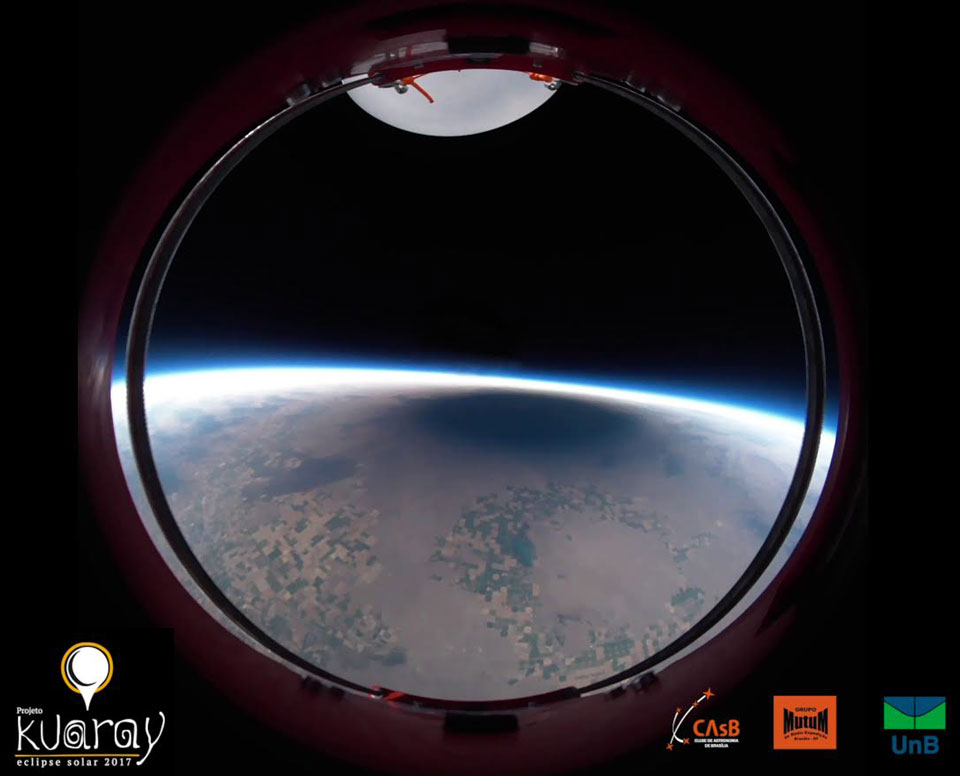
Where were you during the Great American Eclipse of 2017? A year ago last week, over 100 million of people in North America went outside to see a partial eclipse of the Sun, while over ten million drove across part of the USA to see the Sun completely disappear behind the Moon — a total solar eclipse. An estimated 88 percent of American adults saw the eclipse either personally or electronically. One of the better photographed events in human history, images from the eclipse included some unusual vistas, such as from balloons floating in the Earth’s stratosphere. About fifty such robotic balloons were launched as part of NASA’s Eclipse Ballooning project. Featured is a frame taken from a 360-degree panoramic video captured by one such balloon set aloft in Idaho by students from Brazil in conjunction with NASA and Montana State University. Pictured, the dark shadow of the Moon was seen crossing the Earth below. Although the total eclipse lasted less than three minutes, many who saw it may remember it for a lifetime. Many North Americans will get a another chance to experience a total solar eclipse in 2024.

from NASA https://ift.tt/2obXrNS
via IFTTT

Fire on Earth


Sometimes, regions of planet Earth light up with fire. Since fire is the rapid acquisition of oxygen, and since oxygen is a key indicator of life, fire on any planet would be an indicator of life on that planet. Most of the Earth’s land has been scorched by fire at some time in the past. Although causing many a tragedy, for many places on Earth fire is considered part of a natural ecosystem cycle. Large forest fires on Earth are usually caused either by humans or lightning and can be visible from orbit. Featured from the year 2000, stunned elk avoid a fire sweeping through Montana‘s Bitterroot Valley by standing in a river.

from NASA https://ift.tt/2NjMEw0
via IFTTT

Stripping ESO 137-001


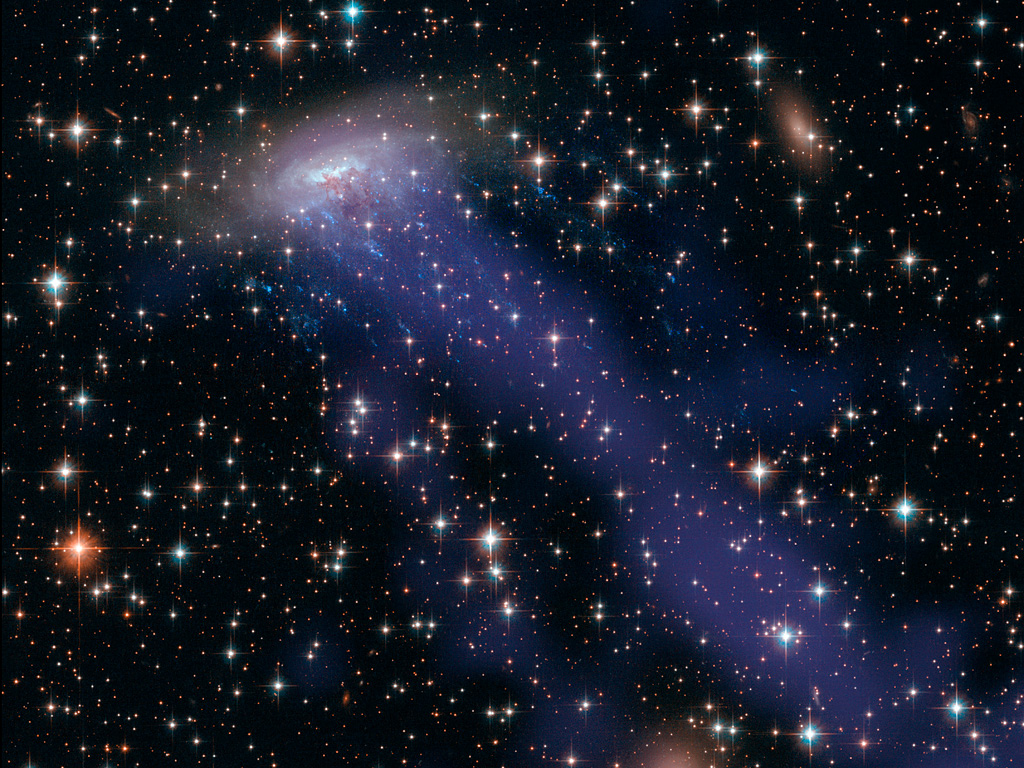
Spiral galaxy ESO 137-001 hurtles through massive galaxy cluster Abell 3627 some 220 million light years away. The distant galaxy is seen in this colorful Hubble/Chandra composite image through a foreground of the Milky Way’s stars toward the southern constellation Triangulum Australe. As the spiral speeds along at nearly 7 million kilometers per hour, its gas and dust are stripped away when ram pressure with the cluster’s own hot, tenuous intracluster medium overcomes the galaxy’s gravity. Evident in Hubble’s near visible light data, bright star clusters have formed in the stripped material along the short, trailing blue streaks. Chandra’s X-ray data shows off the enormous extent of the heated, stripped gas as diffuse, darker blue trails stretching over 400,000 light-years toward the bottom right. The significant loss of dust and gas will make new star formation difficult for this galaxy. A yellowish elliptical galaxy, lacking in star forming dust and gas, is just to the right of ESO 137-001 in the frame.

from NASA https://ift.tt/2Ne73Ct
via IFTTT

Comet Heart and Soul


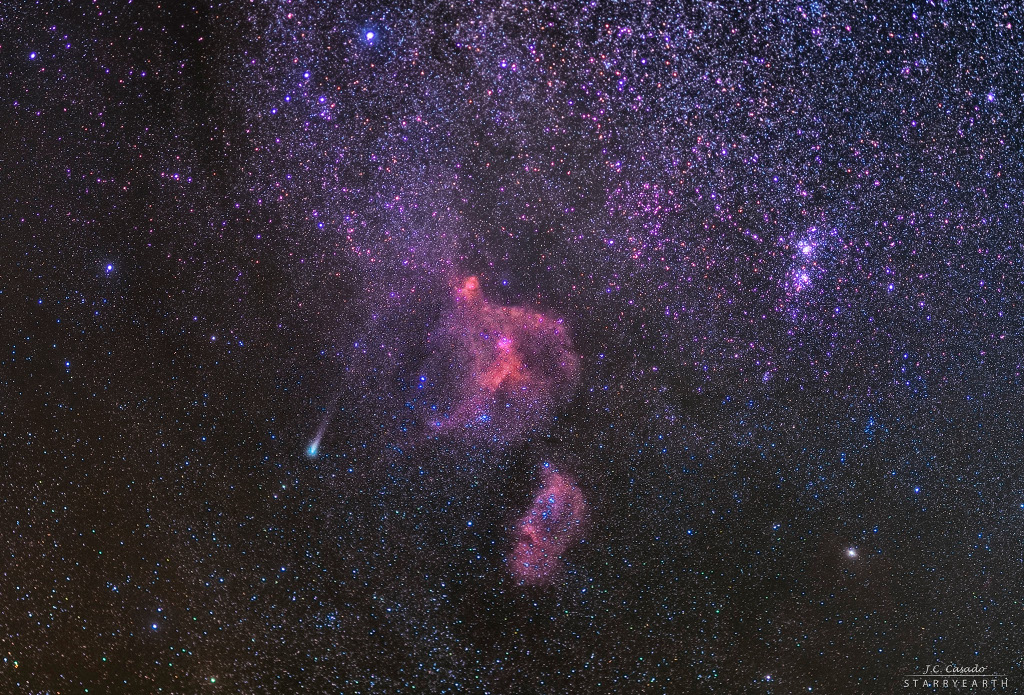
The greenish coma of comet 21P/Giacobini-Zinner stands out at the left of this telephoto skyscape spanning over 10 degrees toward the northern constellations Cassiopeia and Perseus. Captured on August 17, the periodic comet is the known parent body of the upcoming Draconid meteor shower. Predicted to be at its brightest next month, the comet is actually in the foreground of the rich starfield, only about 4 light-minutes from our fair planet. Giacobini-Zinner should remain too faint for your eye to see though, like the colorful Heart and Soul nebulae near the center of the sensitive digital camera’s field of view. But the pair of open star clusters at the right, h and Chi Persei, could just be seen by the unaided eye from dark locations. The Heart and Soul nebulae with their own embedded clusters of young stars a million or so years old, are each over 200 light-years across and 6 to 7 thousand light-years away. They are part of a large, active star forming complex sprawling along the Perseus spiral arm of our Milky Way Galaxy. Also known as the Double Cluster, h and Chi Persei are located at about that same distance. Periodic Giacobini-Zinner was visited by a spacecraft from Earth when the repurposed International Cometary Explorer passed through its tail in September 1985.

from NASA https://ift.tt/2w5P7n1
via IFTTT

Asteroid Ryugu from Hayabusa2


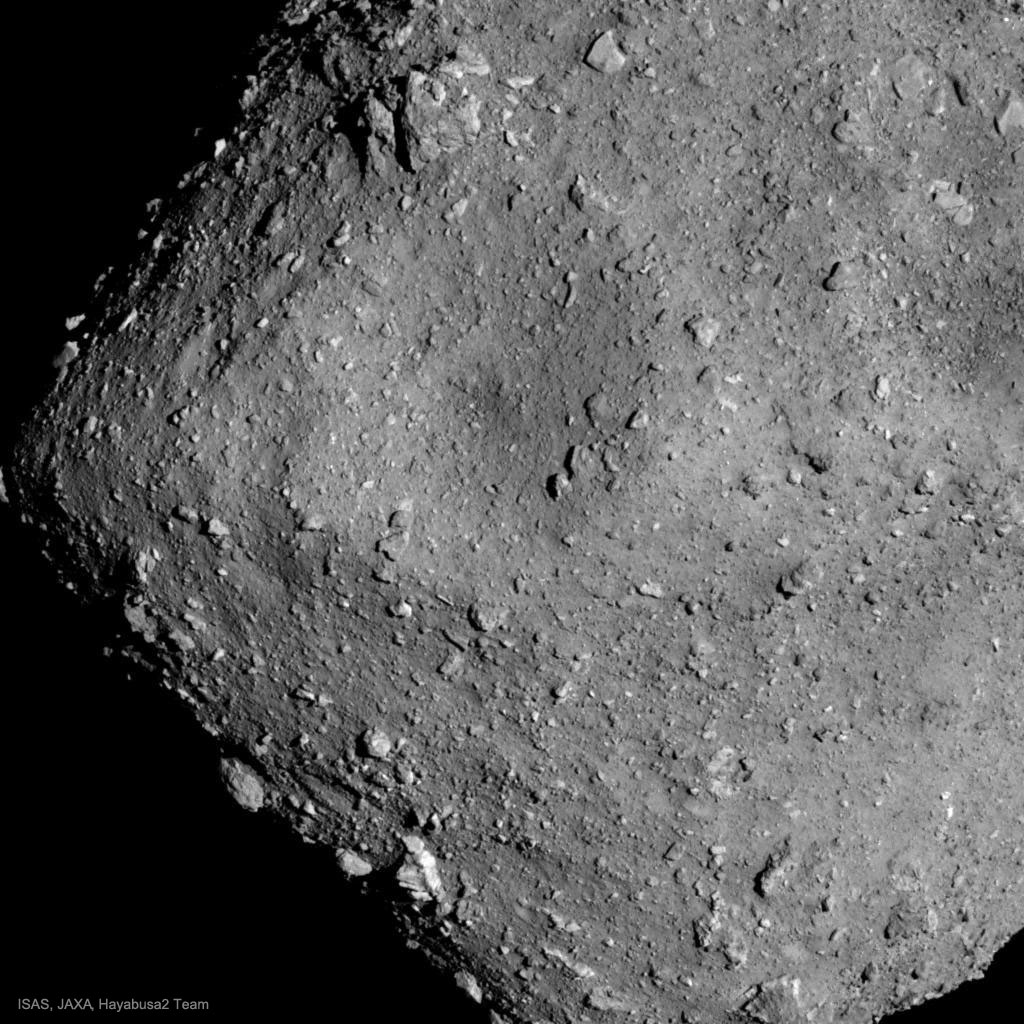
This big space diamond has an estimated value of over 80 billion dollars. It’s only diamond in shape, though — asteroid 162173 Ryugu is thought to be composed of mostly nickel and iron. Asteroids like Ryugu are interesting for several reasons, perhaps foremost because they are near the Earth and might, one day in the far future, pose an impact threat. In the nearer term, Ryugu is interesting because it may be possible to send future spacecraft there to mine it, thus providing humanity with a new source of valuable metals. Scientifically, Ryugu is interesting because it carries information about how our Solar System formed billions of years ago, and why its orbit takes it so close to Earth. Japan‘s robotic spacecraft Hayabusa2 just arrived at this one-kilometer wide asteroid in late June. The featured image shows surface structures unknown before spacecraft Hayabusa2’s arrival, including rock fields and craters. Within the next three months, Hayabusa2 is scheduled to unleash several probes, some that will land on Ryugu and hop around, while Hayabusa2 itself will mine just a little bit of the asteroid for return to Earth.

from NASA https://ift.tt/2OYUFaf
via IFTTT

Glowing Elements in the Soul Nebula


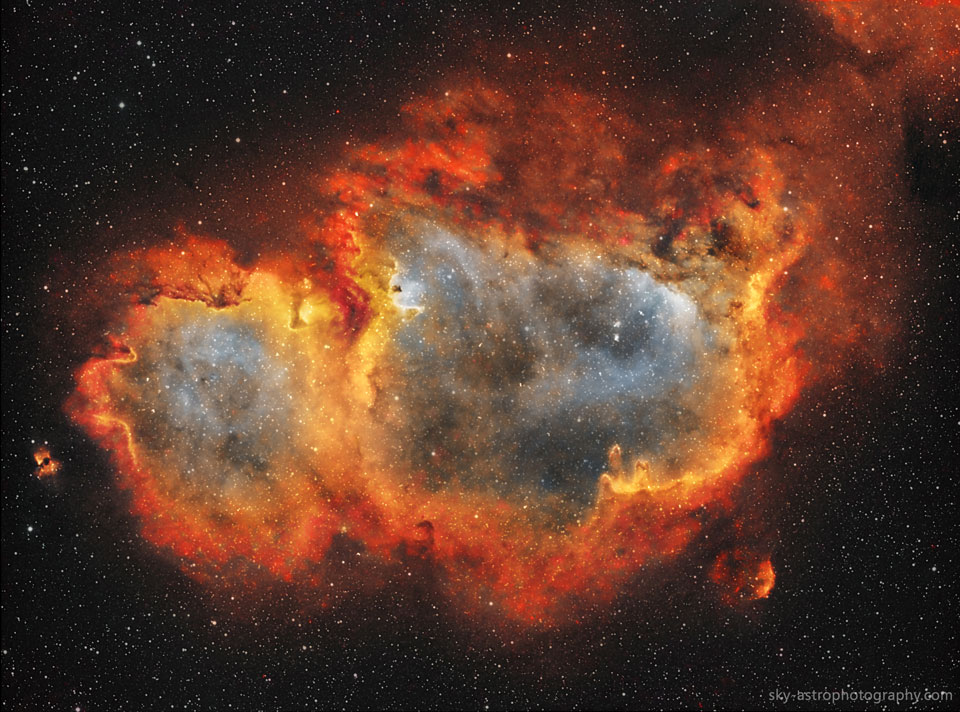
Stars are forming in the Soul of the Queen of Aethopia. More specifically, a large star forming region called the Soul Nebula (IC 1898) can be found in the direction of the constellation Cassiopeia, who Greek mythology credits as the vain wife of a King who long ago ruled lands surrounding the upper Nile river. The Soul Nebula houses several open clusters of stars, a large radio source known as W5, and huge evacuated bubbles formed by the winds of young massive stars. Located about 6,500 light years away, the Soul Nebula spans about 100 light years and is usually imaged next to its celestial neighbor the Heart Nebula (IC 1805). The featured image is a composite of three exposures in different colors: red as emitted by hydrogen gas, yellow as emitted by sulfur, and blue as emitted by oxygen.

from NASA https://ift.tt/2nTX22k
via IFTTT

Active Prominences on a Quiet Sun


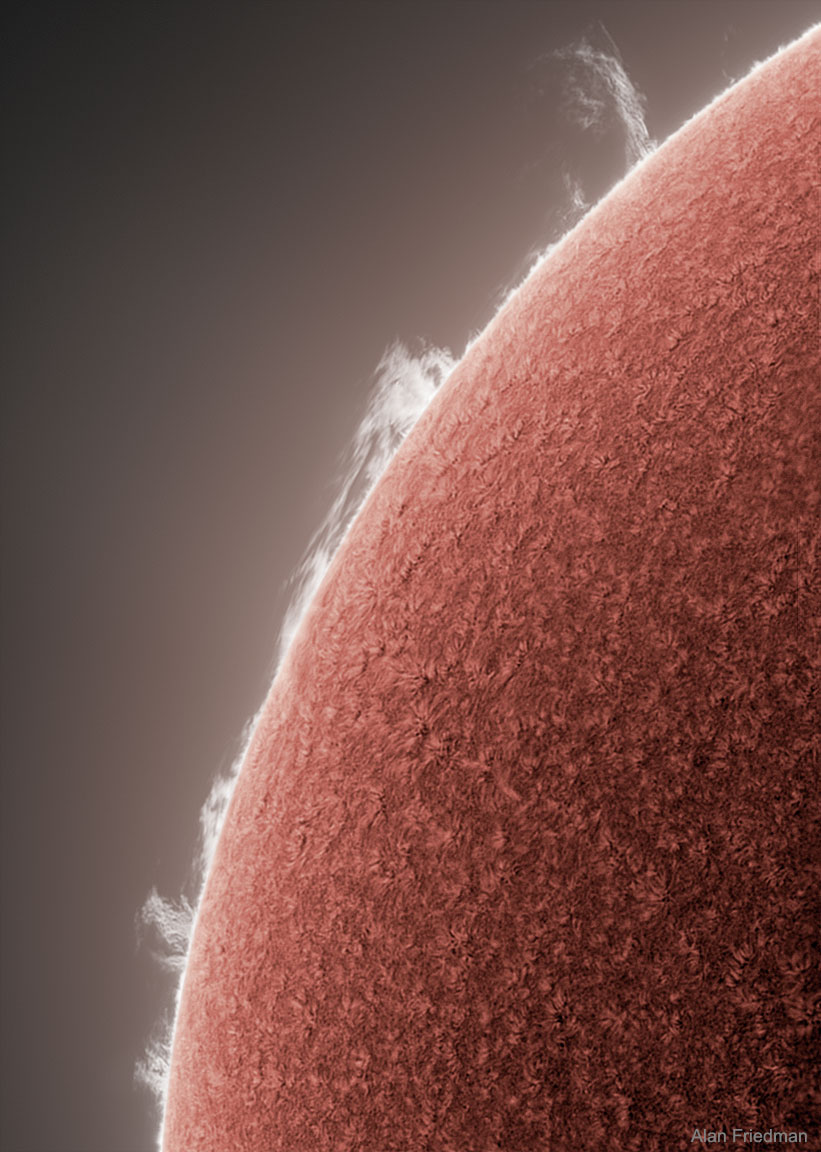
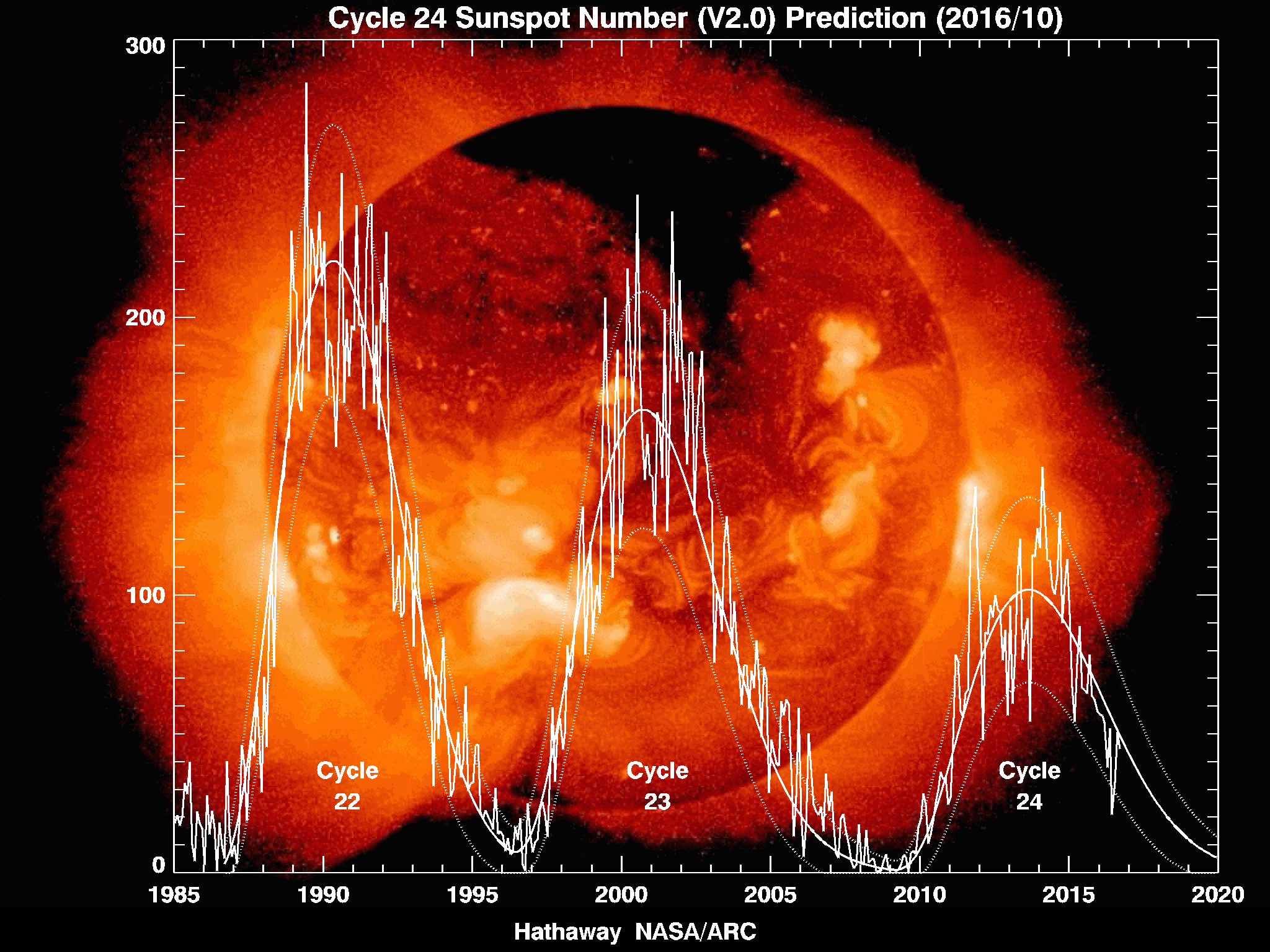
Why is the Sun so quiet? As the Sun enters into a period of time known as a Solar Minimum, it is, as expected, showing fewer sunspots and active regions than usual. The quietness is somewhat unsettling, though, as so far this year, most days show no sunspots at all. In contrast, from 2011 – 2015, during Solar Maximum, the Sun displayed spots just about every day. Maxima and minima occur on an 11-year cycle, with the last Solar Minimum being the most quiet in a century. Will this current Solar Minimum go even deeper? Even though the Sun’s activity affects the Earth and its surroundings, no one knows for sure what the Sun will do next, and the physics behind the processes remain an active topic of research. The featured image was taken three weeks ago and shows that our Sun is busy even on a quiet day. Prominences of hot plasma, some larger than the Earth, dance continually and are most easily visible over the edge.

from NASA https://ift.tt/2wgX1cN
via IFTTT

Asperitas Clouds Over New Zealand


What kind of clouds are these? Although their cause is presently unknown, such unusual atmospheric structures, as menacing as they might seem, do not appear to be harbingers of meteorological doom. Formally recognized as a distinct cloud type only last year, Asperitas clouds can be stunning in appearance, unusual in occurrence, and are relatively unstudied. Whereas most low cloud decks are flat bottomed, asperitas clouds appear to have significant vertical structure underneath. Speculation therefore holds that asperitas clouds might be related to lenticular clouds that form near mountains, or mammatus clouds associated with thunderstorms, or perhaps a foehn wind — a type of dry downward wind that flows off mountains. Such a wind called the Canterbury arch streams toward the east coast of New Zealand’s South Island. The featured image, taken above Hanmer Springs in Canterbury, New Zealand, in 2005, shows great detail partly because sunlight illuminates the undulating clouds from the side.

from NASA https://ift.tt/2OMJ8ui
via IFTTT

Perseid Fireball and Persistent Train


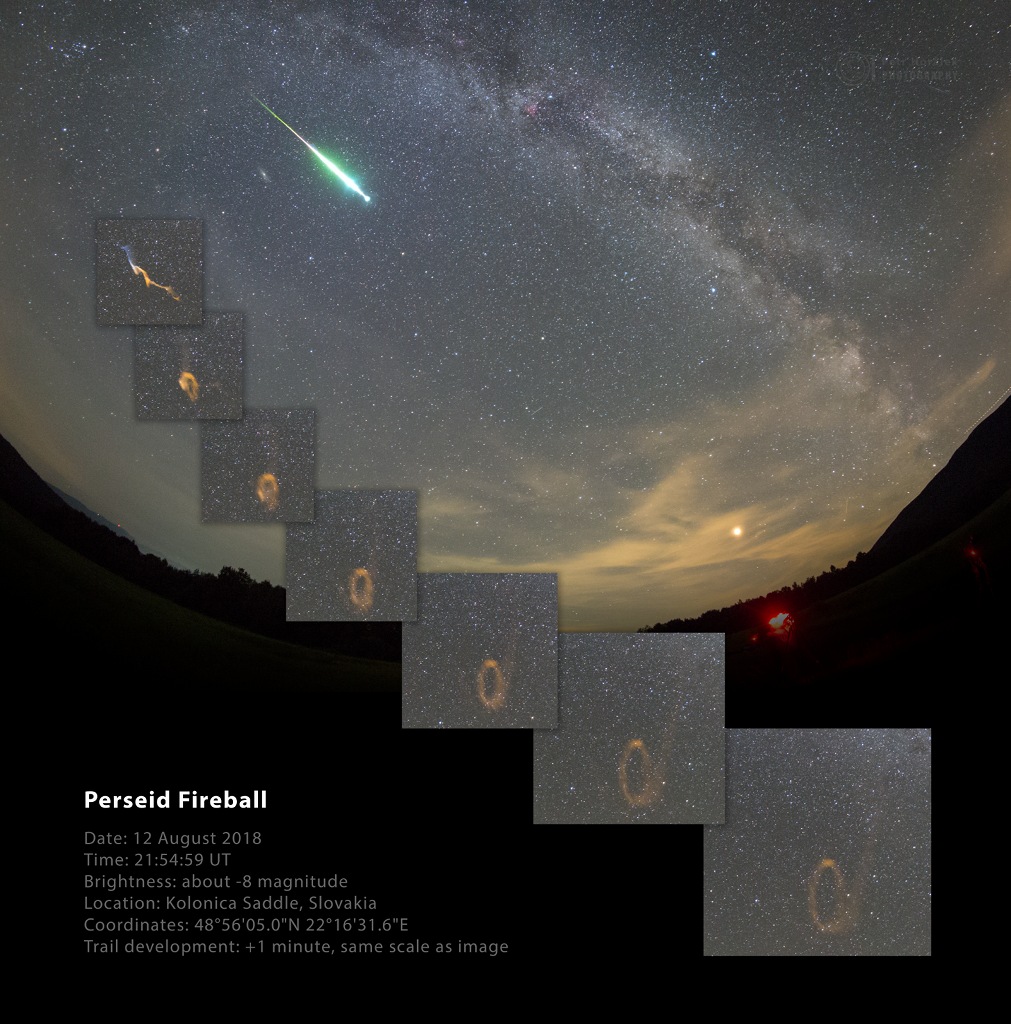
Before local midnight on August 12, this brilliant Perseid meteor flashed above the Poloniny Dark Sky Park, Slovakia, planet Earth. Streaking beside the summer Milky Way, its initial color is likely due to the shower meteor’s characteristically high speed. Moving at about 60 kilometers per second, Perseid meteors can excite green emission from oxygen atoms while passing through the thin atmosphere at high altitudes. Also characteristic of bright meteors, this Perseid left a lingering visible trail known as a persistent train, wafting in the upper atmosphere. Its development is followed in the inset frames, exposures separated by one minute and shown at the scale of the original image. Compared to the brief flash of the meteor, the wraith-like trail really is persistent. After an hour faint remnants of this one could still be traced, expanding to over 80 degrees on the sky.

from NASA https://ift.tt/2Bkgnn6
via IFTTT

Parker vs Perseid


The brief flash of a bright Perseid meteor streaks across the upper right in this composited series of exposures made early Sunday morning near the peak of the annual Perseid meteor shower. Set up about two miles from Space Launch Complex 37 at Cape Canaveral Air Force Station, the photographer also captured the four minute long trail of a Delta IV Heavy rocket carrying the Parker Solar Probe into the dark morning sky. Perseid meteors aren’t slow. The grains of dust from periodic comet Swift-Tuttle vaporize as they plow through Earth’s upper atmosphere at about 60 kilometers per second (133,000 mph). On its way to seven gravity-assist flybys of Venus over its seven year mission, the Parker Solar Probe’s closest approach to the Sun will steadily decrease, finally reaching a distance of 6.1 million kilometers (3.8 million miles). That’s about 1/8 the distance between Mercury and the Sun, and within the solar corona, the Sun’s tenuous outer atmosphere. By then it will be traveling roughly 190 kilometers per second (430,000 mph) with respect to the Sun, a record for fastest spacecraft from planet Earth.

from NASA https://ift.tt/2vMpgAH
via IFTTT