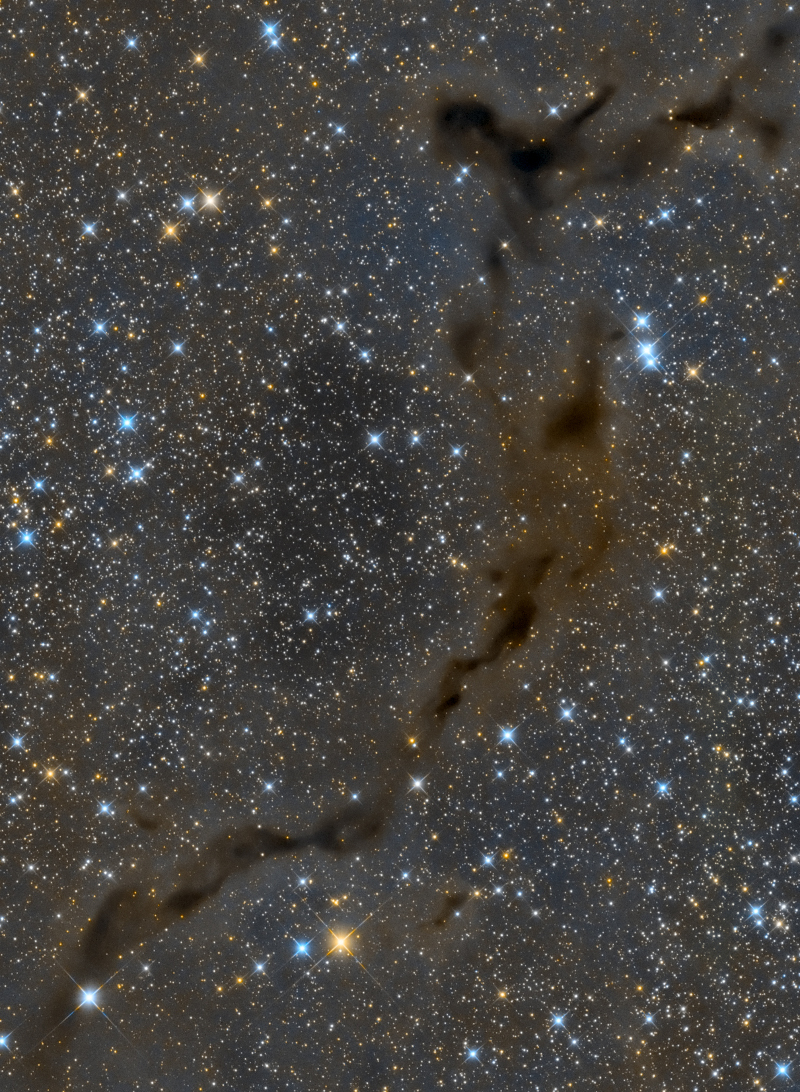
The Dark Seahorse in Cepheus


Light-years across, this suggestive shape known as the Seahorse Nebula appears in silhouette against a rich, luminous background of stars. Seen toward the royal northern constellation of Cepheus, the dusty, obscuring clouds are part of a Milky Way molecular cloud some 1,200 light-years distant. It is also listed as Barnard 150 (B150), one of 182 dark markings of the sky cataloged in the early 20th century by astronomer E. E. Barnard. Packs of low mass stars are forming within, but their collapsing cores are only visible at long infrared wavelengths. Still, the colorful stars of Cepheus add to this pretty, galactic skyscape.

from NASA https://ift.tt/3o5NRuG
via IFTTT

NGC 147 and NGC 185


Dwarf galaxies NGC 147 (left) and NGC 185 stand side by side in this sharp telescopic portrait. The two are not-often-imaged satellites of M31, the great spiral Andromeda Galaxy, some 2.5 million light-years away. Their separation on the sky, less than one degree across a pretty field of view, translates to only about 35 thousand light-years at Andromeda’s distance, but Andromeda itself is found well outside this frame. Brighter and more famous satellite galaxies of Andromeda, M32 and M110, are seen closer to the great spiral. NGC 147 and NGC 185 have been identified as binary galaxies, forming a gravitationally stable binary system. But recently discovered faint dwarf galaxy Cassiopeia II also seems to be part of their system, forming a gravitationally bound group within Andromeda’s intriguing population of small satellite galaxies.

from NASA https://ift.tt/3q5uhkA
via IFTTT

The Horsehead and Flame Nebulas


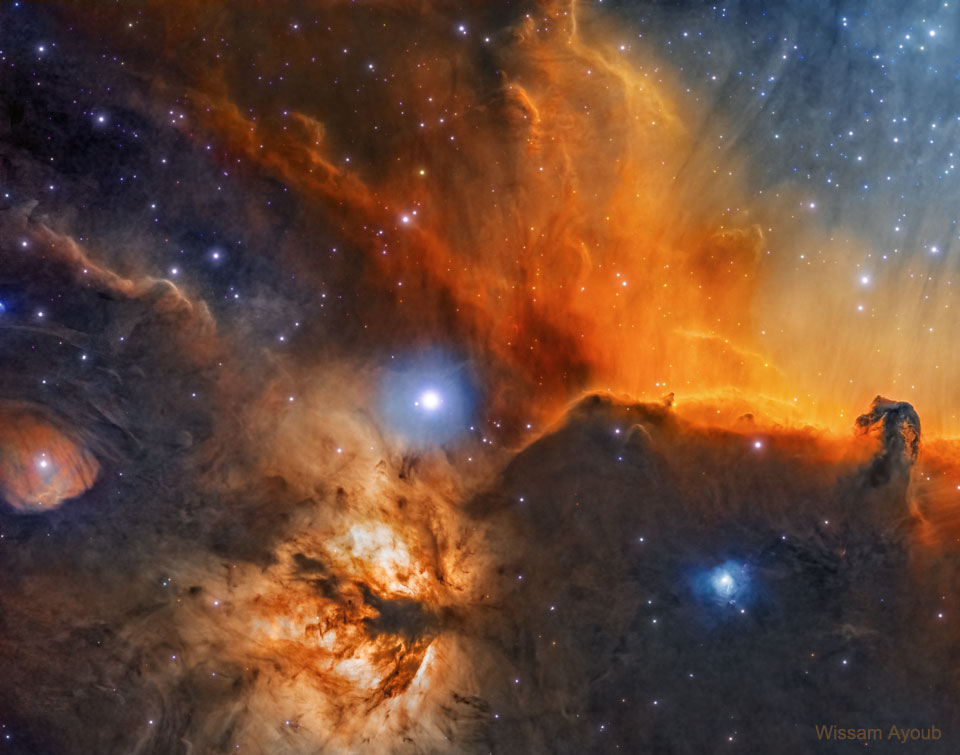
The Horsehead Nebula is one of the most famous nebulae on the sky. It is visible as the dark indentation to the orange emission nebula at the far right of the featured picture. The horse-head feature is dark because it is really an opaque dust cloud that lies in front of the bright emission nebula. Like clouds in Earth’s atmosphere, this cosmic cloud has assumed a recognizable shape by chance. After many thousands of years, the internal motions of the cloud will surely alter its appearance. The emission nebula‘s orange color is caused by electrons recombining with protons to form hydrogen atoms. Toward the lower left of the image is the Flame Nebula, an orange-tinged nebula that also contains intricate filaments of dark dust. Two prominent reflection nebulas are visible: round IC 432 on the far left, and blue NGC 2023 just to the lower left of the Horsehead nebula. Each glows primarily by reflecting the light of their central star.

from NASA https://ift.tt/3q5loYi
via IFTTT

SN Requiem: A Supernova Seen Three Times So Far


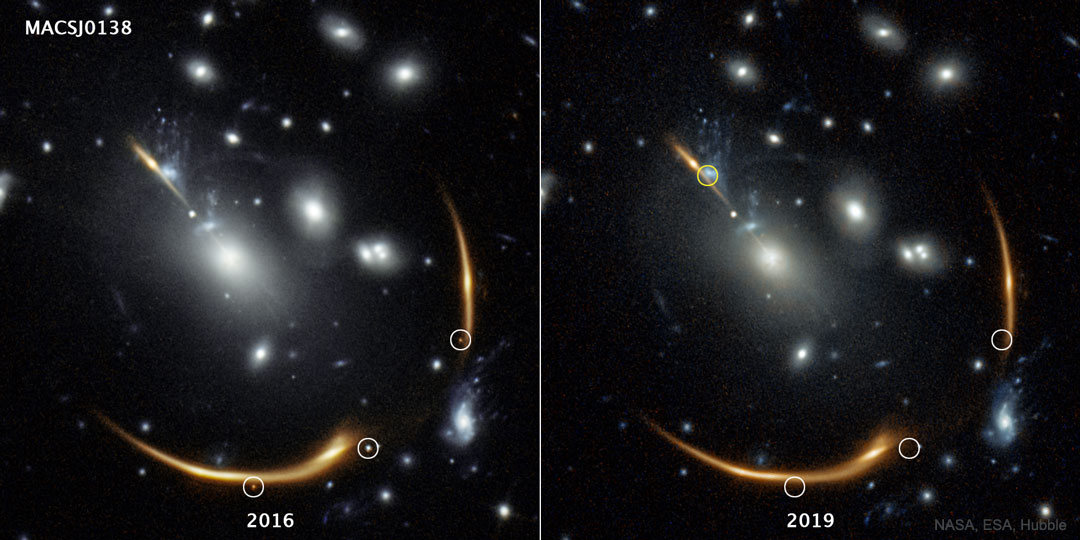
We’ve seen this same supernova three times — when will we see it a fourth? When a distant star explodes in a supernova, we’re lucky if we see it even once. In the case of AT 2016jka (“SN Requiem”), because the exploding star happened to be lined up behind the center of a galaxy cluster (MACS J0138 in this case), a comparison of Hubble Space Telescope images demonstrate that we saw it three times. These three supernova images are highlighted in circles near the bottom of the left frame taken in 2016. On the right frame, taken in 2019, the circles are empty because all three images of the single supernova had faded. Computer modeling of the cluster lens, however, indicates that a fourth image of the same supernova should eventually appear in the upper circle on the right image. But when? The best models predict this will happen in 2037, but this date is uncertain by about two years because of ambiguities in the mass distribution of the cluster lens and the brightness history of the stellar explosion. With refined predictions and vigilant monitoring, Earthlings living 16 years from now may be able to catch this fourth image — and perhaps learn more about both galaxy clusters and supernovas at once.

from NASA https://ift.tt/3CD5CaC
via IFTTT

A Waterfall and the Milky Way


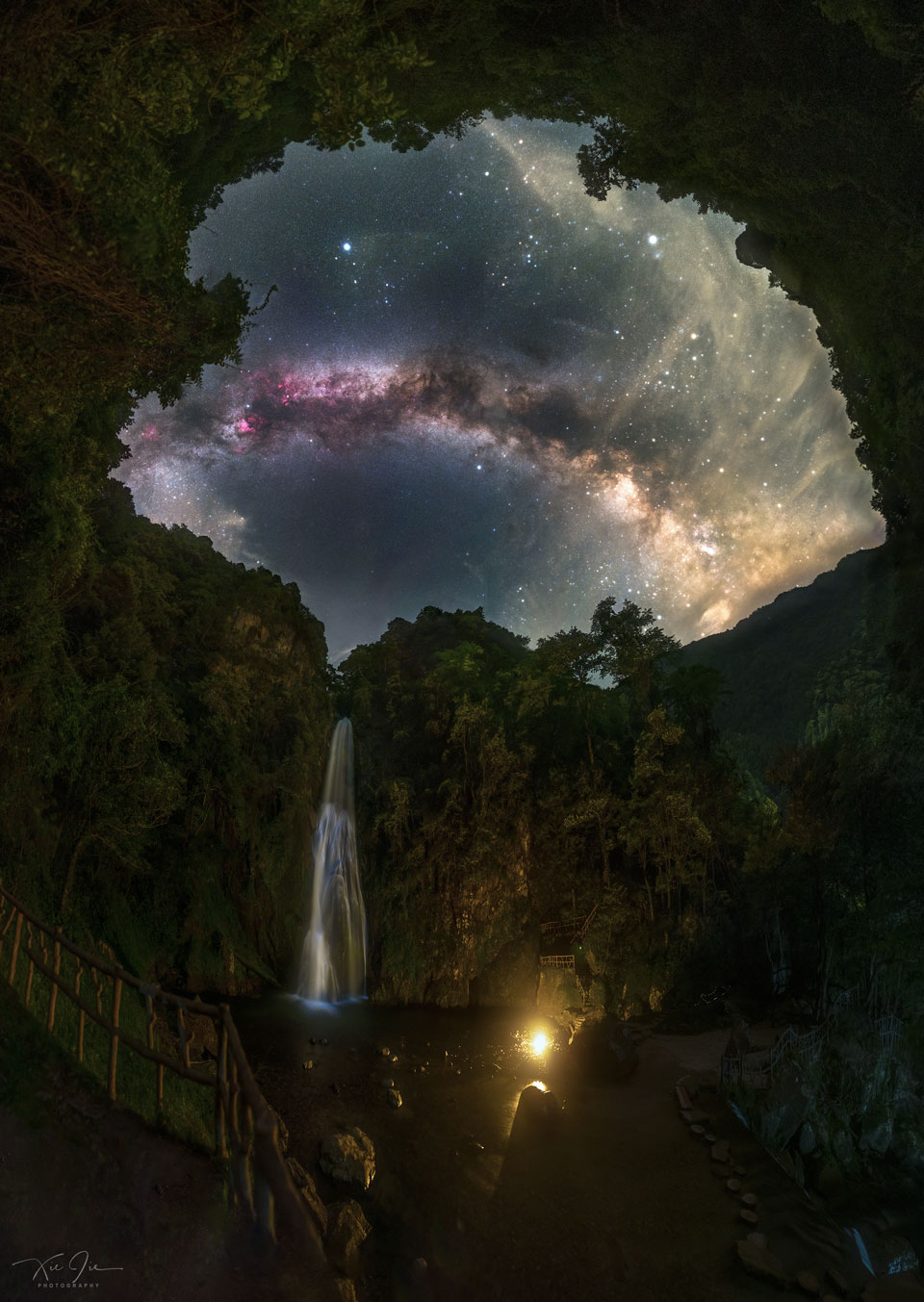
The dream was to capture both the waterfall and the Milky Way together. Difficulties included finding a good camera location, artificially illuminating the waterfall and the surrounding valley effectively, capturing the entire scene with numerous foreground and background shots, worrying that fireflies would be too distracting, keeping the camera dry, and avoiding stepping on a poisonous snake. Behold the result — captured after midnight in mid-July and digitally stitched into a wide-angle panorama. The waterfall is the picturesque Zhulian waterfall in the Luoxiao Mountains in eastern Hunan Province, China. The central band of our Milky Way Galaxy crosses the sky and shows numerous dark dust filaments and colorful nebulas. Bright stars dot the sky — all residing in the nearby Milky Way — including the Summer Triangle with bright Vega visible above the Milky Way’s arch. After capturing all 78 component exposures for you to enjoy, the photographer and friends enjoyed the view themselves for the rest of the night.

from NASA https://ift.tt/3mvKkpC
via IFTTT

Dark Matter in a Simulated Universe


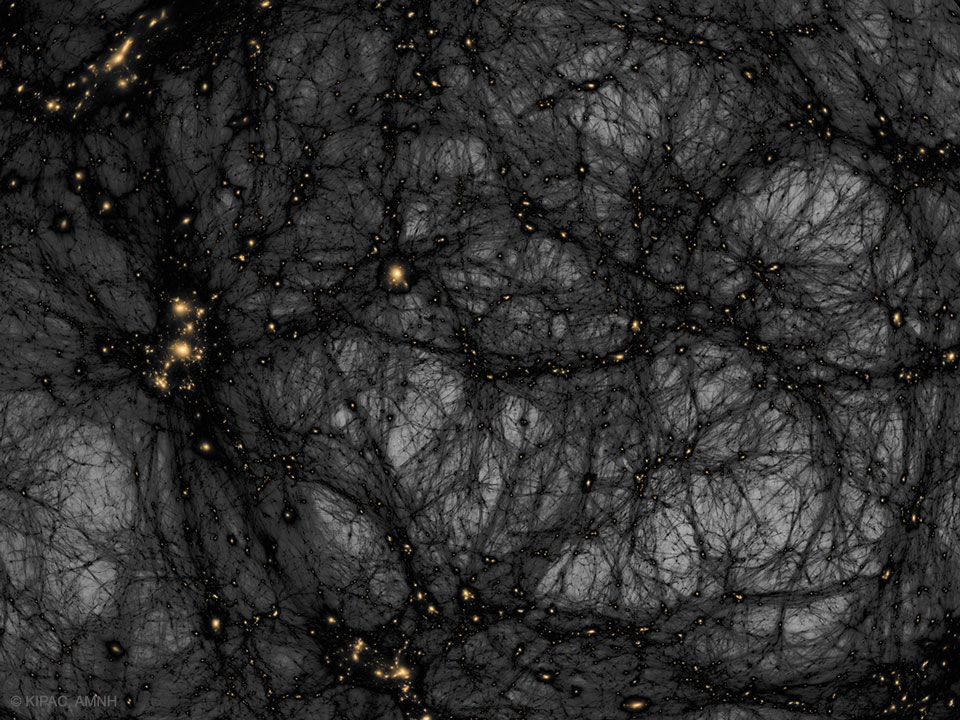
Is our universe haunted? It might look that way on this dark matter map. The gravity of unseen dark matter is the leading explanation for why galaxies rotate so fast, why galaxies orbit clusters so fast, why gravitational lenses so strongly deflect light, and why visible matter is distributed as it is both in the local universe and on the cosmic microwave background. The featured image from the American Museum of Natural History‘s Hayden Planetarium Space Show Dark Universe highlights one example of how pervasive dark matter might haunt our universe. In this frame from a detailed computer simulation, complex filaments of dark matter, shown in black, are strewn about the universe like spider webs, while the relatively rare clumps of familiar baryonic matter are colored orange. These simulations are good statistical matches to astronomical observations. In what is perhaps a scarier turn of events, dark matter — although quite strange and in an unknown form — is no longer thought to be the strangest source of gravity in the universe. That honor now falls to dark energy, a more uniform source of repulsive gravity that seems to now dominate the expansion of the entire universe.

from NASA https://ift.tt/2ZNKLmF
via IFTTT

A Rorschach Aurora


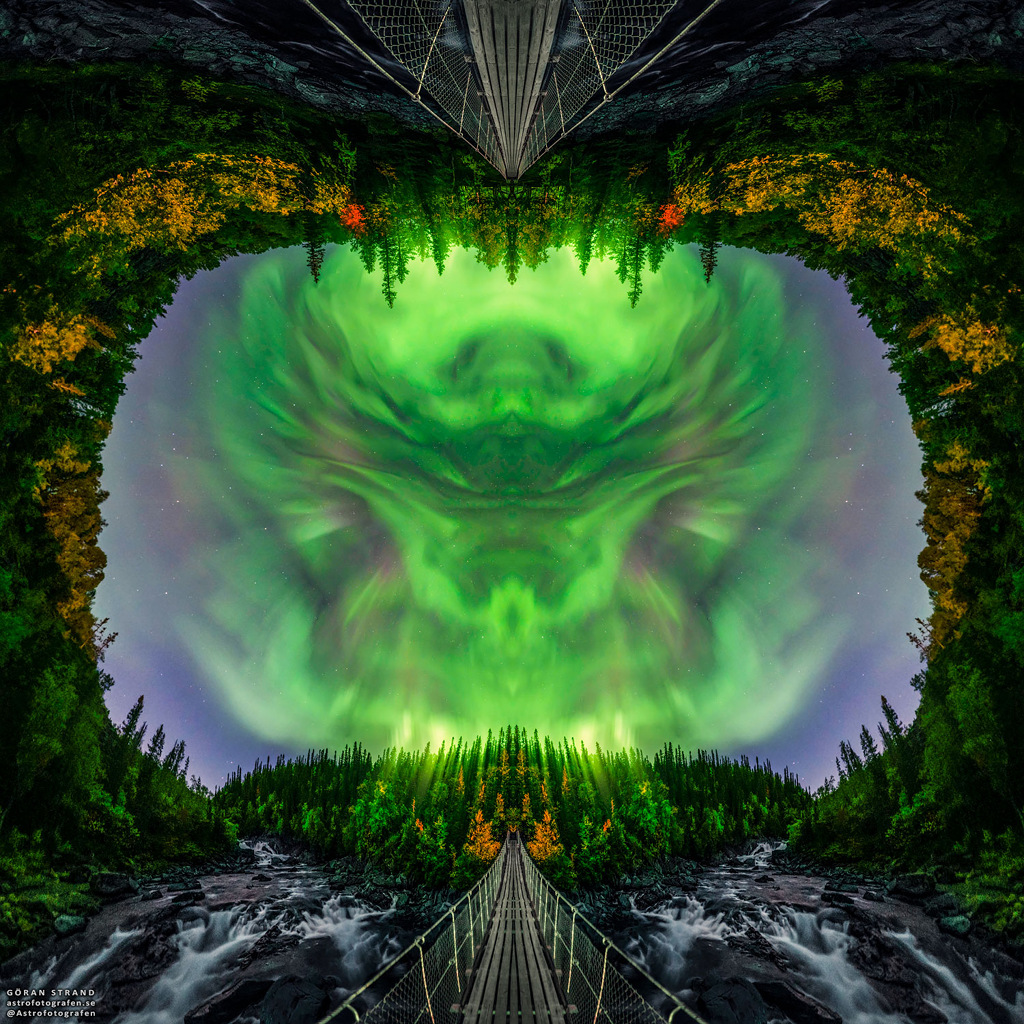
If you see this as a monster’s face, don’t panic. It’s only pareidolia, often experienced as the tendency to see faces in patterns of light and shadow. In fact, the startling visual scene is actually a 180 degree panorama of Northern Lights, digitally mirrored like inkblots on a folded piece of paper. Frames used to construct it were captured on a September night from the middle of a waterfall-crossing suspension bridge in Jamtland, Sweden. With geomagnetic storms triggered by recent solar activity, auroral displays could be very active at planet Earth’s high latitudes in the coming days. But if you see a monster’s face in your own neighborhood tomorrow night, it might just be Halloween.

from NASA https://ift.tt/3bvoA6V
via IFTTT

Haunting the Cepheus Flare


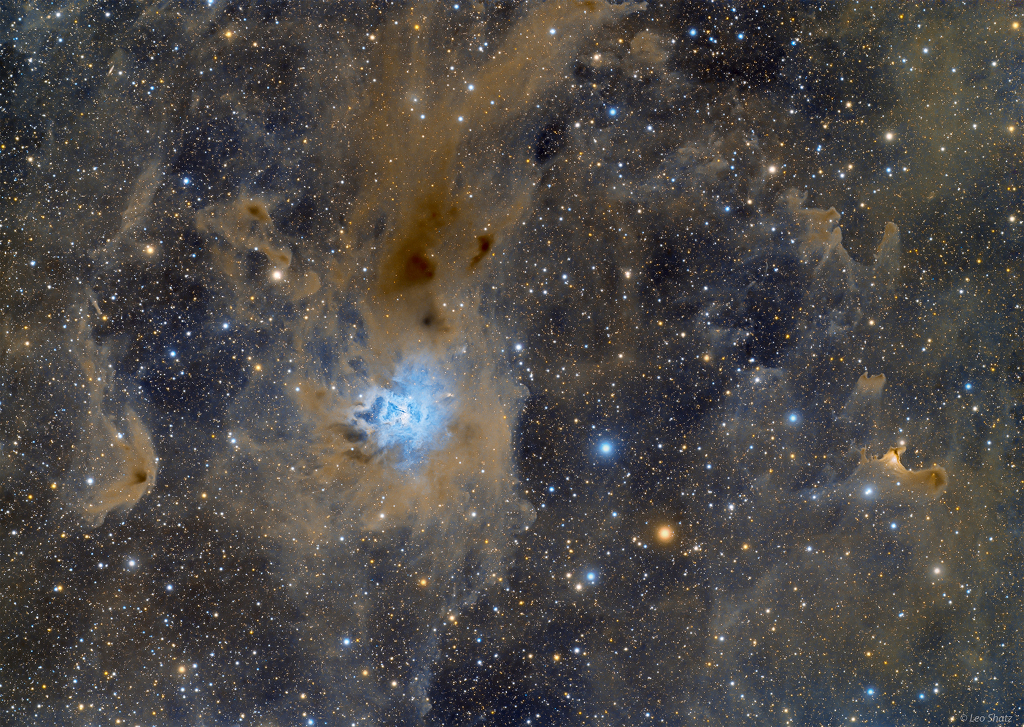
Spooky shapes seem to haunt this dusty expanse, drifting through the night in the royal constellation Cepheus. Of course, the shapes are cosmic dust clouds visible in dimly reflected starlight. Far from your own neighborhood, they lurk above the plane of the Milky Way at the edge of the Cepheus Flare molecular cloud complex some 1,200 light-years away. Over 2 light-years across and brighter than most of the other ghostly apparitions, vdB 141 or Sh2-136 is also known as the Ghost Nebula, seen at the right of the starry field of view. Inside the nebula are the telltale signs of dense cores collapsing in the early stages of star formation. With the eerie hue of dust reflecting bluish light from hot young stars of NGC 7023, the Iris Nebula stands out against the dark just left of center. In the broad telescopic frame, these fertile interstellar dust fields stretch almost seven full moons across the sky.

from NASA https://ift.tt/31dQlPN
via IFTTT

Mirach s Ghost


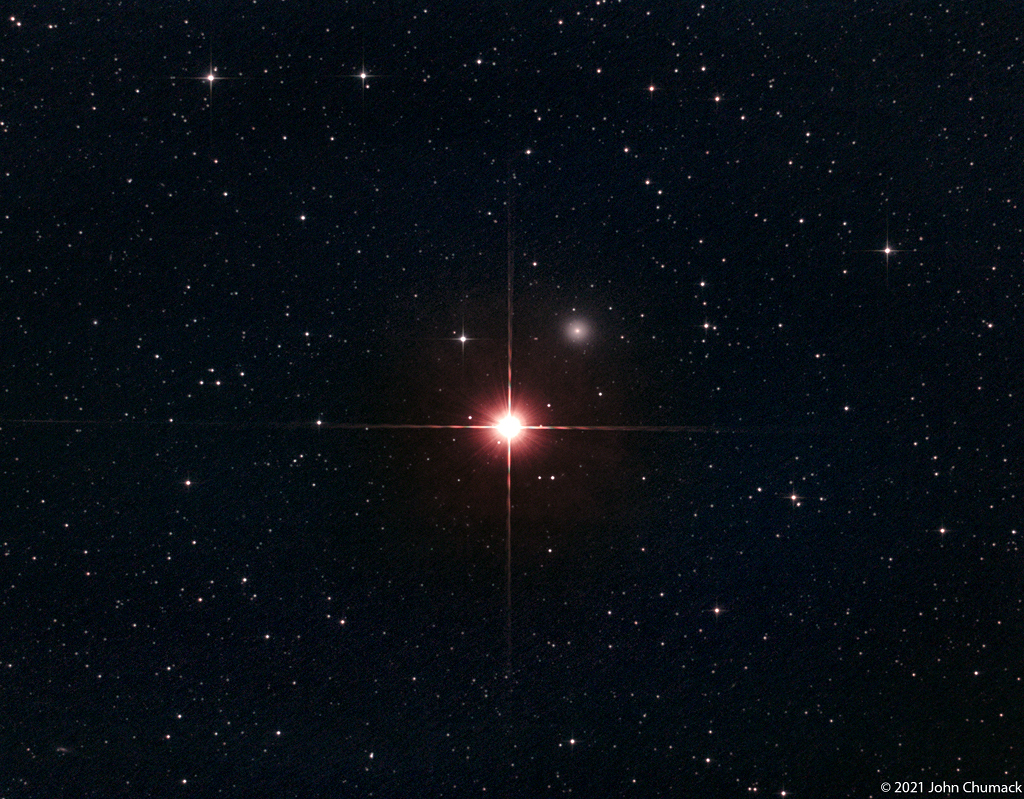
As far as ghosts go, Mirach’s Ghost isn’t really that scary. Mirach’s Ghost is just a faint, fuzzy galaxy, well known to astronomers, that happens to be seen nearly along the line-of-sight to Mirach, a bright star. Centered in this star field, Mirach is also called Beta Andromedae. About 200 light-years distant, Mirach is a red giant star, cooler than the Sun but much larger and so intrinsically much brighter than our parent star. In most telescopic views, glare and diffraction spikes tend to hide things that lie near Mirach and make the faint, fuzzy galaxy look like a ghostly internal reflection of the almost overwhelming starlight. Still, appearing in this sharp image just above and to the right of Mirach, Mirach’s Ghost is cataloged as galaxy NGC 404 and is estimated to be some 10 million light-years away.

from NASA https://ift.tt/3GwBSyi
via IFTTT

NGC 6995: The Bat Nebula


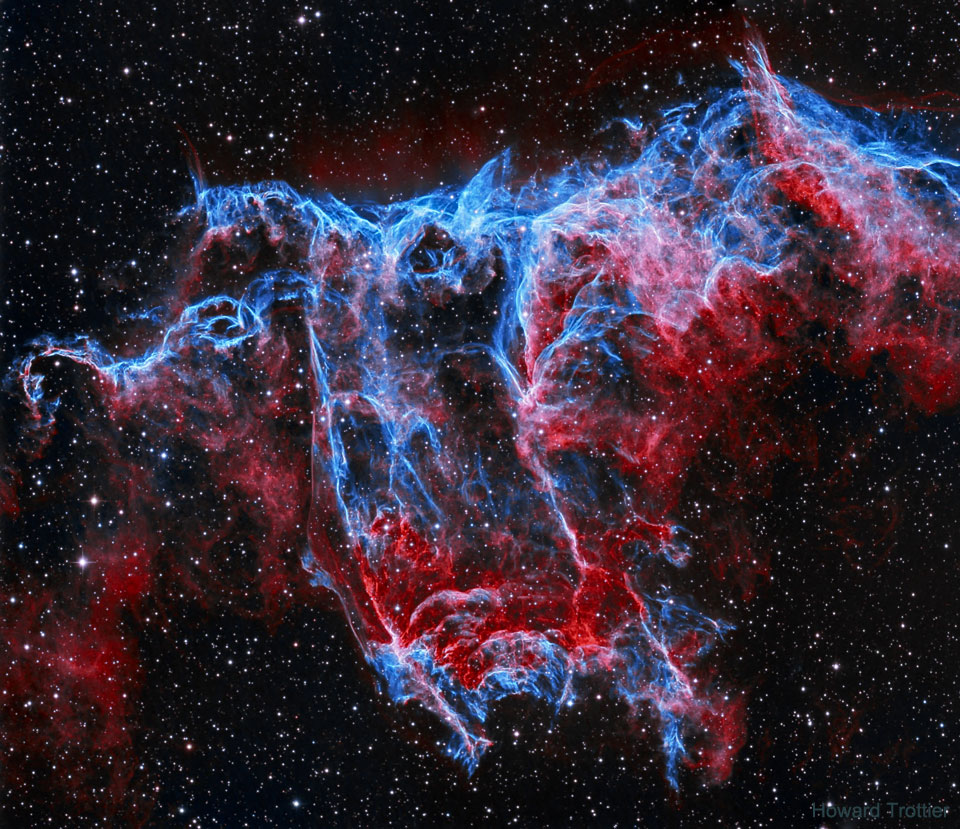
Do you see the bat? It haunts this cosmic close-up of the eastern Veil Nebula. The Veil Nebula itself is a large supernova remnant, the expanding debris cloud from the death explosion of a massive star. While the Veil is roughly circular in shape and covers nearly 3 degrees on the sky toward the constellation of the Swan (Cygnus), NGC 6995, known informally as the Bat Nebula, spans only 1/2 degree, about the apparent size of the Moon. That translates to 12 light-years at the Veil’s estimated distance, a reassuring 1,400 light-years from planet Earth. In the composite of image data recorded through narrow band filters, emission from hydrogen atoms in the remnant is shown in red with strong emission from oxygen atoms shown in hues of blue. Of course, in the western part of the Veil lies another seasonal apparition: the Witch’s Broom Nebula.

from NASA https://ift.tt/3nuu8o8
via IFTTT