Zodiacal Road


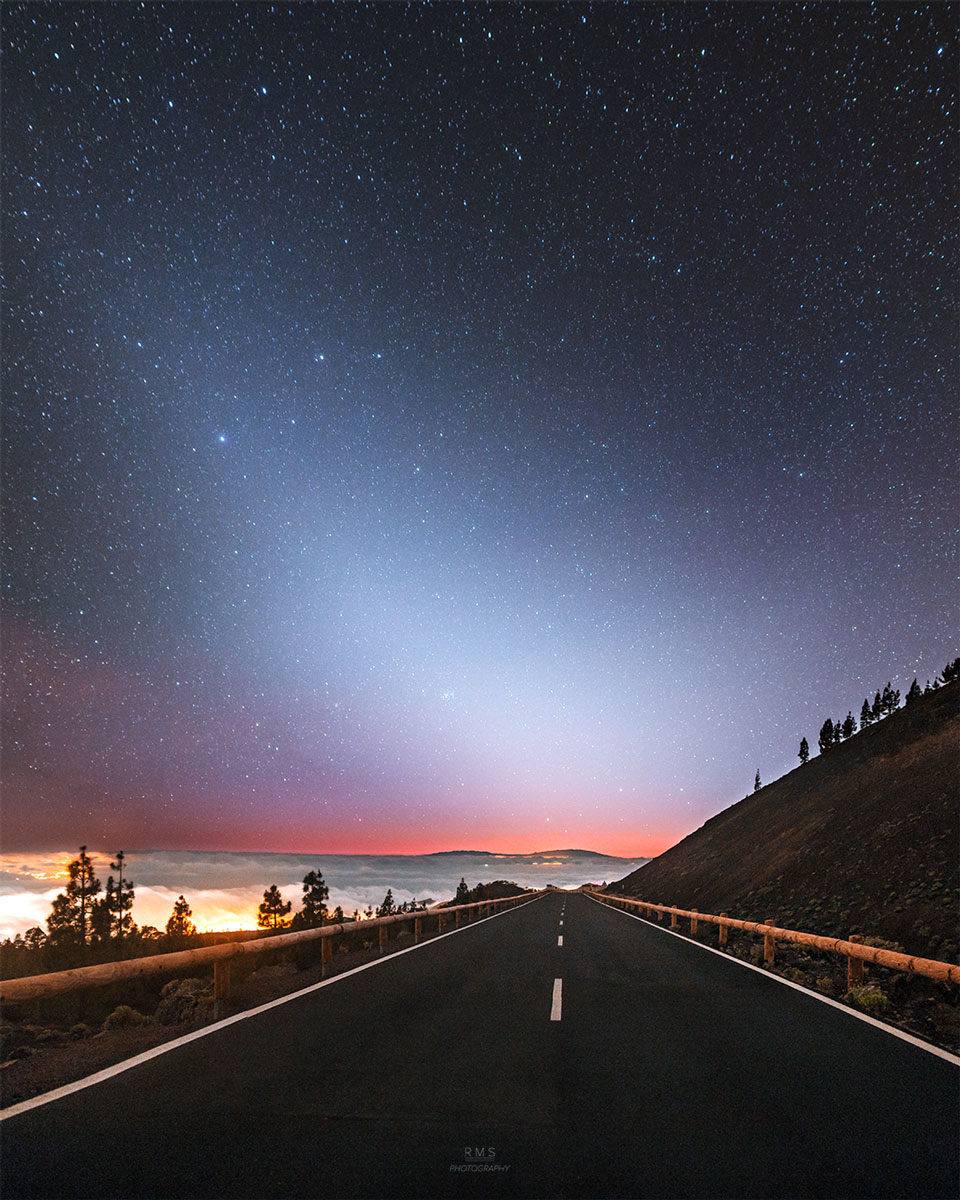
What’s that strange light down the road? Dust orbiting the Sun. At certain times of the year, a band of sun-reflecting dust from the inner Solar System appears prominently just after sunset — or just before sunrise — and is called zodiacal light. Although the origin of this dust is still being researched, a leading hypothesis holds that zodiacal dust originates mostly from faint Jupiter-family comets and slowly spirals into the Sun. Recent analysis of dust emitted by Comet 67P, visited by ESA’s robotic Rosetta spacecraft, bolster this hypothesis. Pictured when climbing a road up to Teide National Park in the Canary Islands of Spain, a bright triangle of zodiacal light appeared in the distance soon after sunset. Captured on June 21, the scene includes bright Regulus, alpha star of Leo, standing above center toward the left. The Beehive Star Cluster (M44) can be spotted below center, closer to the horizon and also immersed in the zodiacal glow.

from NASA https://ift.tt/2YoF8sv
via IFTTT
M82: Galaxy with a Supergalactic Wind


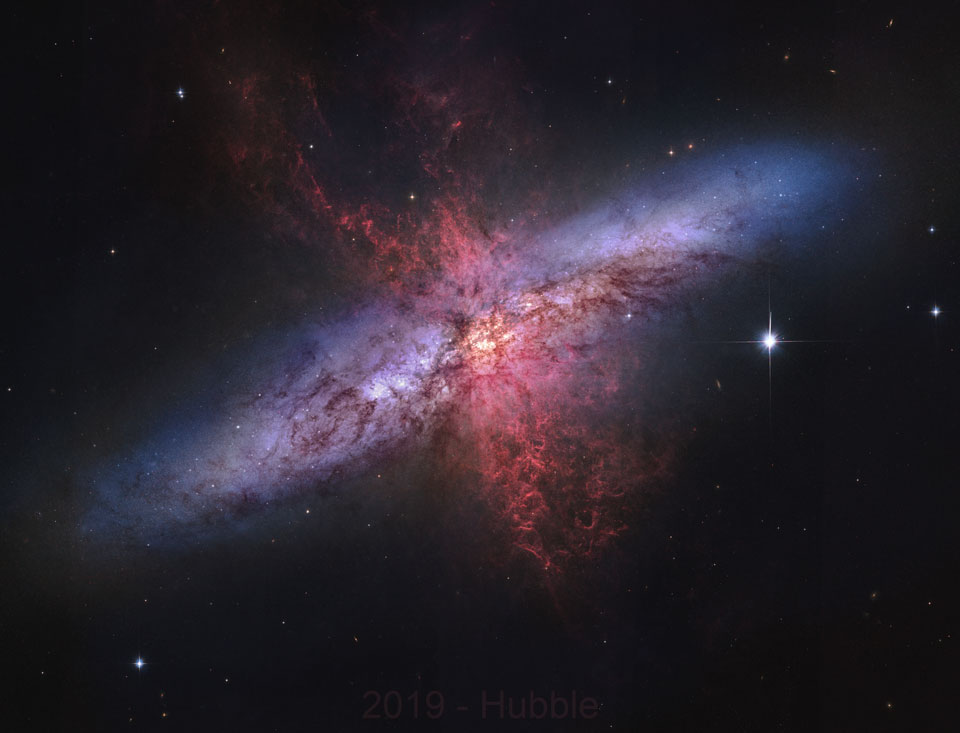
Why is the Cigar Galaxy billowing red smoke? M82, as this starburst galaxy is also known, was stirred up by a recent pass near large spiral galaxy M81. This doesn’t fully explain the source of the red-glowing outwardly expanding gas and dust, however. Evidence indicates that this gas and dust is being driven out by the combined emerging particle winds of many stars, together creating a galactic superwind. The dust particles are thought to originate in M82’s interstellar medium and are actually similar in size to particles in cigar smoke. The featured photographic mosaic highlights a specific color of red light strongly emitted by ionized hydrogen gas, showing detailed filaments of this gas and dust. The filaments extend for over 10,000 light years. The 12-million light-year distant Cigar Galaxy is the brightest galaxy in the sky in infrared light, and can be seen in visible light with a small telescope towards the constellation of the Great Bear (Ursa Major).

from NASA https://ift.tt/2OdU3BX
via IFTTT

HDR: Earths Circular Shadow on the Moon


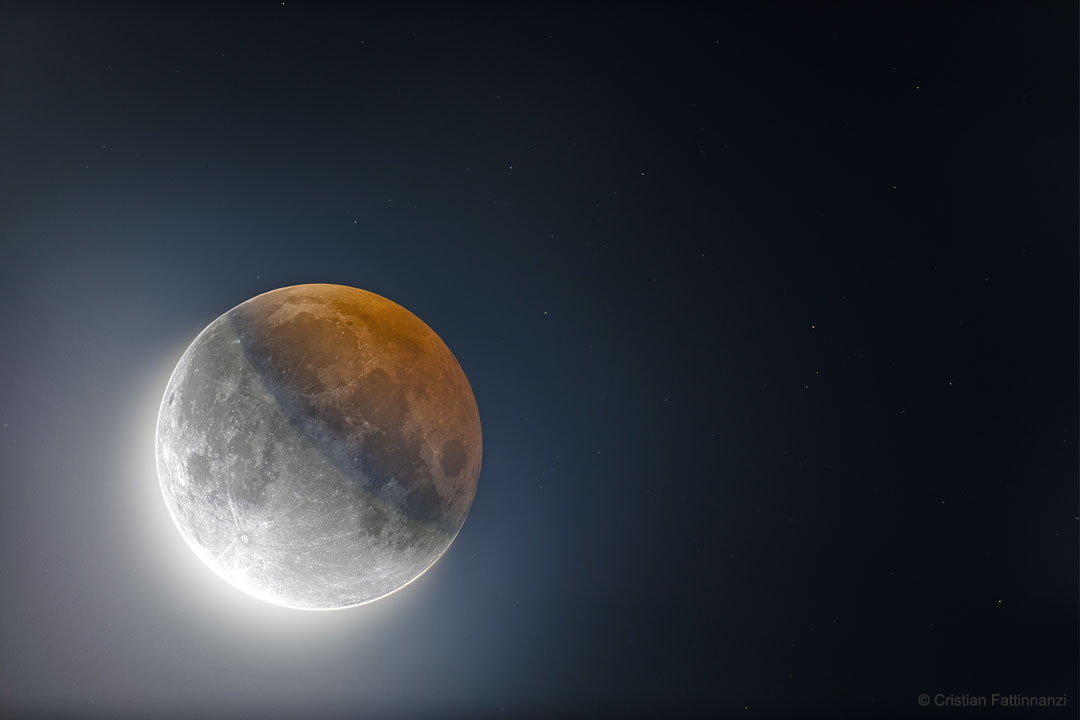
What could create such a large circular shadow on the Moon? The Earth. Last week’s full Moon — the Buck Moon — was so full that it fell almost exactly in a line with the Sun and the Earth. When that happens the Earth casts its shadow onto the Moon. The circularity of the Earth’s shadow on the Moon was commented on by Aristotle and so has been noticed since at least the 4th century BC. What’s new is humanity’s ability to record this shadow with such high dynamic range (HDR). The featured HDR composite of last week’s partial lunar eclipse combines 15 images and include an exposure as short as 1/400th of a second — so as not to overexpose the brightest part — and an exposure that lasted five seconds — to bring up the dimmest part. This dimmest part — inside Earth’s umbra — is not completely dark because some light is refracted through the Earth’s atmosphere onto the Moon. A total lunar eclipse will occur next in 2021 May.

from NASA https://ift.tt/2JTAABc
via IFTTT

Moonquakes Surprisingly Common


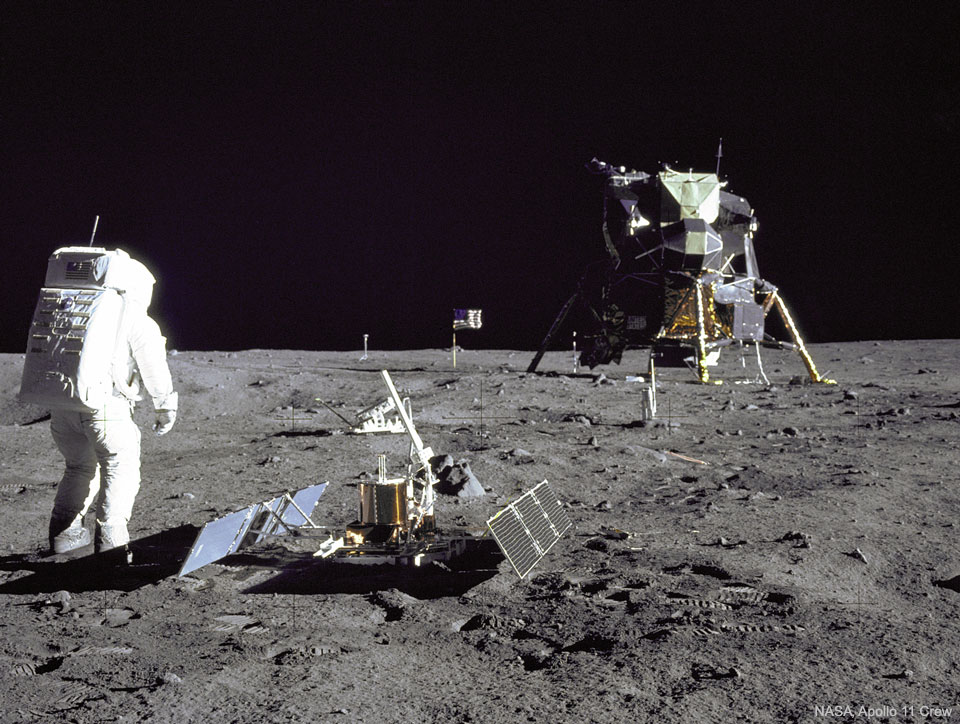
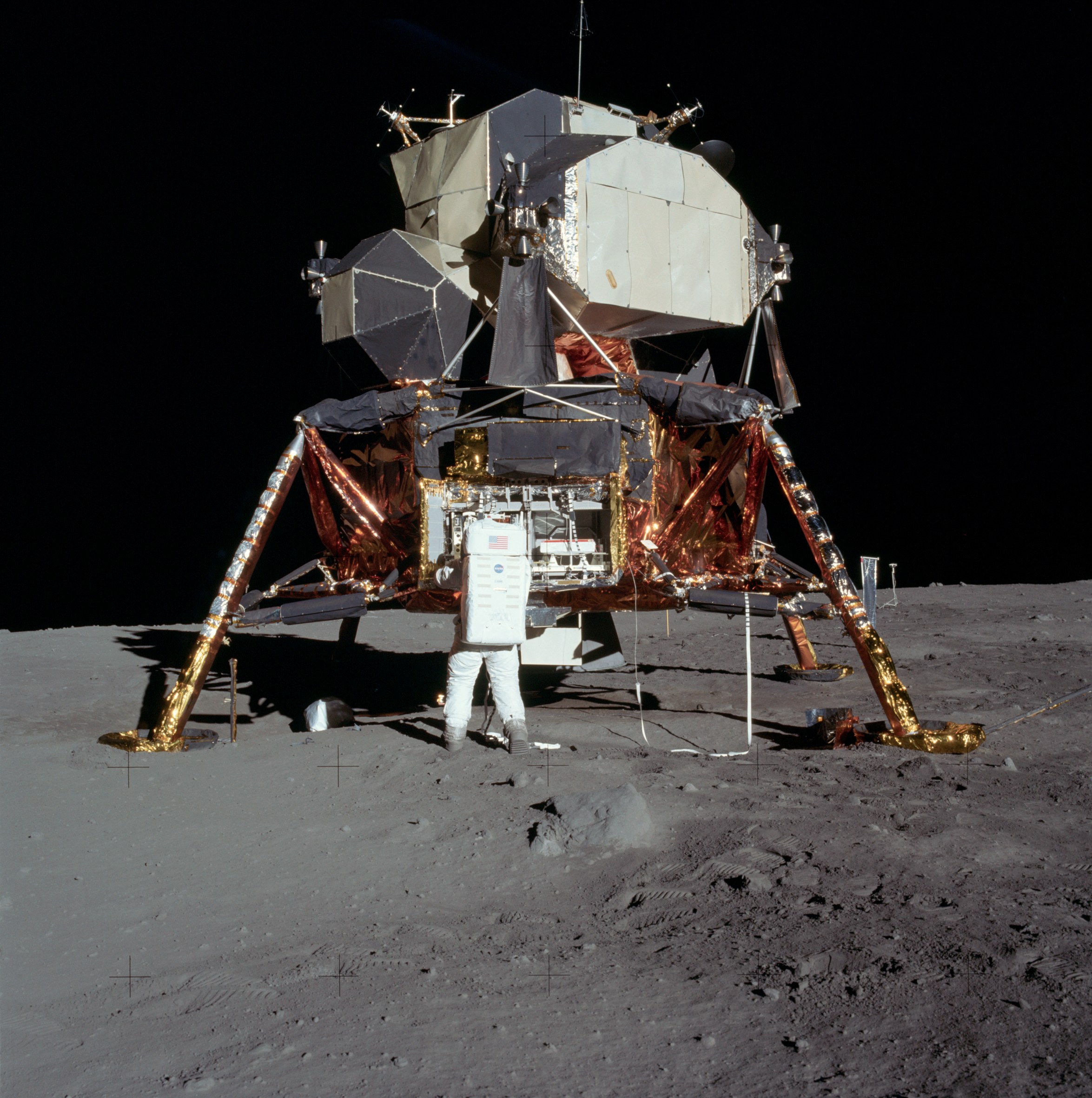
Why are there so many moonquakes? Analyses of seismometers left on the moon by the Apollo moon landings reveals a surprising number of moonquakes occurring within 100 kilometers of the surface. In fact, 62 moonquakes were detected in data recorded between 1972 and 1977. Many of these moonquakes are not only strong enough to move furniture in a lunar apartment, but the stiff rock of the moon continues to vibrate for many minutes, significantly longer than the softer rock earthquakes on Earth. The cause of the moonquakes remains unknown, but a leading hypothesis is the collapse of underground faults. Regardless of the source, future moon dwellings need to be built to withstand the frequent shakings. Pictured here 50 years ago today, Apollo 11 astronaut Buzz Aldrin stands beside a recently deployed lunar seismometer, looking back toward the lunar landing module.

from NASA https://ift.tt/2O7yD9s
via IFTTT

Apollo 11 Landing Panorama


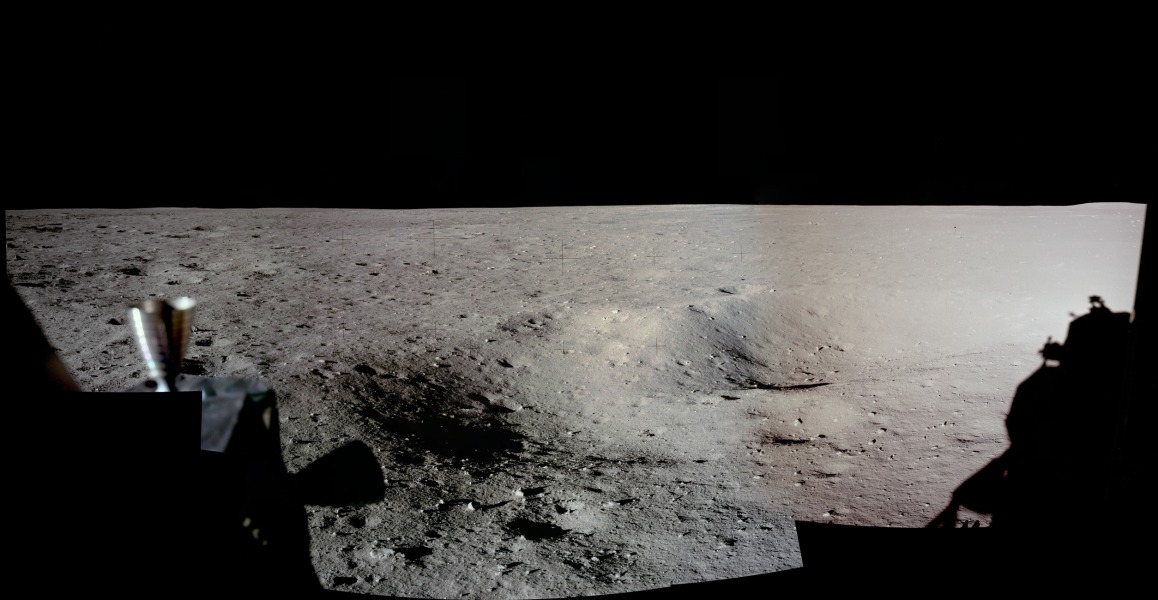
Have you seen a panorama from another world lately? Assembled from high-resolution scans of the original film frames, this one sweeps across the magnificent desolation of the Apollo 11 landing site on the Moon’s Sea of Tranquility. The images were taken by Neil Armstrong looking out his window of the Eagle Lunar Module fifty years ago, shortly after the July 20, 1969 landing. The frame at the far left (AS11-37-5449) is the first picture taken by a person on another world. Toward the south, thruster nozzles can be seen in the foreground on the left, while at the right, the shadow of the Eagle is visible to the west. For scale, the large, shallow crater on the right has a diameter of about 12 meters. Frames taken from the Lunar Module windows about an hour and a half after landing, before walking on the lunar surface, were intended to initially document the landing site in case an early departure was necessary.

from NASA https://ift.tt/2XYjZBe
via IFTTT

Apollo 11: Descent to the Moon


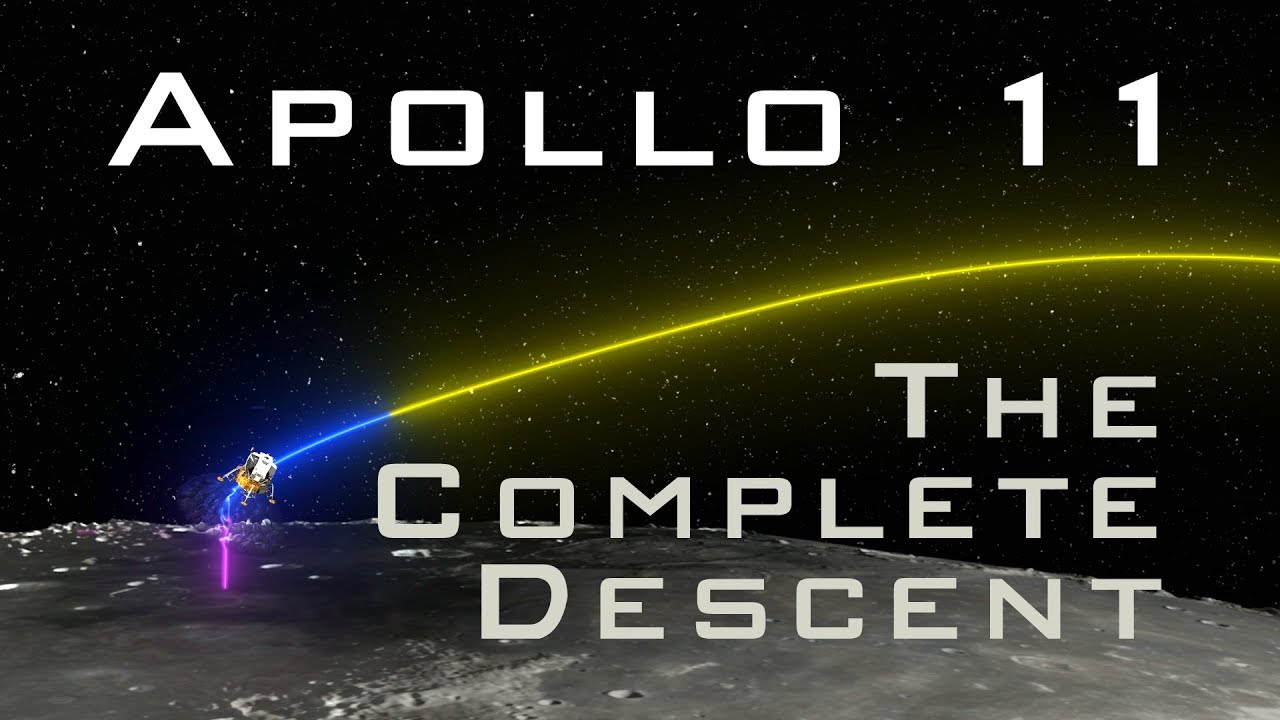
It had never been done before. But with the words “You’re Go for landing”, 50 years ago this Saturday, Apollo 11 astronauts Aldrin and Armstrong were cleared to make the first try. The next few minutes would contain more than a bit of drama, as an unexpected boulder field and an unacceptably sloping crater loomed below. With fuel dwindling, Armstrong coolly rocketed the lander above the lunar surface as he looked for a clear and flat place to land. With only seconds of fuel remaining, and with the help of Aldrin and mission control calling out data, Armstrong finally found a safe spot — and put the Eagle down. Many people on Earth listening to the live audio felt great relief on hearing “The Eagle has landed”, and great pride knowing that for the first time ever, human beings were on the Moon. Combined in the featured descent video are two audio feeds, a video feed similar to what the astronauts saw, captions of the dialog, and data including the tilt of the Eagle lander. The video concludes with the panorama of the lunar landscape visible outside the Eagle. A few hours later, hundreds of millions of people across planet Earth, drawn together as a single species, watched fellow humans walk on the Moon.

from NASA https://ift.tt/2NYuZyQ
via IFTTT

Apollo 11 Launches Humans to the Moon


Everybody saw the Moon. Nobody had ever been there. Humans across planet Earth watched in awe 50 years ago today as a powerful Saturn V rocket attempted to launch humans — to the Moon. Some in space flight guessed that the machinery was so complex, that so many things had to go right for it to work, that Apollo 11 would end up being another useful dress rehearsal for a later successful Moon-landing mission. But to the Moon they went. The featured video starts by showing astronauts Aldrin, Armstrong, and Collins making their way to the waiting rocket. As the large and mighty Saturn V launched, crowds watched from Cape Canaveral in Florida, USA and on television around the world. The events that unfolded over the next few days, including a dramatic moon walk 50 years ago this Saturday, will forever be remembered as a milestone in human history and an unrivaled demonstration of human ingenuity. This week, many places around the world are planning celebrations of the 50th anniversary of the first humans landing on the Moon.

from NASA https://ift.tt/2k5dHll
via IFTTT

The Space Station Crosses a Spotless Sun


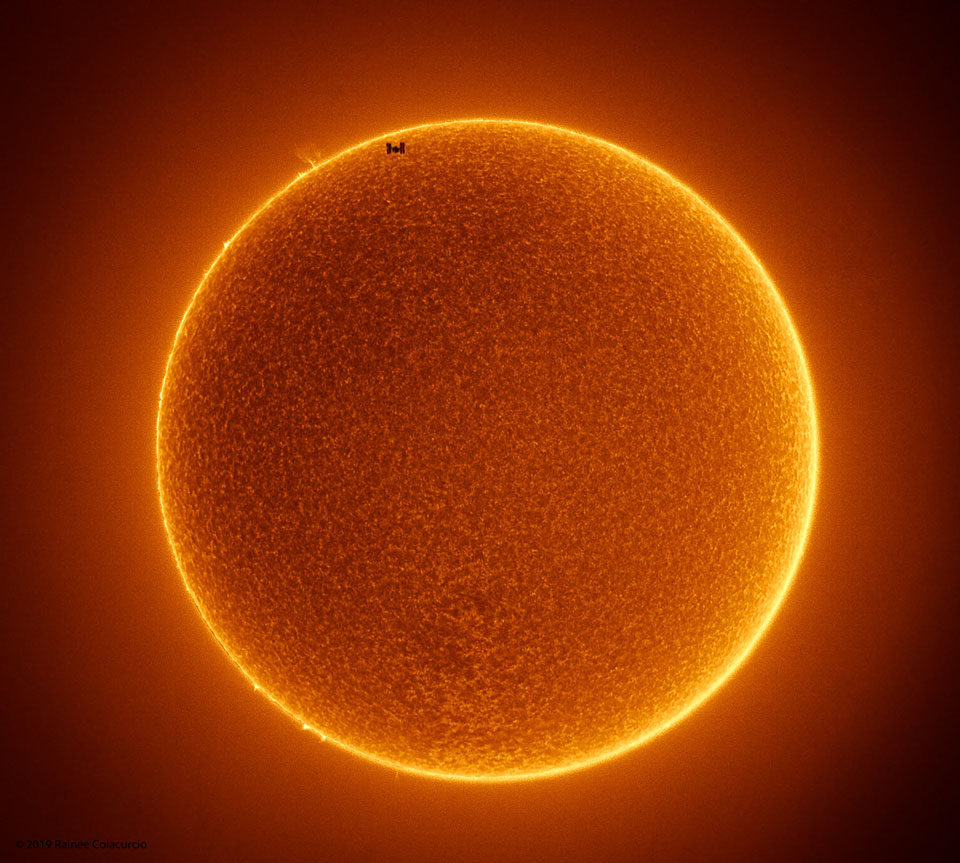
That’s no sunspot. It’s the International Space Station (ISS) caught passing in front of the Sun. Sunspots, individually, have a dark central umbra, a lighter surrounding penumbra, and no solar panels. By contrast, the ISS is a complex and multi-spired mechanism, one of the largest and most sophisticated machines ever created by humanity. Also, sunspots occur on the Sun, whereas the ISS orbits the Earth. Transiting the Sun is not very unusual for the ISS, which orbits the Earth about every 90 minutes, but getting one’s timing and equipment just right for a great image is rare. Strangely, besides that fake spot, in this recent two-image composite, the Sun lacked any real sunspots. The featured picture combines two images — one capturing the space station transiting the Sun — and another taken consecutively capturing details of the Sun’s surface. Sunspots have been rare on the Sun since the dawn of the current Solar Minimum, a period of low solar activity. For reasons not yet fully understood, the number of sunspots occurring during both the previous and current solar minima have been unusually low.

from NASA https://ift.tt/2JHcGsB
via IFTTT

Eagle Aurora over Norway


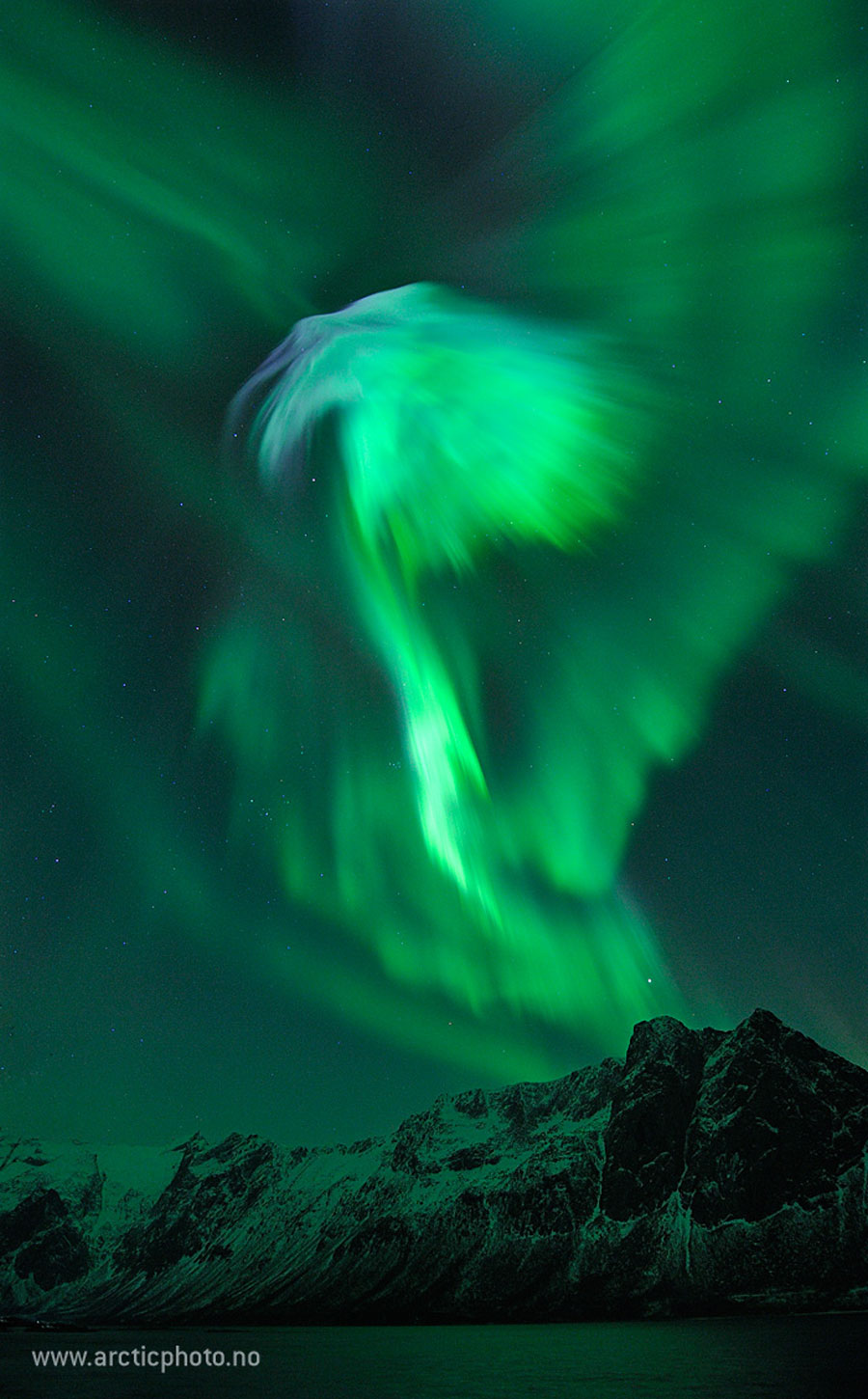
What’s that in the sky? An aurora. A large coronal mass ejection occurred on our Sun five days before this 2012 image was taken, throwing a cloud of fast moving electrons, protons, and ions toward the Earth. Although most of this cloud passed above the Earth, some of it impacted our Earth’s magnetosphere and resulted in spectacular auroras being seen at high northern latitudes. Featured here is a particularly photogenic auroral corona captured above Grotfjord, Norway. To some, this shimmering green glow of recombining atmospheric oxygen might appear as a large eagle, but feel free to share what it looks like to you. Although the Sun is near Solar Minimum, streams of the solar wind continue to impact the Earth and create impressive auroras visible even last week.

from NASA https://ift.tt/2GcyTxv
via IFTTT

Magellanic Galaxy NGC 55


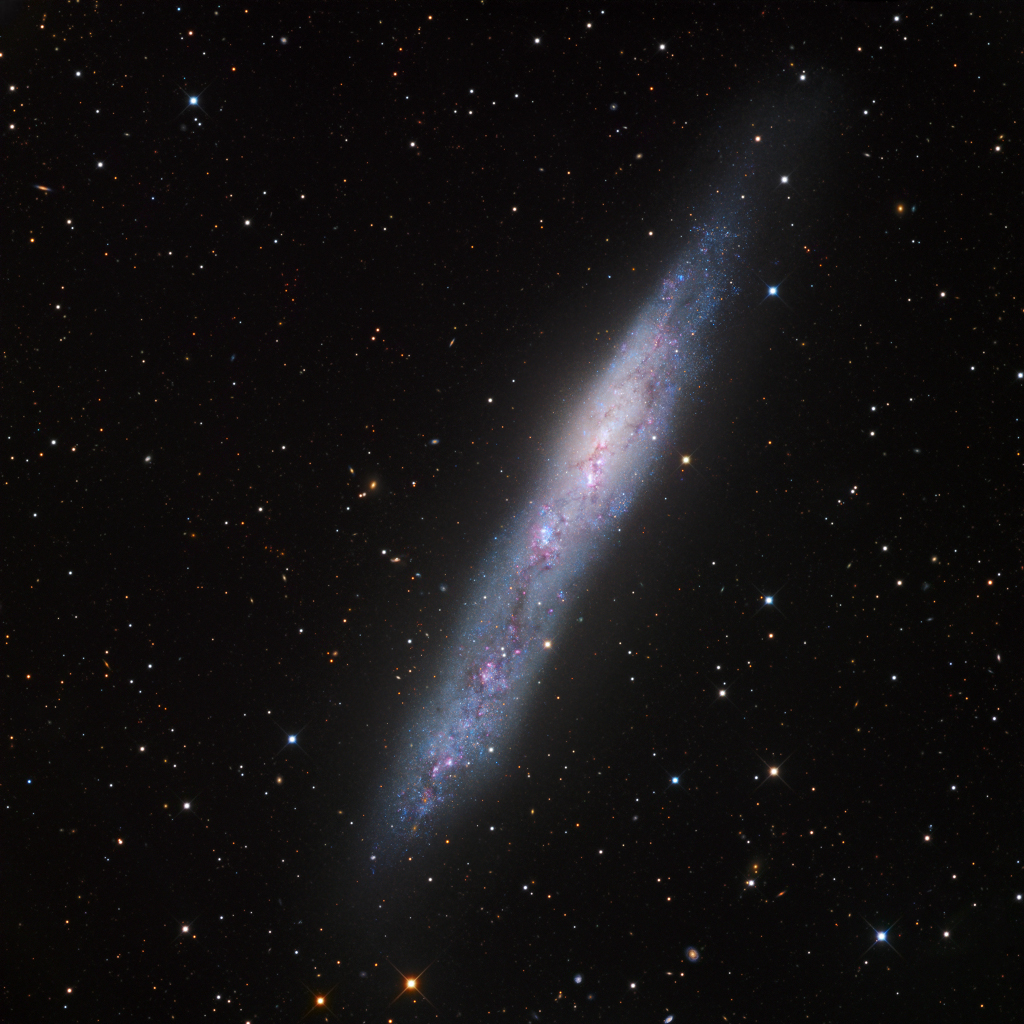
Irregular galaxy NGC 55 is thought to be similar to the Large Magellanic Cloud (LMC). But while the LMC is about 180,000 light-years away and a well-known satellite of our own Milky Way Galaxy, NGC 55 is more like 6 million light-years distant, a member of the Sculptor Galaxy Group. Classified as an irregular galaxy, in deep exposures the LMC itself resembles a barred disk galaxy. Spanning about 50,000 light-years, NGC 55 is seen nearly edge-on though, presenting a flattened, narrow profile in contrast with our face-on view of the LMC. Just as large star forming regions create emission nebulae in the LMC, NGC 55 is also seen to be producing new stars. This highly detailed galaxy portrait highlights a bright core crossed with dust clouds, telltale pinkish star forming regions, and young blue star clusters in NGC 55.

from NASA https://ift.tt/2Y1gbmS
via IFTTT