The Snows of Churyumov Gerasimenko


You couldn’t really be caught in this blizzard while standing by a cliff on periodic comet 67P/Churyumov-Gerasimenko. Orbiting the comet in June of 2016, the Rosetta spacecraft’s narrow angle camera did record streaks of dust and ice particles similar to snow as they drifted across the field of view close to the camera and above the comet’s surface. Still, some of the bright specks in the scene are likely due to a rain of energetic charged particles or cosmic rays hitting the camera, and the dense background of stars in the direction of the constellation of the Big Dog (Canis Major). In the video, the background stars are easy to spot trailing from top to bottom. The stunning movie was constructed from 33 consecutive images taken over 25 minutes while Rosetta cruised some 13 kilometers from the comet’s nucleus. In September 2016, the nucleus became the final resting place for the Rosetta spacecraft after its mission was ended with a successful controlled impact on 67P/Churyumov-Gerasimenko.

from NASA https://ift.tt/EeONKx8
via IFTTT
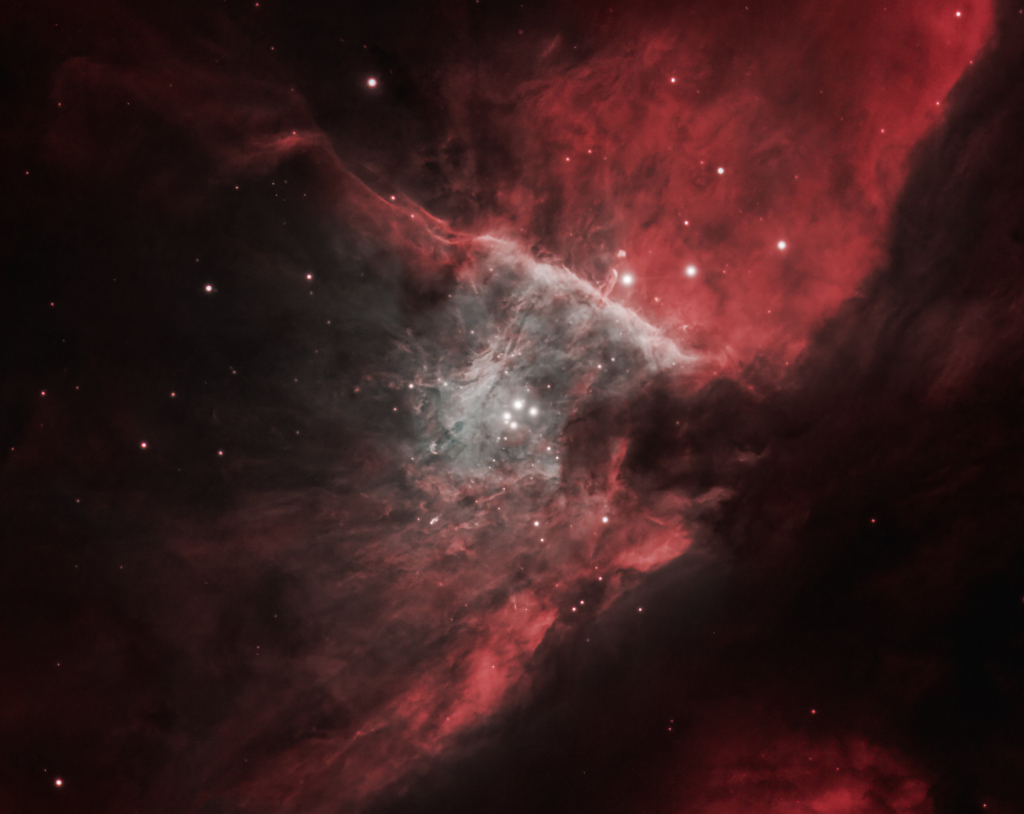
Trapezium: At the Heart of Orion


Near the center of this sharp cosmic portrait, at the heart of the Orion Nebula, are four hot, massive stars known as the Trapezium. Gathered within a region about 1.5 light-years in radius, they dominate the core of the dense Orion Nebula Star Cluster. Ultraviolet ionizing radiation from the Trapezium stars, mostly from the brightest star Theta-1 Orionis C powers the complex star forming region’s entire visible glow. About three million years old, the Orion Nebula Cluster was even more compact in its younger years and a dynamical study indicates that runaway stellar collisions at an earlier age may have formed a black hole with more than 100 times the mass of the Sun. The presence of a black hole within the cluster could explain the observed high velocities of the Trapezium stars. The Orion Nebula’s distance of some 1,500 light-years would make it one of the closest known black holes to planet Earth.

from NASA https://ift.tt/WJOqQy9
via IFTTT

Zeta Oph: Runaway Star


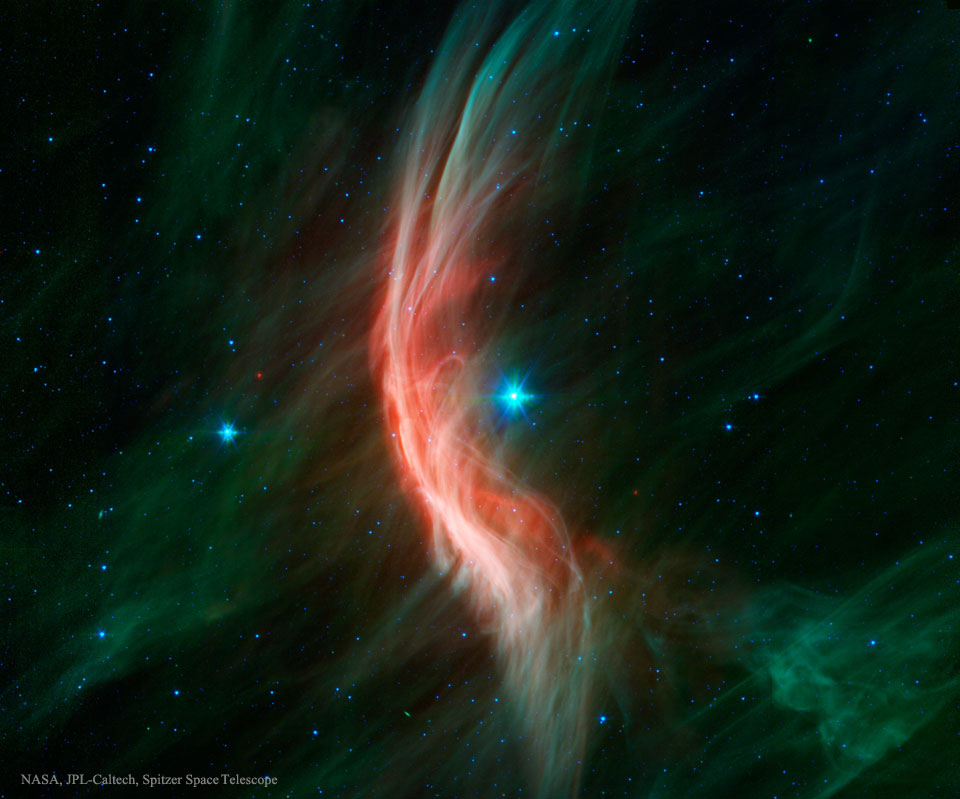
Like a ship plowing through cosmic seas, runaway star Zeta Ophiuchi produces the arcing interstellar bow wave or bow shock seen in this stunning infrared portrait. In the false-color view, bluish Zeta Oph, a star about 20 times more massive than the Sun, lies near the center of the frame, moving toward the left at 24 kilometers per second. Its strong stellar wind precedes it, compressing and heating the dusty interstellar material and shaping the curved shock front. What set this star in motion? Zeta Oph was likely once a member of a binary star system, its companion star was more massive and hence shorter lived. When the companion exploded as a supernova catastrophically losing mass, Zeta Oph was flung out of the system. About 460 light-years away, Zeta Oph is 65,000 times more luminous than the Sun and would be one of the brighter stars in the sky if it weren’t surrounded by obscuring dust. The image spans about 1.5 degrees or 12 light-years at the estimated distance of Zeta Ophiuchi. In January 2020, NASA placed the Spitzer Space Telescope in safe mode, ending its 16 successful years of exploring the cosmos.

from NASA https://ift.tt/QeaBcT8
via IFTTT


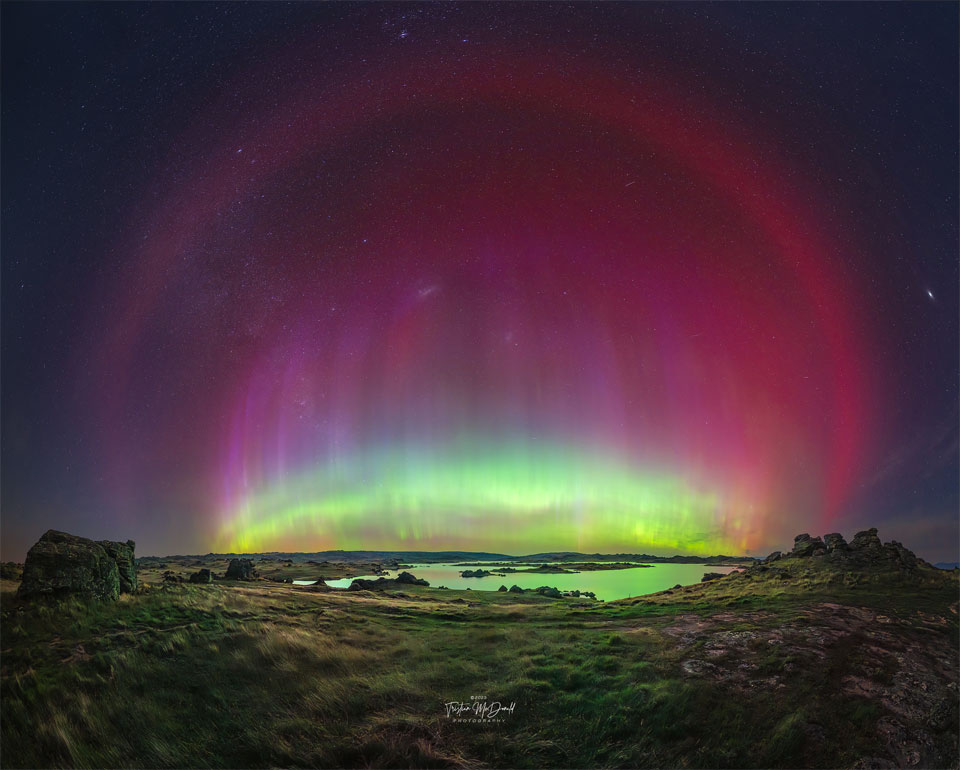
What is that unusual red halo surrounding this aurora? It is a Stable Auroral Red (SAR) arc. SAR arcs are rare and have only been acknowledged and studied since 1954. The featured wide-angle photograph, capturing nearly an entire SAR arc surrounding more common green and red aurora, was taken earlier this month from Poolburn, New Zealand, during an especially energetic geomagnetic storm. Why SAR arcs form remains a topic of research, but is likely related to Earth’s protective magnetic field, a field created by molten iron flowing deep inside the Earth. This magnetic field usually redirects incoming charged particles from the Sun’s wind toward the Earth’s poles. However, it also traps a ring of ions closer to the equator, where they can gain energy from the magnetosphere during high solar activity. The energetic electrons in this ion ring can collide with and excite oxygen higher in Earth’s ionosphere than typical auroras, causing the oxygen to glow red. Ongoing research has uncovered evidence that a red SAR arc can even transform into a purple and green STEVE.

from NASA https://ift.tt/IFx7nKs
via IFTTT


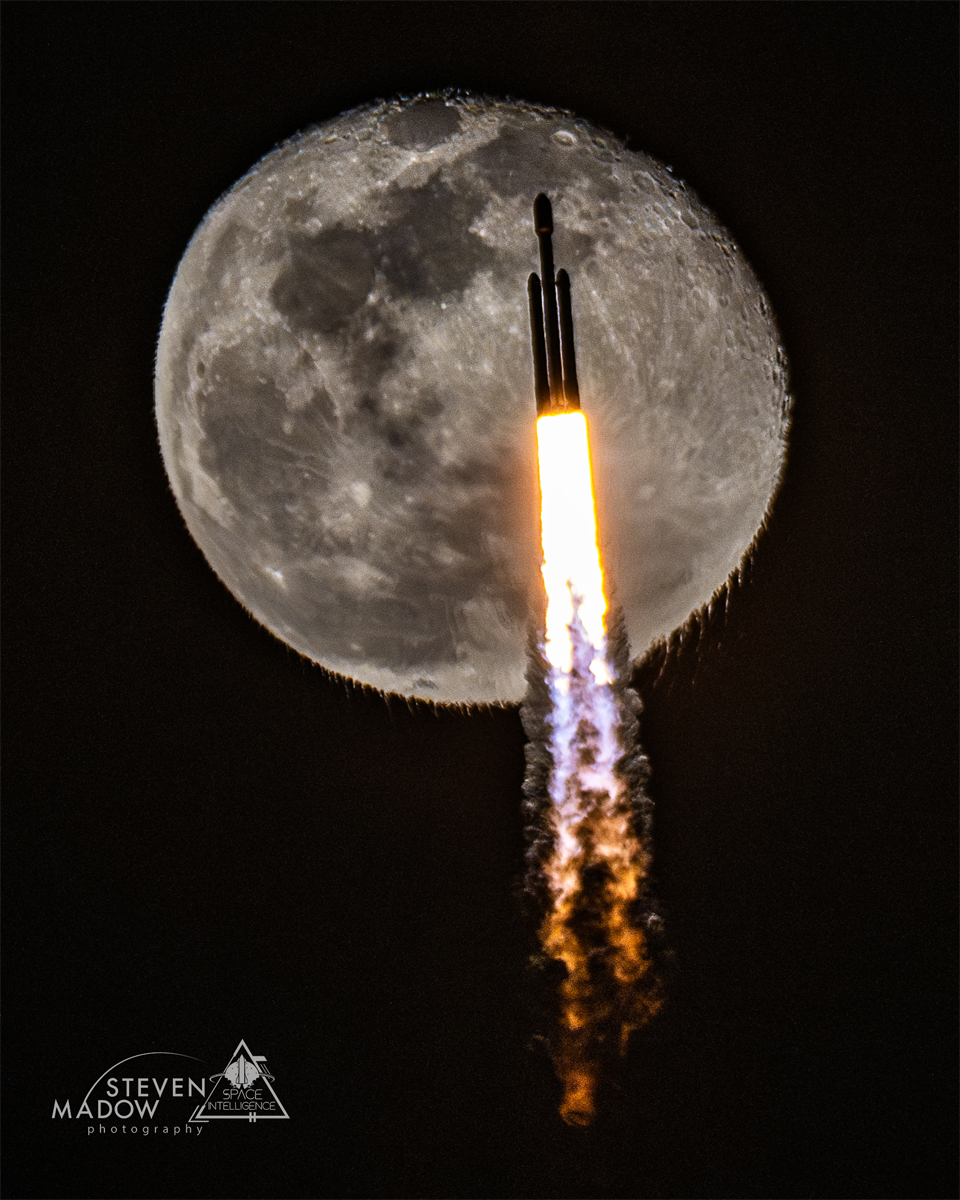
Can a rocket make the Moon ripple? No, but it can make a background moon appear wavy. The rocket, in this case, was a SpaceX Falcon Heavy that blasted off from NASA‘s Kennedy Space Center last week. In the featured launch picture, the rocket’s exhaust plume glows beyond its projection onto the distant, rising, and nearly full moon. Oddly, the Moon’s lower edge shows unusual drip-like ripples. The Moon itself, far in the distance, was really unchanged. The physical cause of these apparent ripples was pockets of relatively hot or rarefied air deflecting moonlight less strongly than pockets of relatively cool or compressed air: refraction. Although the shot was planned, the timing of the launch had to be just right for the rocket to be transiting the Moon during this single exposure.

from NASA https://ift.tt/qyeQIUF
via IFTTT


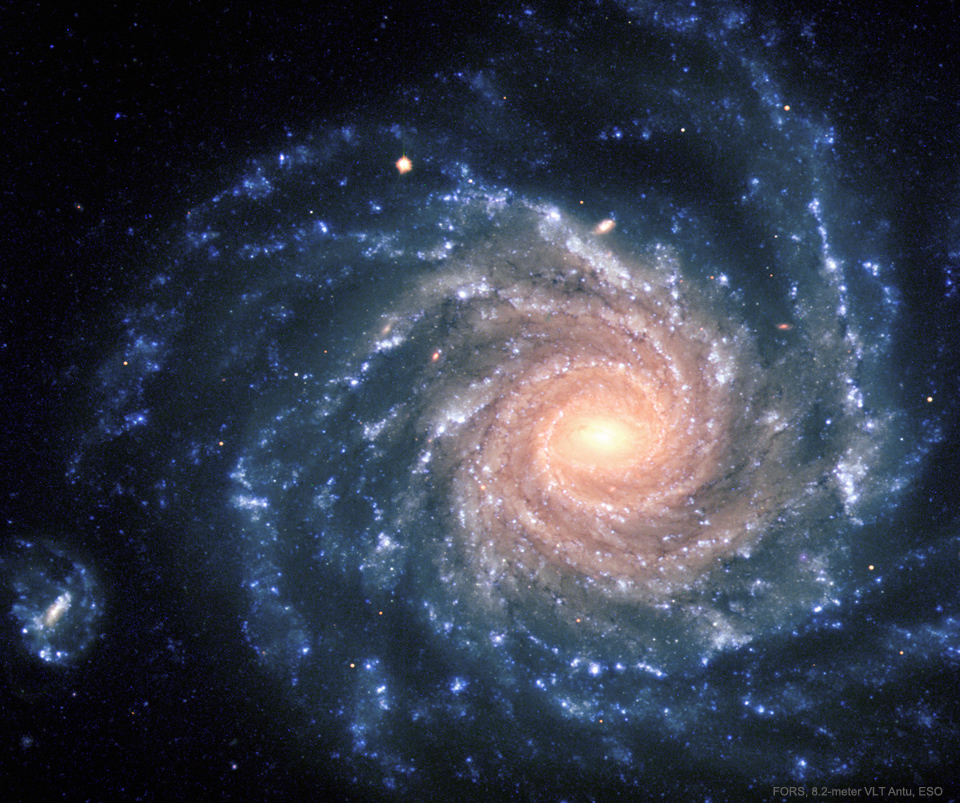
Galaxies are fascinating not only for what is visible, but for what is invisible. Grand spiral galaxy NGC 1232, captured in detail by one of the Very Large Telescopes, is a good example. The visible is dominated by millions of bright stars and dark dust, caught up in a gravitational swirl of spiral arms revolving about the center. Open clusters containing bright blue stars can be seen sprinkled along these spiral arms, while dark lanes of dense interstellar dust can be seen sprinkled between them. Less visible, but detectable, are billions of dim normal stars and vast tracts of interstellar gas, together wielding such high mass that they dominate the dynamics of the inner galaxy. Leading theories indicate that even greater amounts of matter are invisible, in a form we don’t yet know. This pervasive dark matter is postulated, in part, to explain the motions of the visible matter in the outer regions of galaxies.

from NASA https://ift.tt/QkHlPFv
via IFTTT


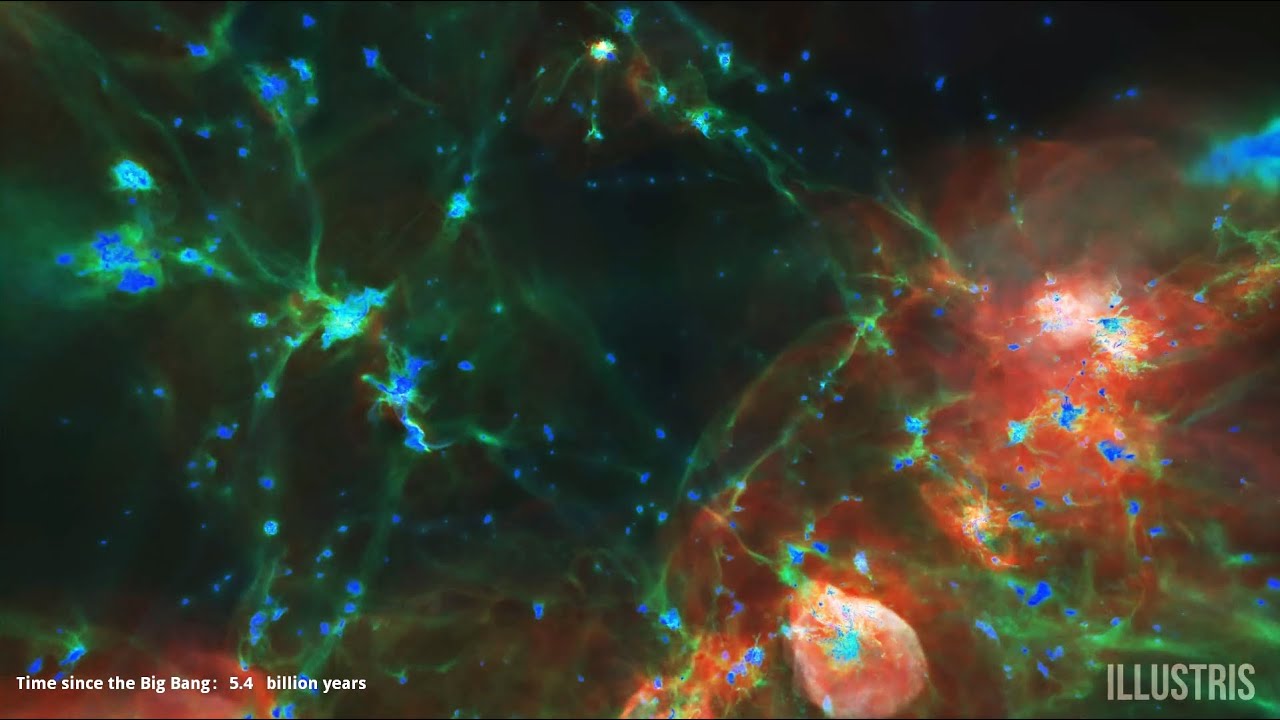
How did we get here? Click play, sit back, and watch. A computer simulation of the evolution of the universe provides insight into how galaxies formed and perspectives into humanity’s place in the universe. The Illustris project exhausted 20 million CPU hours in 2014 following 12 billion resolution elements spanning a cube 35 million light years on a side as it evolved over 13 billion years. The simulation tracks matter into the formation of a wide variety of galaxy types. As the virtual universe evolves, some of the matter expanding with the universe soon gravitationally condenses to form filaments, galaxies, and clusters of galaxies. The featured video takes the perspective of a virtual camera circling part of this changing universe, first showing the evolution of dark matter, then hydrogen gas coded by temperature (0:45), then heavy elements such as helium and carbon (1:30), and then back to dark matter (2:07). On the lower left the time since the Big Bang is listed, while on the lower right the type of matter being shown is listed. Explosions (0:50) depict galaxy-center supermassive black holes expelling bubbles of hot gas. Interesting discrepancies between Illustris and the real universe have been studied, including why the simulation produced an overabundance of old stars.

from NASA https://ift.tt/vBJeibl
via IFTTT

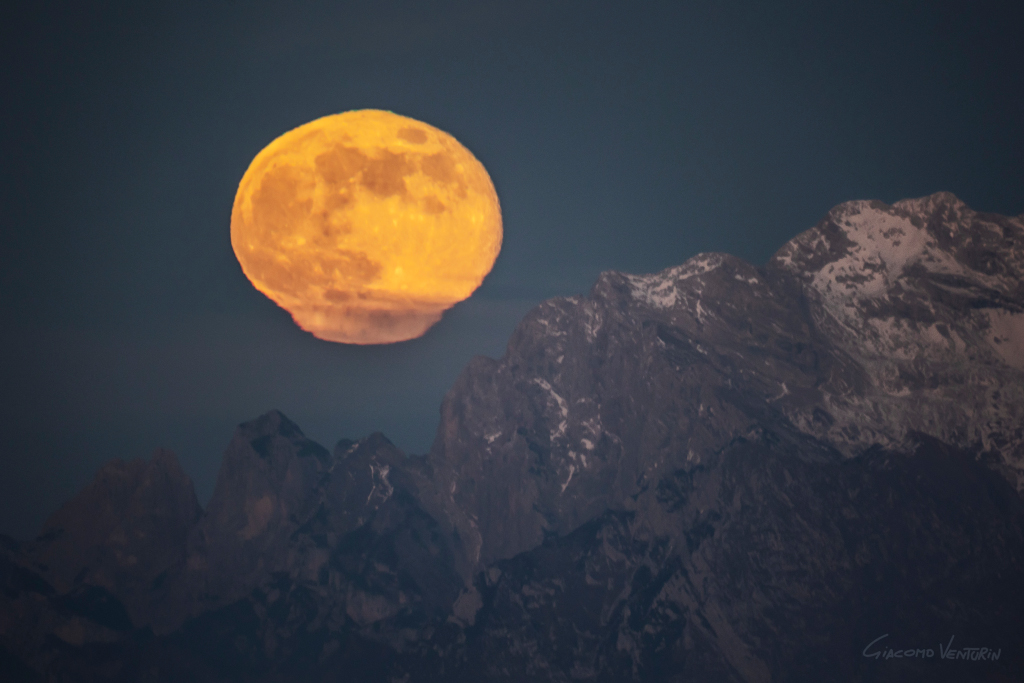
The Last Full Moon


Known to some in the northern hemisphere as December’s Cold Moon or the Long Night Moon, the last full moon of 2023 is rising in this surreal mountain and skyscape. The Daliesque scene was captured in a single exposure with a camera and long telephoto lens near Monte Grappa, Italy. The full moon is not melting, though. Its stretched and distorted appearance near the horizon is caused as refraction along the line of sight changes and creates shifting images or mirages of the bright lunar disk. The changes in atmospheric refraction correspond to atmospheric layers with sharply different temperatures and densities. Other effects of atmospheric refraction produced by the long sight-line to this full moon rising include the thin red rim seen faintly on the distorted lower edge of the Moon and a thin green rim along the top.

from NASA https://ift.tt/6yF4MzI
via IFTTT

Shakespeare in Space


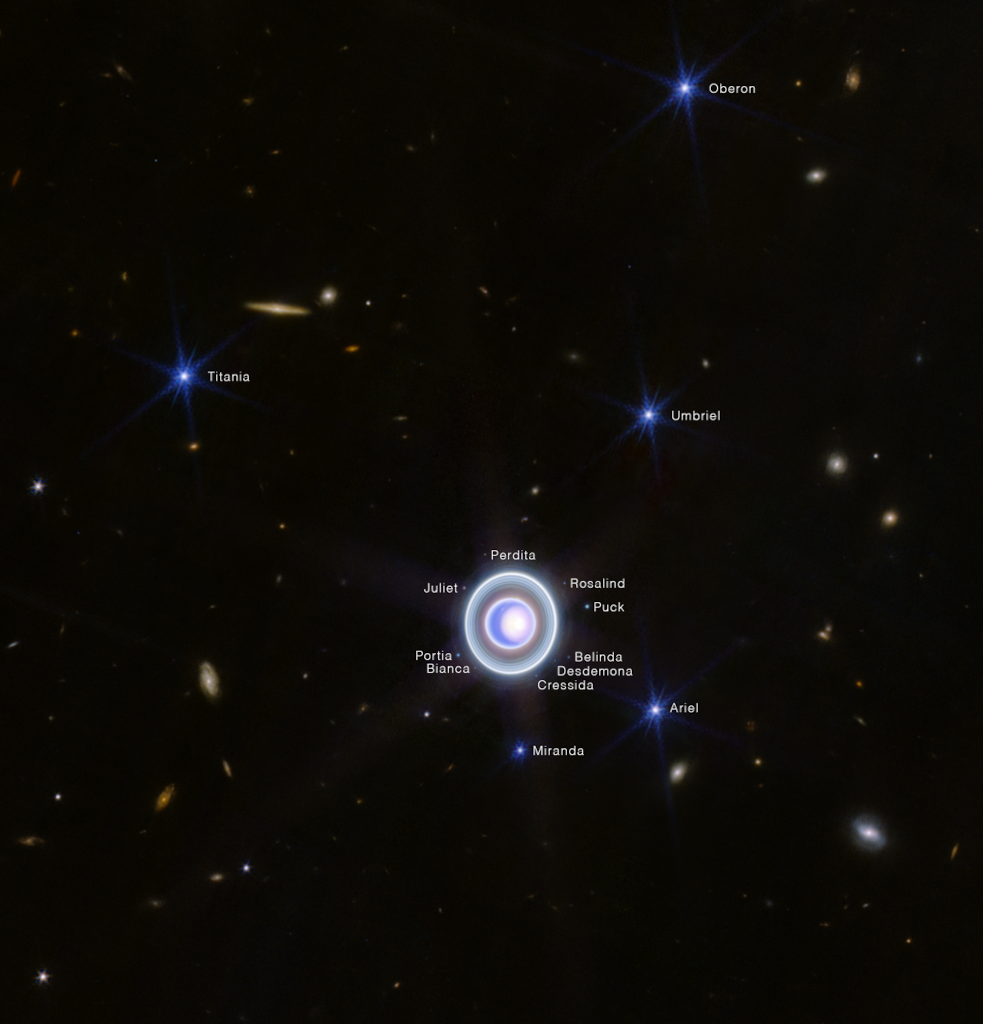
In 1986, Voyager 2 became the only spacecraft to explore ice giant planet Uranus close up. Still, this newly released image from the NIRCam (Near-Infrared Camera) on the James Webb Space Telescope offers a detailed look at the distant world. The tilted outer planet rotates on its axis once in about 17 hours. Its north pole is presently pointed near our line of sight, offering direct views of its northern hemisphere and a faint but extensive system of rings. Of the giant planet’s 27 known moons, 14 are annotated in the image. The brighter ones show hints of Webb’s characteristic diffraction spikes. And though these worlds of the outer Solar System were unknown in Shakespearean times, all but two of the 27 Uranian moons are named for characters in the English Bard’s plays.

from NASA https://ift.tt/hMjB4yF
via IFTTT

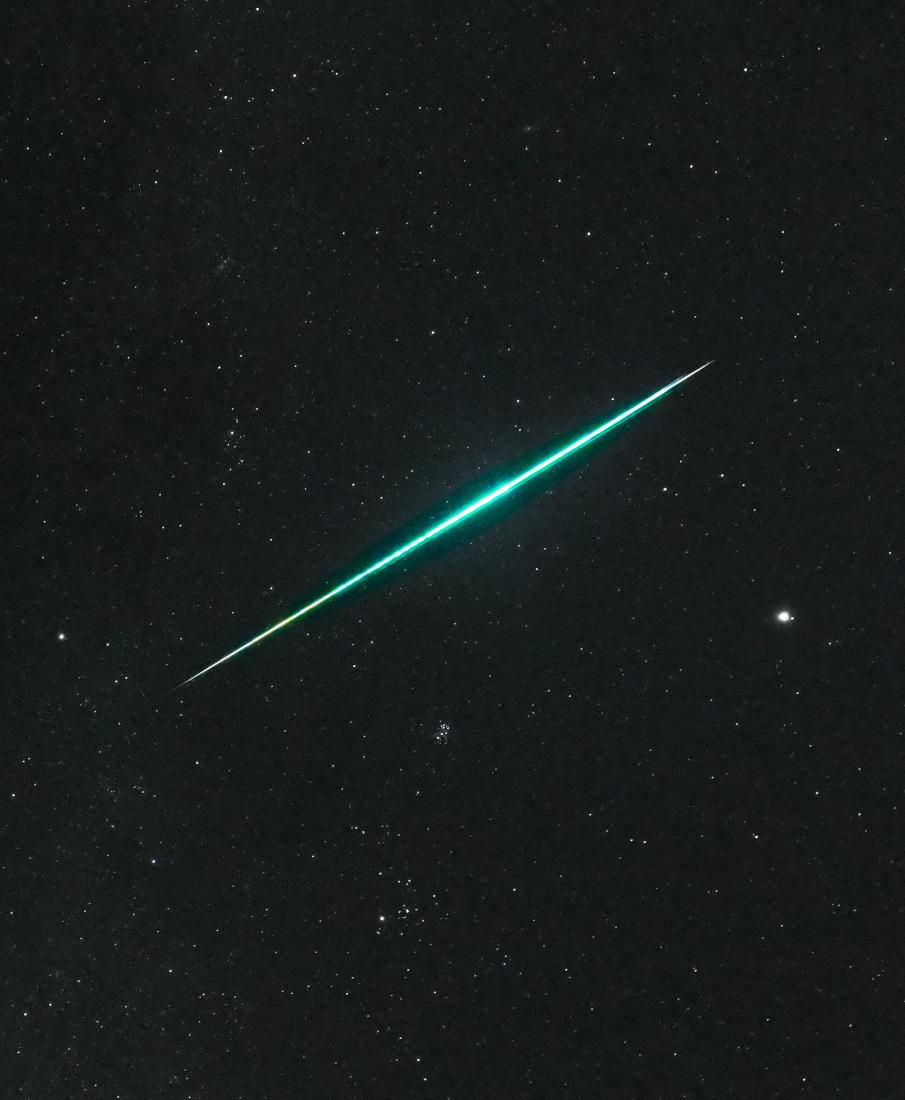
Jupiter and the Geminid


For a brief moment, this brilliant fireball meteor outshone Jupiter in planet Earth’s night. The serendipitous image was captured while hunting meteors under cold Canadian skies with a camera in timelapse mode on December 14, near the peak of the Geminid meteor shower. The Geminid meteor shower, asteroid 3200 Phaethon’s annual gift, always arrives in December. Dust shed along the orbit of the mysterious asteroid causes the meteor streaks, as the vaporizing grains plow through our fair planet’s upper atmosphere at 22 kilometers per second. Of course Geminid shower meteors appear to radiate from a point in the constellation of the Twins. That’s below and left of this frame. With bright Jupiter on the right, also in the December night skyview are the Pleiades and Hyades star clusters.

from NASA https://ift.tt/FCT9wom
via IFTTT