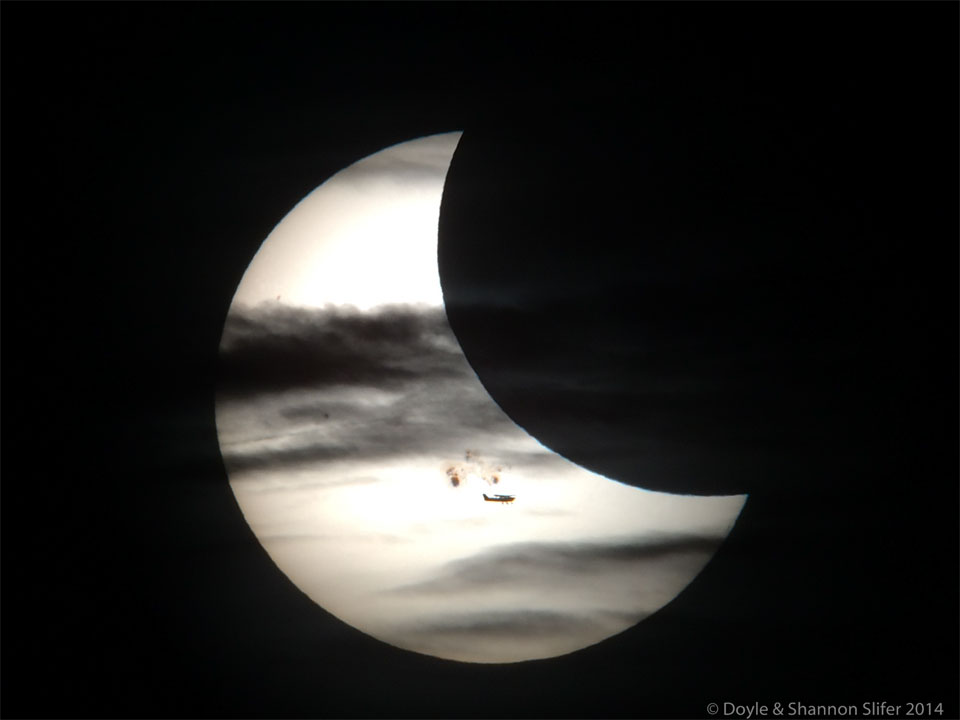
What’s that in front of the Sun? The closest object is an airplane, visible just below the Sun’s center and caught purely by chance. Next out are numerous clouds in Earth’s atmosphere, creating a series of darkened horizontal streaks. Farther out is Earth’s Moon, seen as the large dark circular bite on the upper right. Just above the airplane and just below the Sun’s surface are sunspots. The main sunspot group captured here, AR 2192, was in 2014 one of the largest ever recorded and had been crackling and bursting with flares since it came around the edge of the Sun a week before. This show of solar silhouettes was unfortunately short-lived. Within a few seconds the plane flew away. Within a few minutes the clouds drifted off. Within a few hours the partial solar eclipse of the Sun by the Moon was over. Fortunately, when it comes to the Sun, even unexpected alignments are surprisingly frequent. Perhaps one will be imaged this Saturday when a new partial solar eclipse will be visible from much of North and South America.

from NASA https://ift.tt/UPxTrpl
via IFTTT
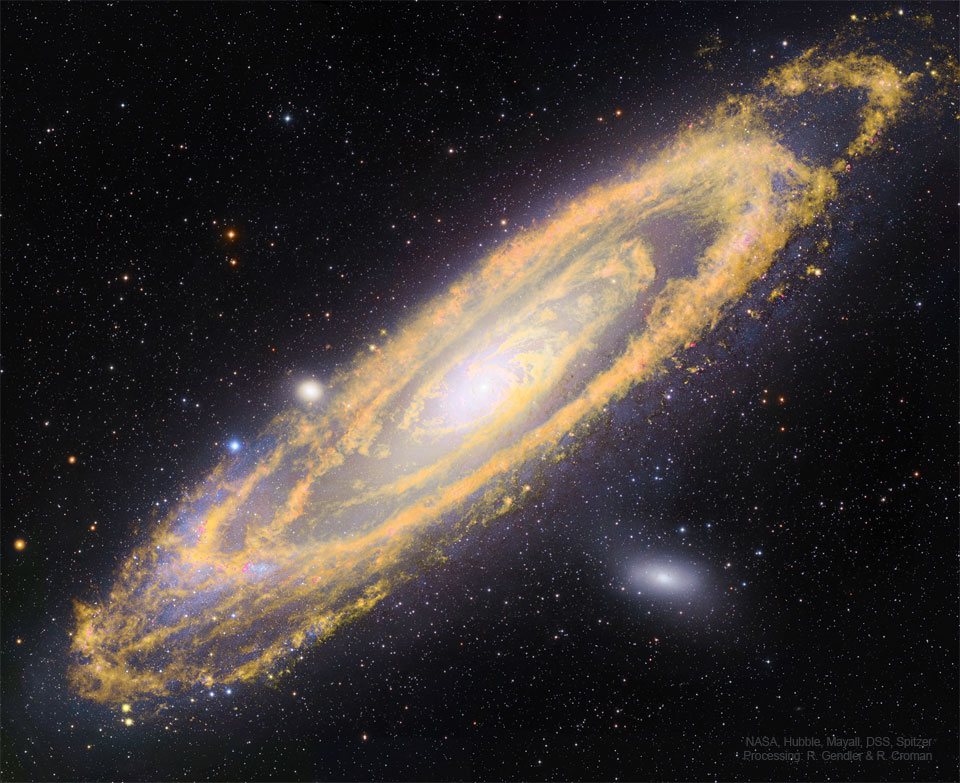
The Once and Future Stars of Andromeda


This picture of Andromeda shows not only where stars are now, but where stars will be. The big, beautiful Andromeda Galaxy, M31, is a spiral galaxy a mere 2.5 million light-years away. Image data from space-based and ground-based observatories have been combined here to produce this intriguing composite view of Andromeda at wavelengths both inside and outside normally visible light. The visible light shows where M31’s stars are now, highlighted in white and blue hues and imaged by the Hubble, Subaru, and Mayall telescopes. The infrared light shows where M31’s future stars will soon form, highlighted in orange hues and imaged by NASA’s Spitzer Space Telescope. The infrared light tracks enormous lanes of dust, warmed by stars, sweeping along Andromeda’s spiral arms. This dust is a tracer of the galaxy’s vast interstellar gas, raw material for future star formation. Of course, the new stars will likely form over the next hundred million years or so. That’s well before Andromeda merges with our Milky Way Galaxy in about 5 billion years.

from NASA https://ift.tt/vV2h6MR
via IFTTT

Edwin Hubble Discovers the Universe


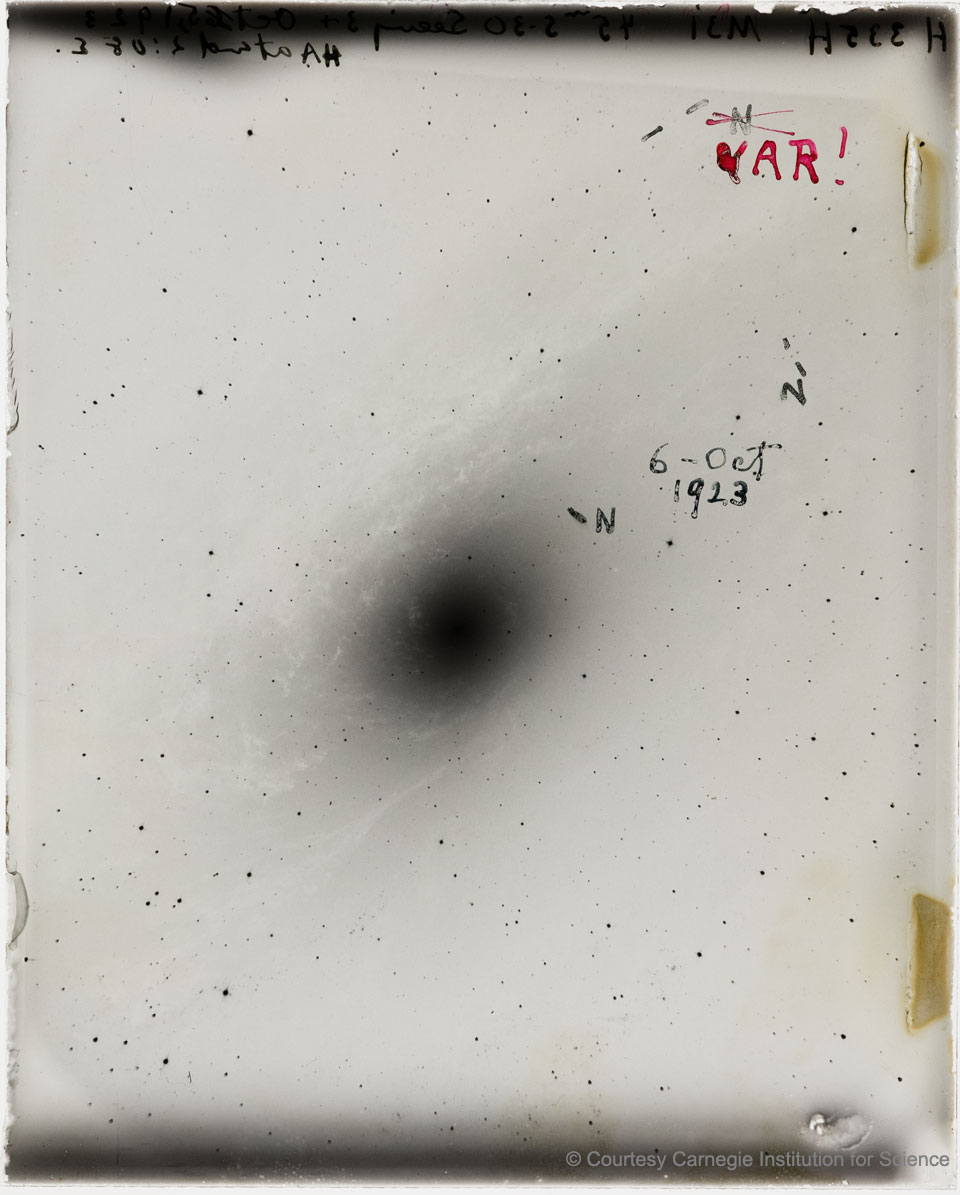
How big is our universe? This question, among others, was debated by two leading astronomers in 1920 in what has since become known as astronomy’s Great Debate. Many astronomers then believed that our Milky Way Galaxy was the entire universe. Many others, though, believed that our galaxy was just one of many. In the Great Debate, each argument was detailed, but no consensus was reached. The answer came over three years later with the detected variation of single spot in the Andromeda Nebula, as shown on the original glass discovery plate digitally reproduced here. When Edwin Hubble compared images, he noticed that this spot varied, and on October 6, 1923 wrote “VAR!” on the plate. The best explanation, Hubble knew, was that this spot was the image of a variable star that was very far away. So M31 was really the Andromeda Galaxy — a galaxy possibly similar to our own. Annotated 100 years ago, the featured image may not be pretty, but the variable spot on it opened a window through which humanity gazed knowingly, for the first time, into a surprisingly vast cosmos.

from NASA https://ift.tt/rw4b5ZW
via IFTTT

Ring of Fire over Monument Valley


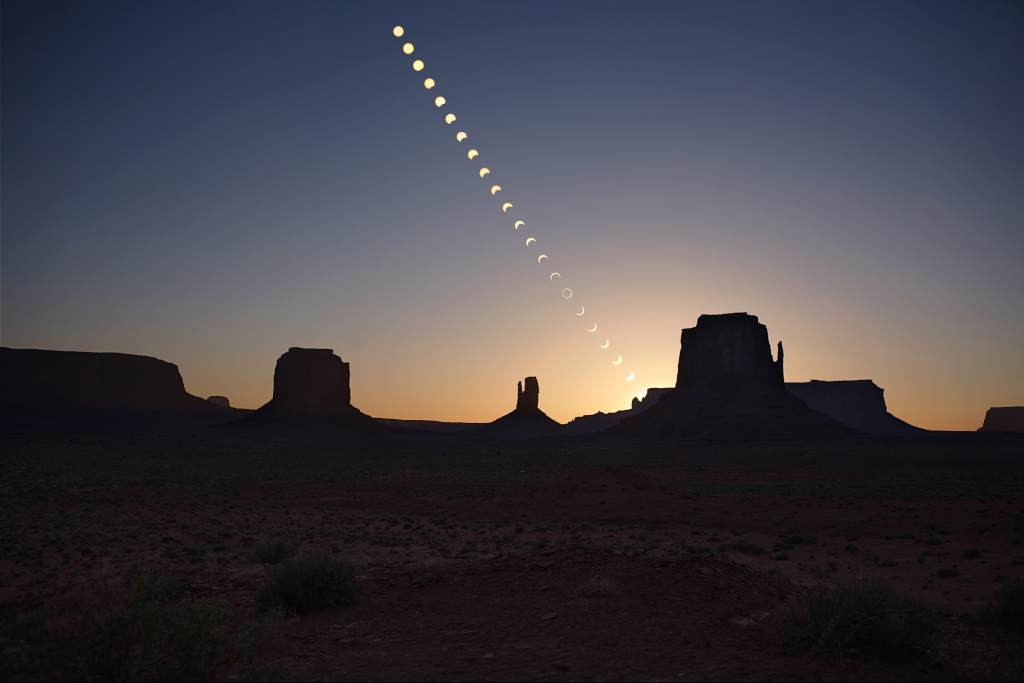
Tracking along a narrow path, the shadow of a new moon will race across North, Central, and South America, on October 14. When viewed from the shadow path the apparent size of the lunar disk will not quite completely cover the Sun though. Instead, the moon in silhouette will appear during the minutes of totality surrounded by a fiery ring, an annular solar eclipse more dramatically known as a ring of fire eclipse. This striking time lapse sequence from May of 2012 illustrates the stages of a ring of fire eclipse. From before eclipse start until sunset, they are seen over the iconic buttes of planet Earth’s Monument Valley. Remarkably, the October 14 ring of fire eclipse will also be visible over Monument Valley, beginning after sunrise in the eastern sky.

from NASA https://ift.tt/YCoWUdA
via IFTTT


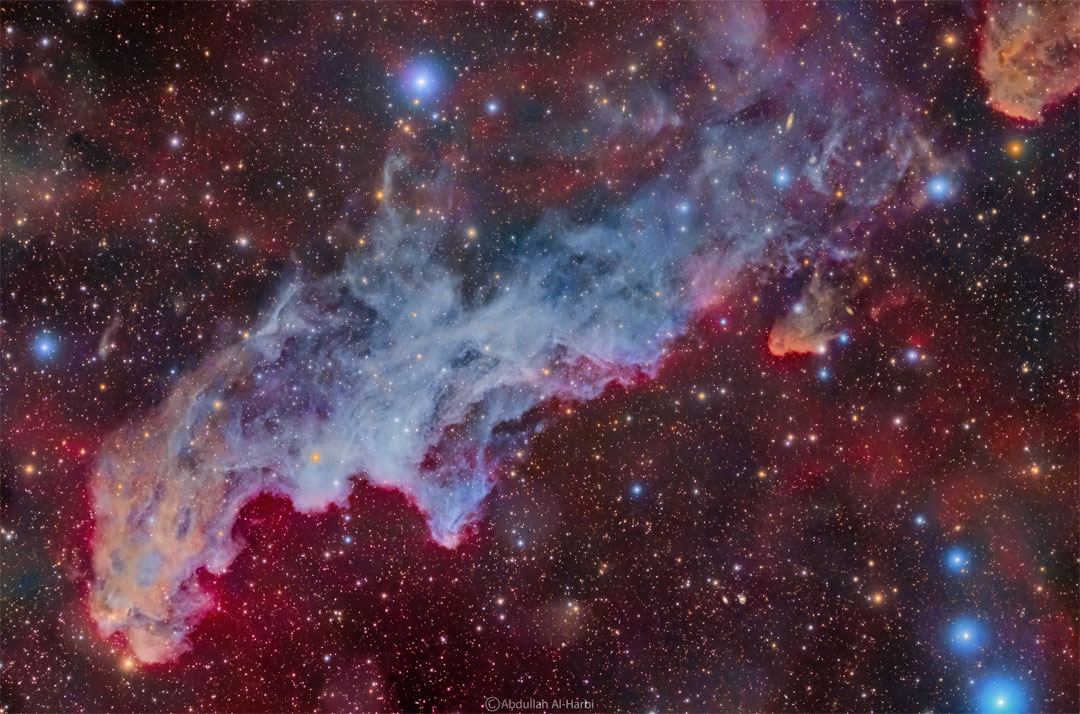
Does this nebula look like the head of a witch? The nebula is known popularly as the Witch Head Nebula because, it is said, the nebula’s shape resembles a Halloween-style caricature of a witch’s head. Exactly how, though, can be a topic of imaginative speculation. What is clear is that IC 2118 is about 50 light-years across and made of gas and dust that points to — because it has been partly eroded by — the nearby star Rigel. One of the brighter stars in the constellation Orion, Rigel lies below the bottom of the featured image. The blue color of the Witch Head Nebula and is caused not only by Rigel’s intense blue starlight but because the dust grains scatter blue light more efficiently than red. The same physical process causes Earth’s daytime sky to appear blue, although the scatterers in planet Earth’s atmosphere are molecules of nitrogen and oxygen.

from NASA https://ift.tt/GankA1f
via IFTTT


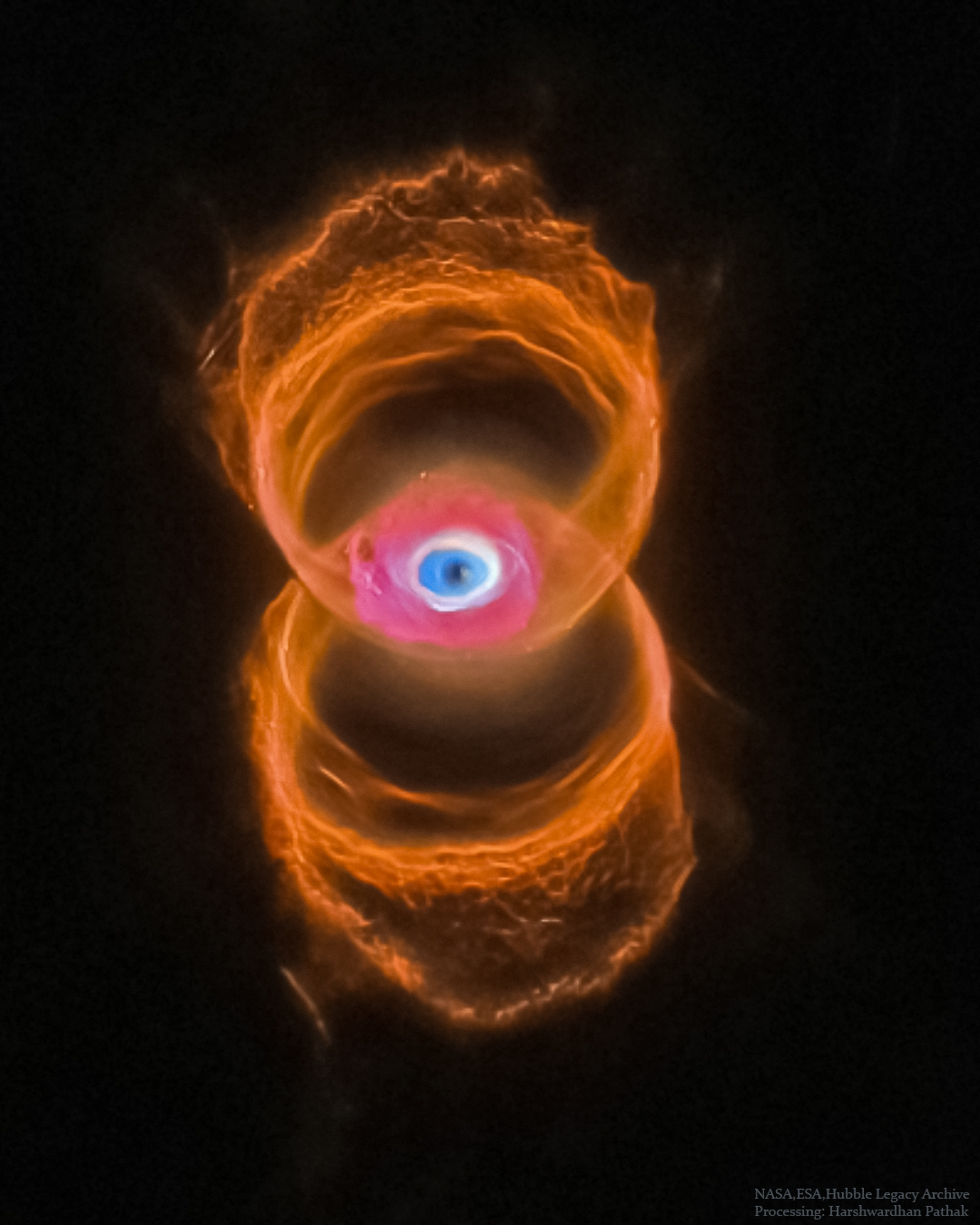
Do you see the hourglass shape — or does it see you? If you can picture it, the rings of MyCn 18 trace the outline of an hourglass — although one with an unusual eye in its center. Either way, the sands of time are running out for the central star of this hourglass-shaped planetary nebula. With its nuclear fuel exhausted, this brief, spectacular, closing phase of a Sun-like star’s life occurs as its outer layers are ejected – its core becoming a cooling, fading white dwarf. In 1995, astronomers used the Hubble Space Telescope (HST) to make a series of images of planetary nebulae, including the one featured here. Pictured, delicate rings of colorful glowing gas (nitrogen-red, hydrogen-green, and oxygen-blue) outline the tenuous walls of the hourglass. The unprecedented sharpness of the Hubble images has revealed surprising details of the nebula ejection process that are helping to resolve the outstanding mysteries of the complex shapes and symmetries of planetary nebulas like MyCn 18.

from NASA https://ift.tt/ePAHtv1
via IFTTT


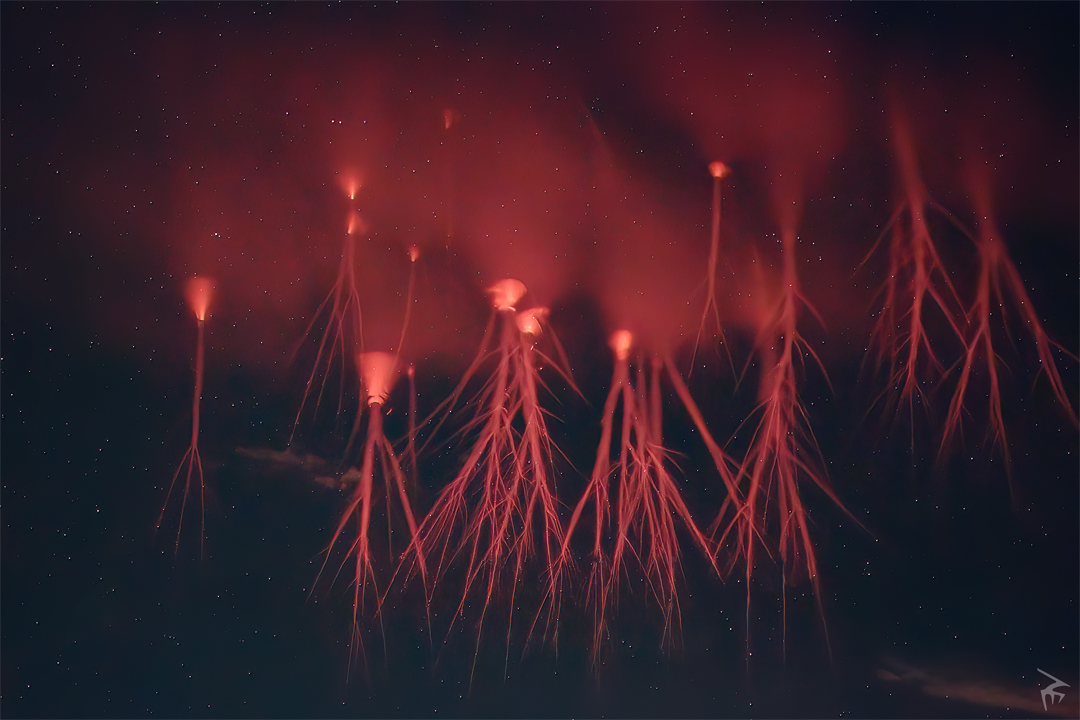
Sometimes lightning occurs out near space. One such lightning type is red sprite lightning, which has only been photographed and studied on Earth over the past 25 years. The origins of all types of lightning remain topics for research, and scientists are still trying to figure out why red sprite lightning occurs at all. Research has shown that following a powerful positive cloud-to-ground lightning strike, red sprites may start as 100-meter balls of ionized air that shoot down from about 80-km high at 10 percent the speed of light. They are quickly followed by a group of upward streaking ionized balls. Featured here is an extraordinarily high-resolution image of a group of red sprites. This image is a single frame lasting only 1/25th of a second from a video taken above Castelnaud Castle in Dordogne, France, about three weeks ago. The sprites quickly vanished — no sprites were visible even on the very next video frame.

from NASA https://ift.tt/3GhAkyc
via IFTTT


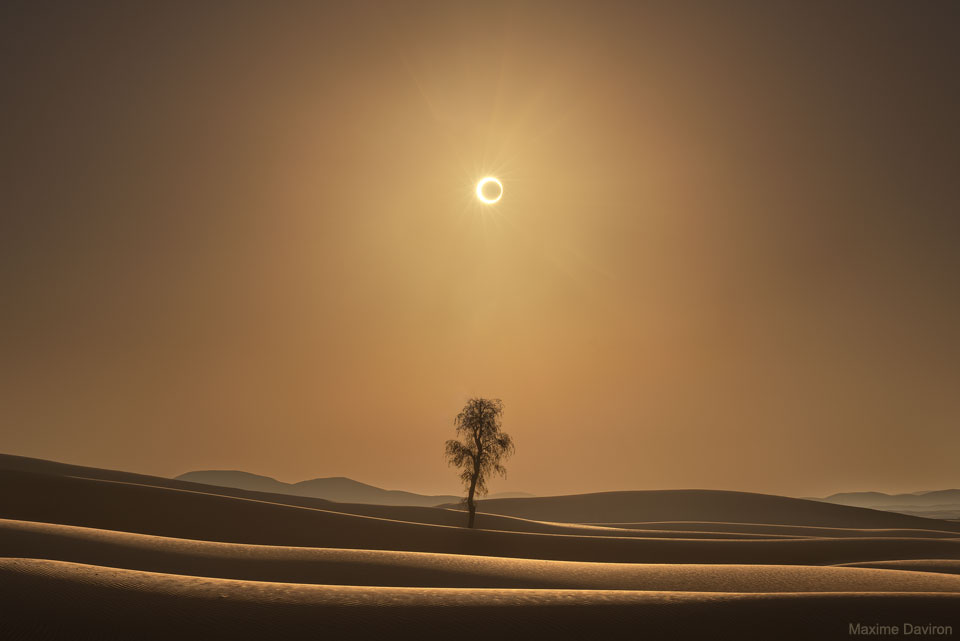
A good place to see a ring-of-fire eclipse, it seemed, would be from a desert. In a desert, there should be relatively few obscuring clouds and trees. Therefore late December of 2019, a group of photographers traveled to the United Arab Emirates and Rub al-Khali, the largest continuous sand desert in world, to capture clear images of an unusual eclipse that would be passing over. A ring-of-fire eclipse is an annular eclipse that occurs when the Moon is far enough away on its elliptical orbit around the Earth so that it appears too small, angularly, to cover the entire Sun. At the maximum of an annular eclipse, the edges of the Sun can be seen all around the edges of the Moon, so that the Moon appears to be a dark spot that covers most — but not all — of the Sun. This particular eclipse, they knew, would peak soon after sunrise. After seeking out such a dry and barren place, it turned out that some of the most interesting eclipse images actually included a tree in the foreground, because, in addition to the sand dunes, the tree gave the surreal background a contrasting sense of normalcy, scale, and texture. On Saturday, October 14, a new ring of fire will be visible through clear skies from a thin swath crossing both North and South America.

from NASA https://ift.tt/7fknzhX
via IFTTT

A Harvest Moon over Tuscany


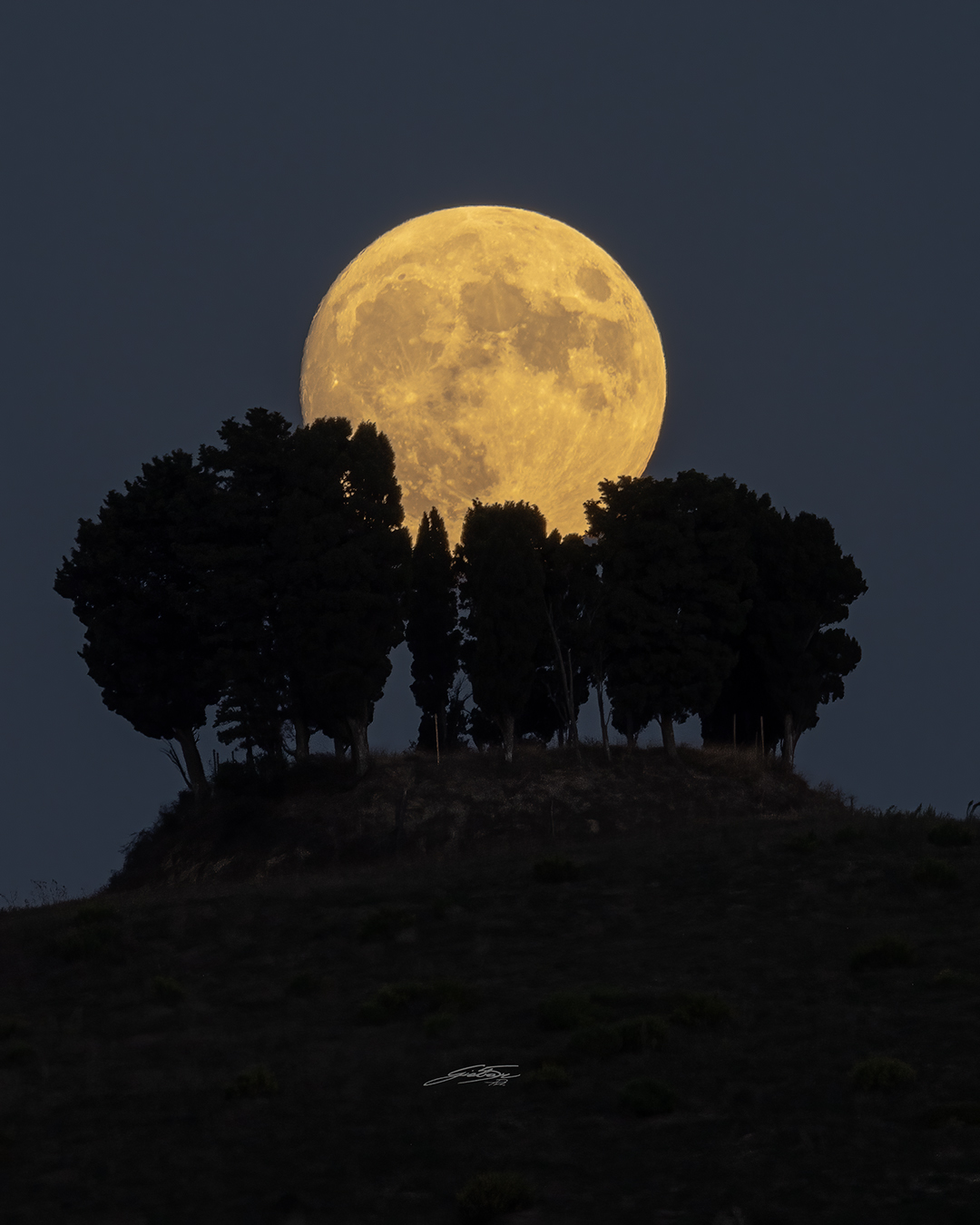
For northern hemisphere dwellers, September’s Full Moon was the Harvest Moon. Reflecting warm hues at sunset, it rises behind cypress trees huddled on a hill top in Tuscany, Italy in this telephoto view from September 28. Famed in festival, story, and song, Harvest Moon is just the traditional name of the full moon nearest the autumnal equinox. According to lore the name is a fitting one. Despite the diminishing daylight hours as the growing season drew to a close, farmers could harvest crops by the light of a full moon shining on from dusk to dawn. This Harvest Moon was also known to some as a supermoon, a term becoming a traditional name for a full moon near perigee. It was the fourth and final supermoon for 2023.

from NASA https://ift.tt/3PK6rNc
via IFTTT

Back from Bennu


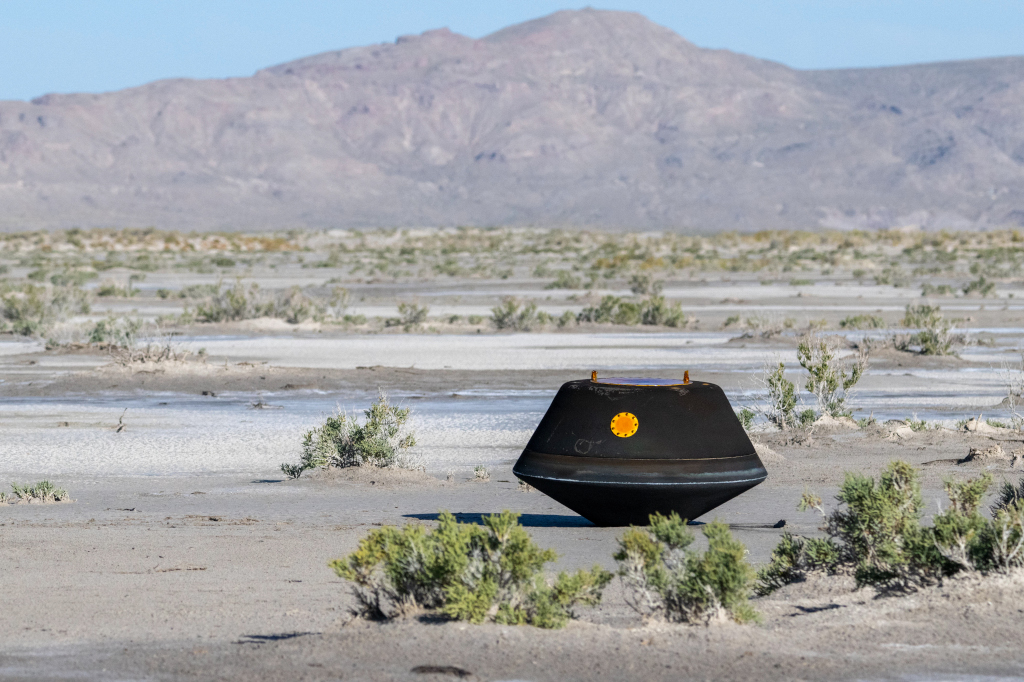
Back from asteroid 101955 Bennu, a 110-pound, 31-inch wide sample return capsule rests in a desert on planet Earth in this photo, taken at the Department of Defense Utah Test and Training Range near Salt Lake City last Sunday, September 24. Dropped off by the OSIRIS-Rex spacecraft, the capsule looks charred from the extreme temperatures experienced during its blistering descent through Earth’s dense atmosphere. OSIRIS-Rex began its home-ward journey from Bennu in May of 2021. Delivered to NASA’s Johnson Space Center in Houston on September 25, the capsule’s canister is expected to contain an uncontaminated sample of about a half pound (250 grams) of Bennu’s loosely packed regolith. Working in a new laboratory designed for the OSIRIS-REx mission, scientists and engineers will complete the canister disassembly process, and plan to unveil the sample of the near-Earth asteroid in a broadcast event on October 11.

from NASA https://ift.tt/r6SuTNz
via IFTTT