Solar System Ball Drop


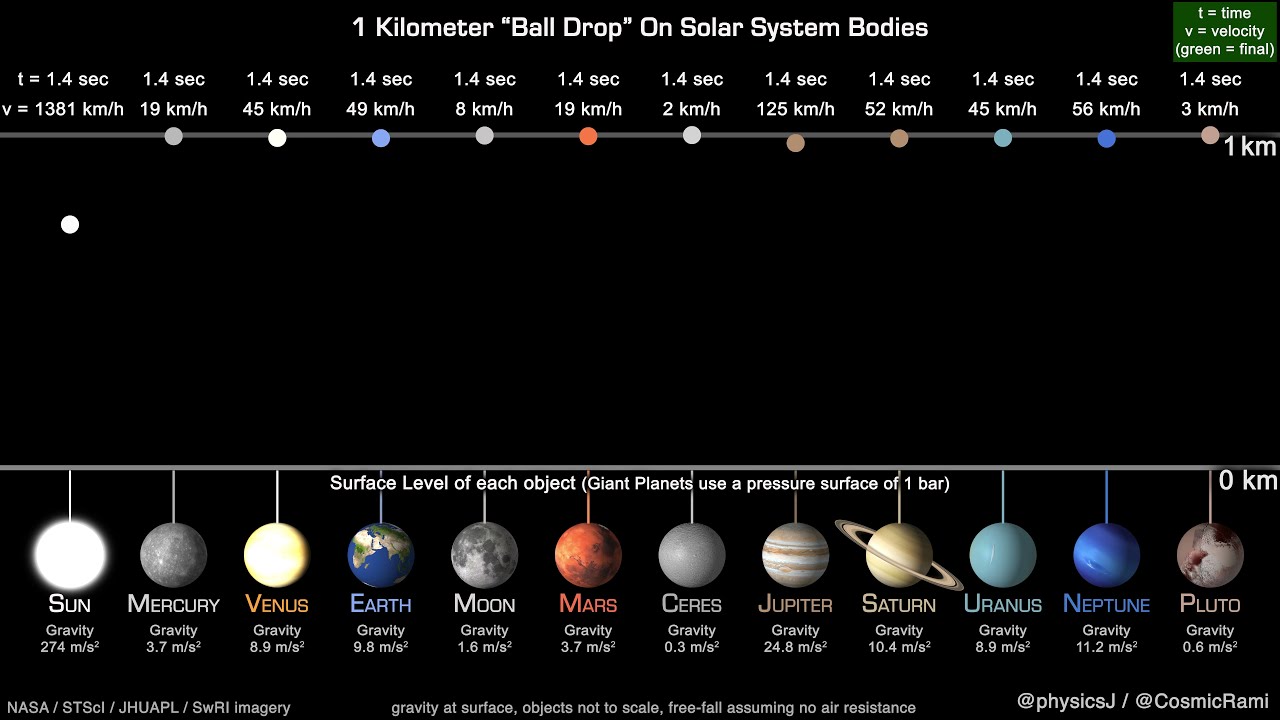
Does a ball drop faster on Earth, Jupiter, or Uranus? The featured animation shows a ball dropping from one kilometer high toward the surfaces of famous solar system bodies, assuming no air resistance. The force of gravity depends on the mass of the attracting object, with higher masses pulling down with greater forces. But gravitational force also depends on distance from the center of gravity, with shorter distances causing the ball to drop faster. Combining both mass and distance, it might be surprising to see that Uranus pulls the ball down slightly slower than Earth, despite containing over 14 times more mass. This happens because Uranus has a much lower density, which puts its cloud tops further away from its center of mass. Although the falling ball always speeds up, if you were on the ball you would not feel this acceleration because you would be in free-fall. Of the three planets mentioned, the video demonstrates a ball drops even faster on Jupiter than either Earth and Uranus.

from NASA https://ift.tt/2XLA42C
via IFTTT
PDS 70: Disk, Planets, and Moons


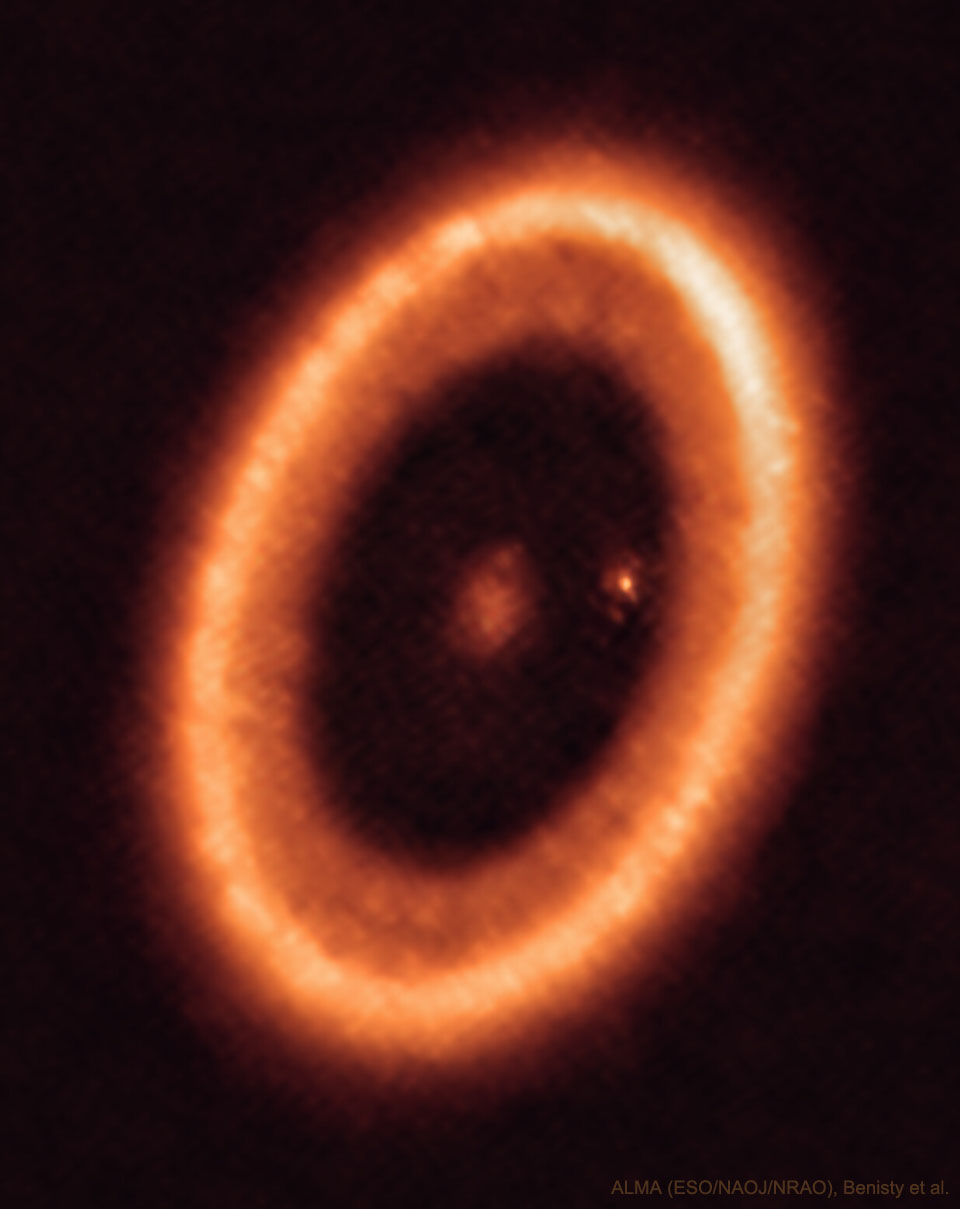
It’s not the big disk that’s attracting the most attention. Although the big planet-forming disk around the star PDS 70 is clearly imaged and itself quite interesting. It’s also not the planet on the right, just inside the big disk, that��������s being talked about the most. Although the planet PDS 70c is a newly formed and, interestingly, similar in size and mass to Jupiter. It’s the fuzzy patch around the planet PDS 70c that’s causing the commotion. That fuzzy patch is thought to be itself a dusty disk that is now forming into moons — and that has never been seen before. The featured image was taken by the Atacama Large Millimeter Array (ALMA) of 66 radio telescopes in the high Atacama Desert of northern Chile. Based on ALMA data, astronomers infer that the moon-forming exoplanetary disk has a radius similar to our Earth’s orbit, and may one day form three or so Luna-sized moons — not very different from our Jupiter‘s four.

from NASA https://ift.tt/3yiEY40
via IFTTT

Abell 3827: Cannibal Cluster Gravitational Lens


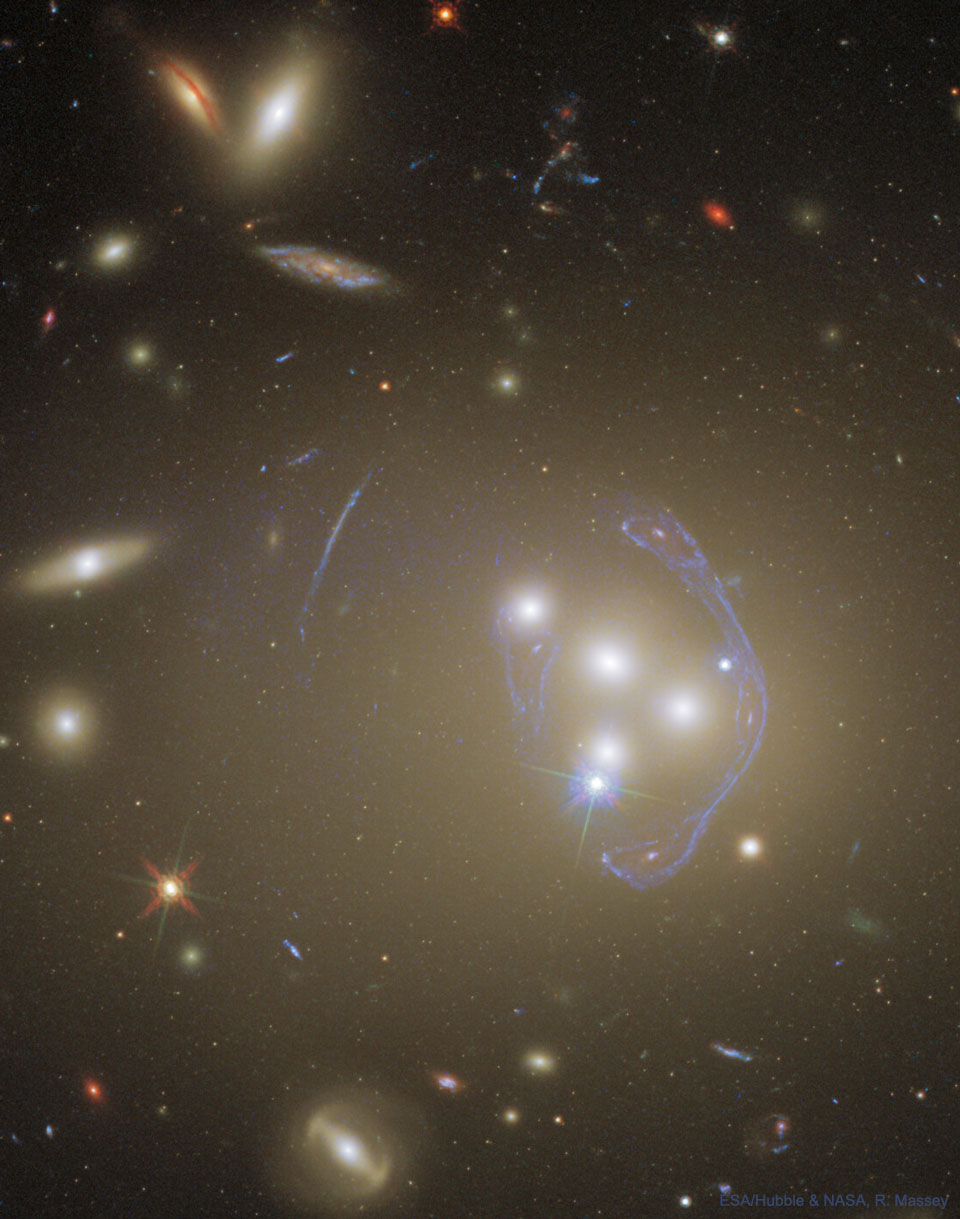
Is that one galaxy or three? Toward the right of the featured Hubble image of the massive galaxy cluster Abell 3827 is what appears to be a most unusual galaxy — curved and with three centers. A detailed analysis, however, finds that these are three images of the same background galaxy — and that there are at least four more images. Light we see from the single background blue galaxy takes multiple paths through the complex gravity of the cluster, just like a single distant light can take multiple paths through the stem of a wine glass. Studying how clusters like Abell 3827 and their component galaxies deflect distant light gives information about how mass and dark matter are distributed. Abell 3827 is so distant, having a redshift of 0.1, that the light we see from it left about 1.3 billion years ago — before dinosaurs roamed the Earth. Therefore, the cluster’s central galaxies have now surely all coalesced — in a feast of galactic cannibalism — into one huge galaxy near the cluster’s center.

from NASA https://ift.tt/3mpzq5m
via IFTTT

Explosions from White Dwarf Star RS Oph


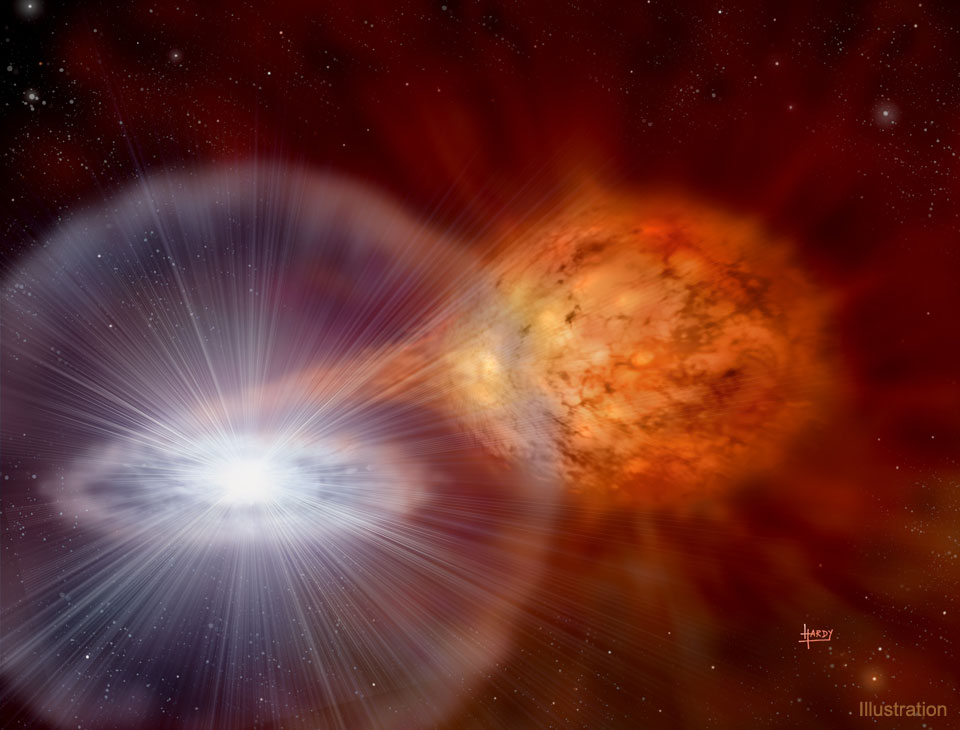
Spectacular explosions keep occurring in the binary star system named RS Ophiuchi. Every 20 years or so, the red giant star dumps enough hydrogen gas onto its companion white dwarf star to set off a brilliant thermonuclear explosion on the white dwarf‘s surface. At about 5,000 light years distant, the resulting nova explosions cause the RS Oph system to brighten up by a huge factor and become visible to the unaided eye. The red giant star is depicted on the right of the above drawing, while the white dwarf is at the center of the bright accretion disk on the left. As the stars orbit each other, a stream of gas moves from the giant star to the white dwarf. Astronomers speculate that at some time in the next 100,000 years, enough matter will have accumulated on the white dwarf to push it over the Chandrasekhar Limit, causing a much more powerful and final explosion known as a supernova. Starting early this month, RS Oph was again seen exploding in a bright nova.

from NASA https://ift.tt/3zdbeGQ
via IFTTT

Triple Transit and Mutual Events


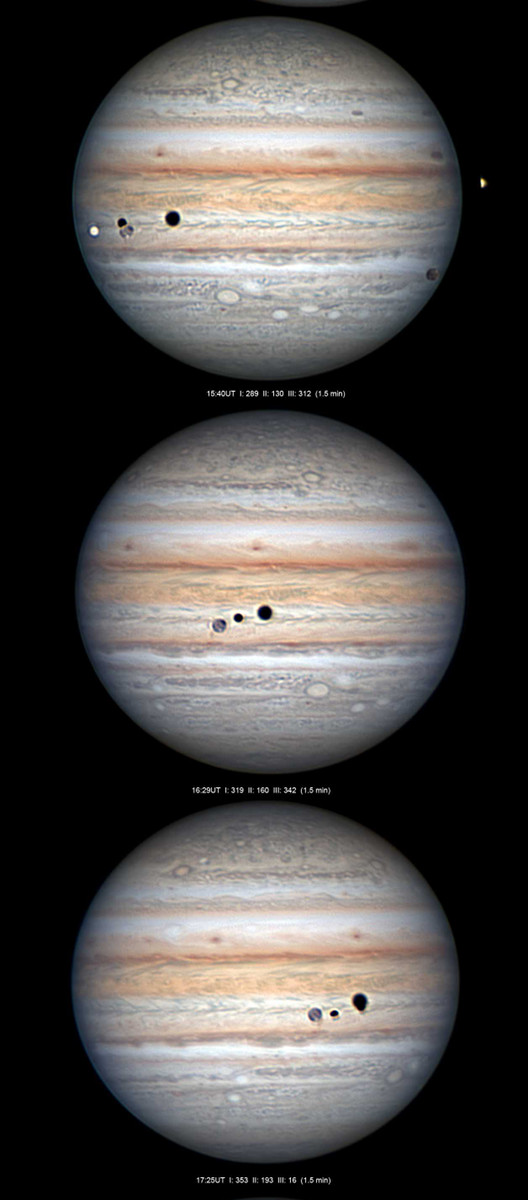
These three panels feature the Solar System’s ruling gas giant Jupiter on August 15 as seen from Cebu City, Phillipines, planet Earth. On that date the well-timed telescopic views detail some remarkable performances, transits and mutual events, by Jupiter’s Galilean moons. In the top panel, Io is just disappearing into Jupiter’s shadow at the far right, but the three other large Jovian moons appear against the planet’s banded disk. Brighter Europa and darker Ganymede are at the far left, also casting their two shadows on the gas giant’s cloud tops. Callisto is below and right near the planet’s edge, the three moons in a triple transit across the face of Jupiter. Moving to the middle panel, shadows of Europa and Ganymede are still visible near center but Ganymede has occulted or passed in front of Europa. The bottom panel captures a rare view of Jovian moons in eclipse while transiting Jupiter, Ganymede’s shadow falling on Europa itself. From planet Earth’s perspective, similar mutual events, when Galilean moons occult and eclipse each other, can be seen every six years or so when Jupiter is near its own equinox.

from NASA https://ift.tt/2W4Z191
via IFTTT

Three Perseid Nights


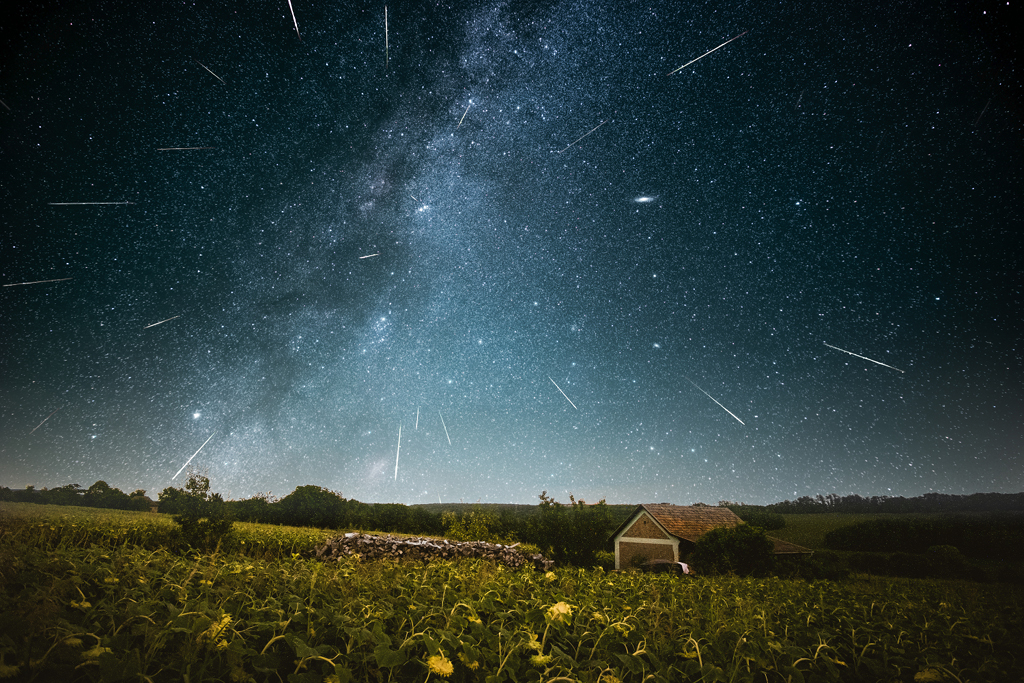
Frames from a camera that spent three moonless nights under the stars create this composite night skyscape. They were recorded during August 11-13 while planet Earth was sweeping through the dusty trail of comet Swift-Tuttle. One long exposure, untracked for the foreground, and the many star tracking captures of Perseid shower meteors were taken from the village of Magyaregres, Hungary. Each aligned against the background stars, the meteor trails all point back to the annual shower’s radiant in the constellation Perseus heroically standing above this rural horizon. Of course the comet dust particles are traveling along trajectories parallel to each other. The radiant effect is due only to perspective, as the parallel tracks appear to converge in the distance against the starry sky.

from NASA https://ift.tt/3j1bGlS
via IFTTT

Bright Meteor, Starry Sky


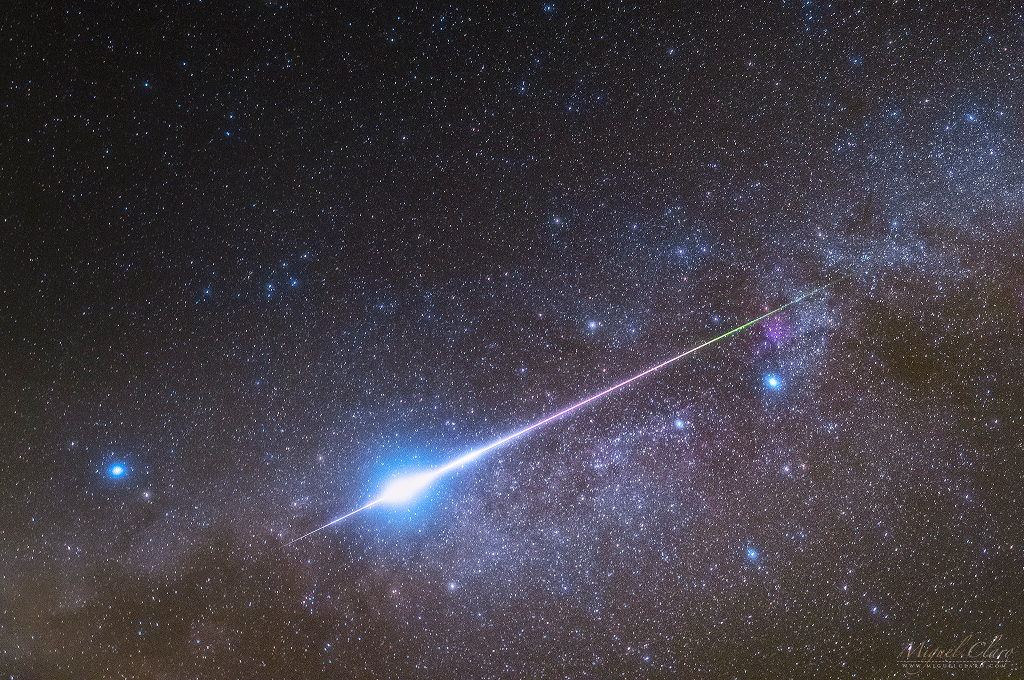
Plowing through Earth’s atmosphere at 60 kilometers per second, this bright perseid meteor streaks along a starry Milky Way. Captured in dark Portugal skies on August 12, it moves right to left through the frame. Its colorful trail starts near Deneb (alpha Cygni) and ends near Altair (alpha Aquilae), stars of the northern summer triangle. In fact this perseid meteor very briefly outshines both, two of the brightest stars in planet Earth’s night. The trail’s initial greenish glow is typical of the bright perseid shower meteors. The grains of cosmic sand, swept up dust from periodic comet Swift-Tuttle, are moving fast enough to excite the characteristic green emission of atomic oxygen at altitudes of 100 kilometers or so before vaporizing in an incandescent flash.

from NASA https://ift.tt/3xXVXbt
via IFTTT

Rings Around the Ring Nebula


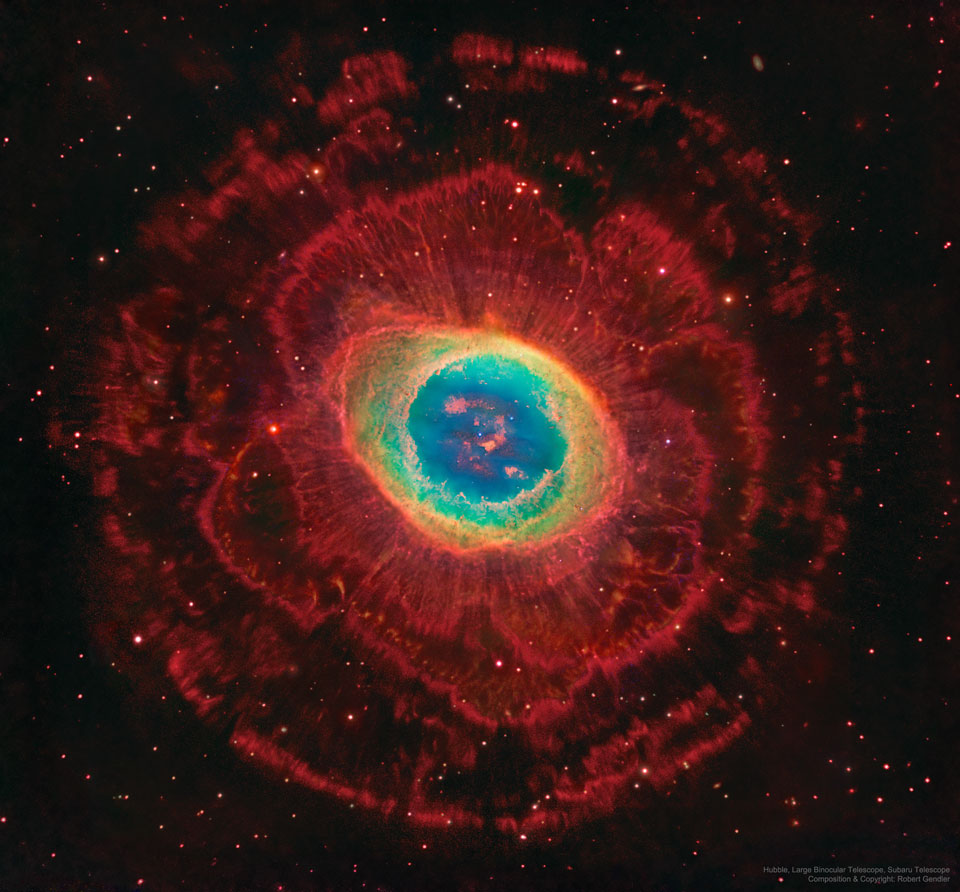
The Ring Nebula (M57), is more complicated than it appears through a small telescope. The easily visible central ring is about one light-year across, but this remarkably deep exposure – a collaborative effort combining data from three different large telescopes – explores the looping filaments of glowing gas extending much farther from the nebula‘s central star. This composite image includes red light emitted by hydrogen as well as visible and infrared light. The Ring Nebula is an elongated planetary nebula, a type of nebula created when a Sun-like star evolves to throw off its outer atmosphere to become a white dwarf star. The Ring Nebula is about 2,500 light-years away toward the musical constellation Lyra.

from NASA https://ift.tt/3CYt9U7
via IFTTT

M57: The Ring Nebula from Hubble


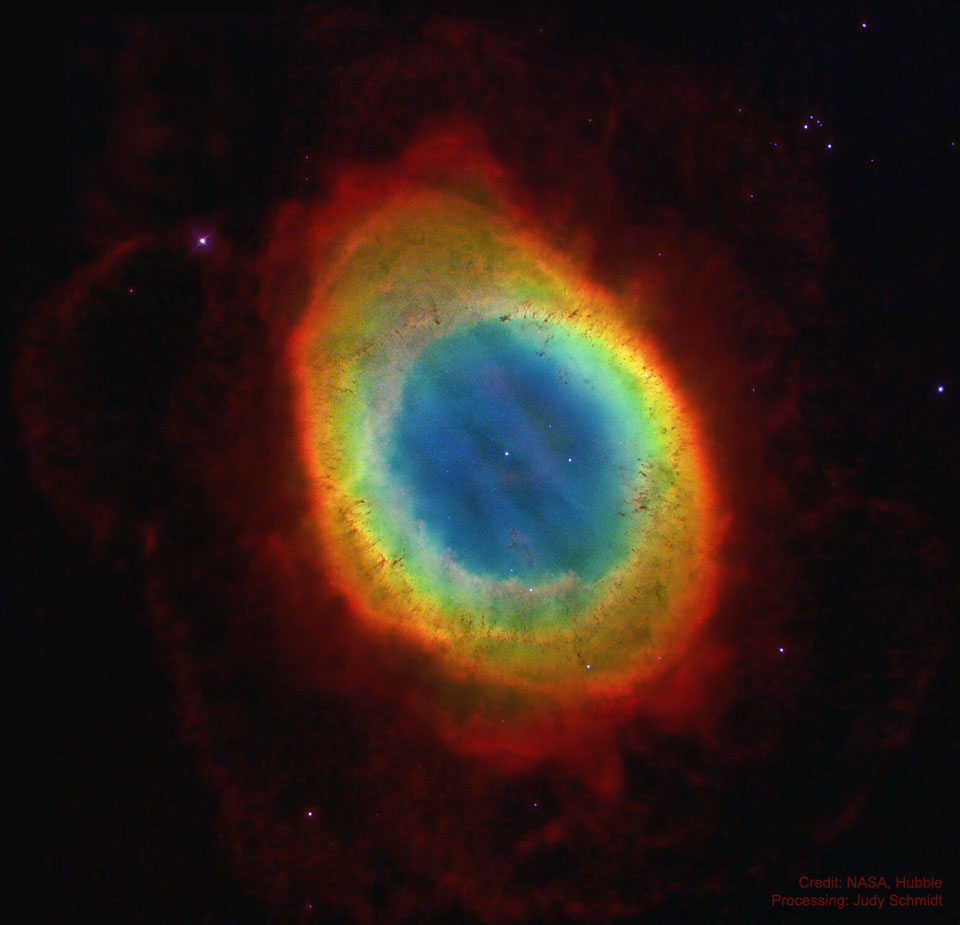
Except for the rings of Saturn, the Ring Nebula (M57) is probably the most famous celestial circle. Its classic appearance is understood to be due to our own perspective, though. The recent mapping of the expanding nebula’s 3-D structure, based in part on this clear Hubble image,indicates that the nebula is a relatively dense, donut-like ring wrapped around the middle of a (American) football-shaped cloud of glowing gas. The view from planet Earth looks down the long axis of the football, face-on to the ring. Of course, in this well-studied example of a planetary nebula, the glowing material does not come from planets. Instead, the gaseous shroud represents outer layers expelled from the dying, once sun-like star, now a tiny pinprick of light seen at the nebula’s center. Intense ultraviolet light from the hot central star ionizes atoms in the gas. The Ring Nebula is about one light-year across and 2,500 light-years away.

from NASA https://ift.tt/3z7rMAd
via IFTTT

Perseid Meteor, Red Sprites, and Nova RS Oph


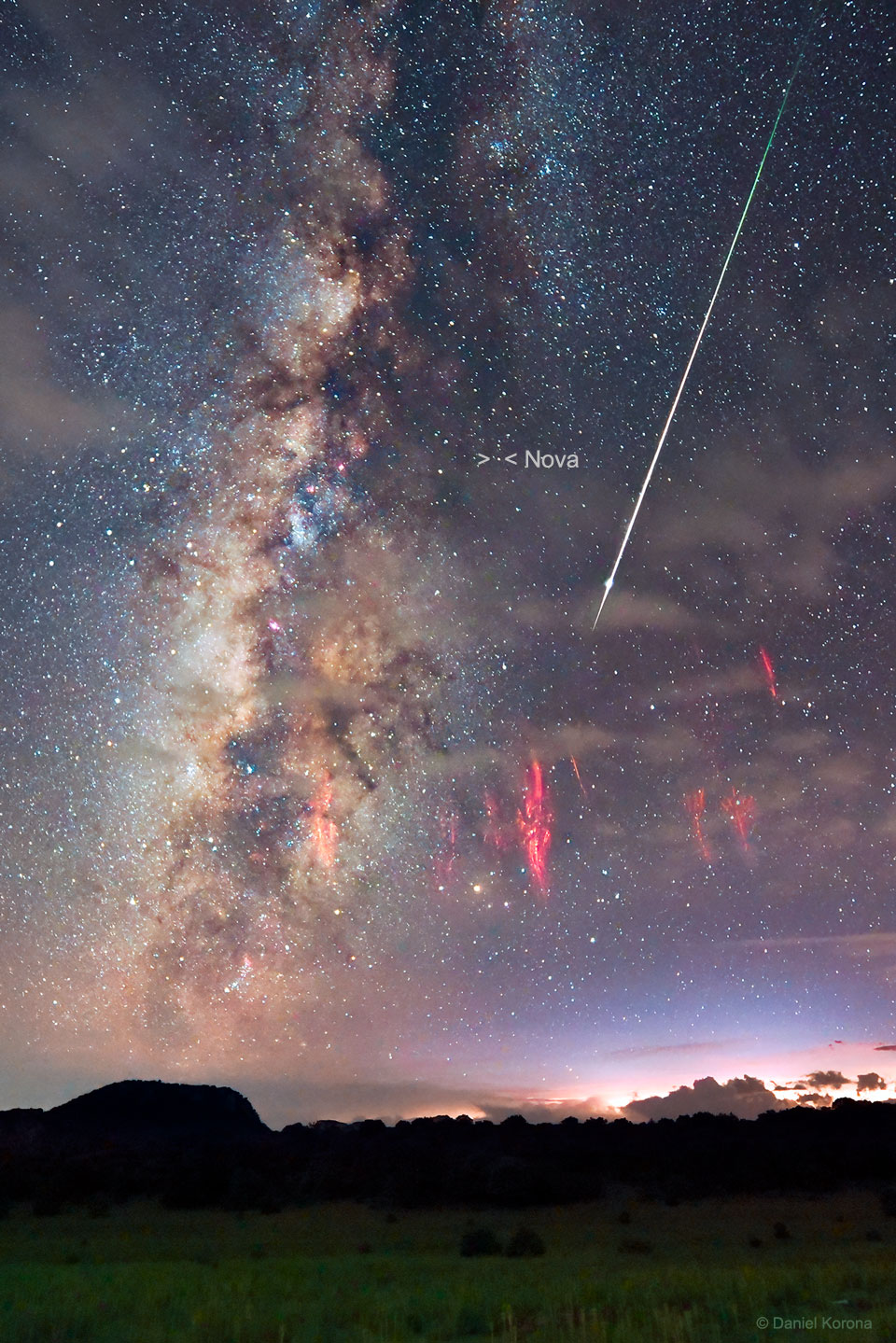
This was an unusual sky. It wasn’t unusual because of the central band the Milky Way Galaxy, visible along the image left. Most dark skies show part of the Milky Way. It wasn’t unusual because of the bright meteor visible on the upper right. Many images taken during last week’s Perseid Meteor Shower show meteors, although this Perseid was particularly bright. This sky wasn’t unusual because of the red sprites, visible on the lower right. Although this type of lightning has only been noted in the past few decades, images of sprites are becoming more common. This sky wasn’t unusual because of the nova, visible just above the image center. Novas bright enough to be seen with the unaided eye occur every few years, with pictured Nova RS Ophiuchus discovered about a week ago. What was most unusual, though, was to capture all these things together, in a single night, on a single sky. The unusual sky occurred above Zacatecas, Mexico.

from NASA https://ift.tt/37I4pRD
via IFTTT