Mars Panorama 360 from Curiosity


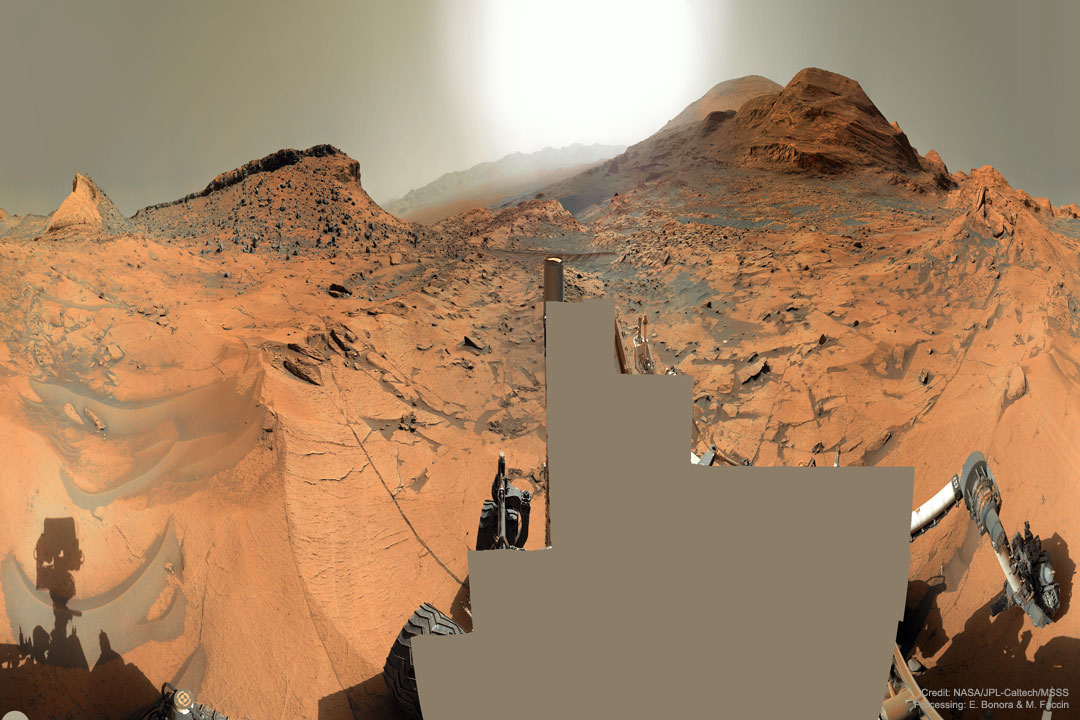
Which way up Mount Sharp? In early September, the robotic rover Curiosity continued its ascent up the central peak of Gale Crater, searching for more clues about ancient water and further evidence that Mars could once have been capable of supporting life. On this recent Martian morning, before exploratory drilling, the rolling rover took this 360-degree panorama, in part to help Curiosity’s human team back on Earth access the landscape and chart possible future routes. In the horizontally-compressed featured image, an amazing vista across Mars was captured, complete with layered hills, red rocky ground, gray drifting sand, and a dusty atmosphere. The hill just left of center has been dubbed Maria Gordon Notch in honor of a famous Scottish geologist. The current plan is to direct Curiosity to approach, study, and pass just to the right of Gordon Notch on its exploratory trek.

from NASA https://ift.tt/3htPpvZ
via IFTTT
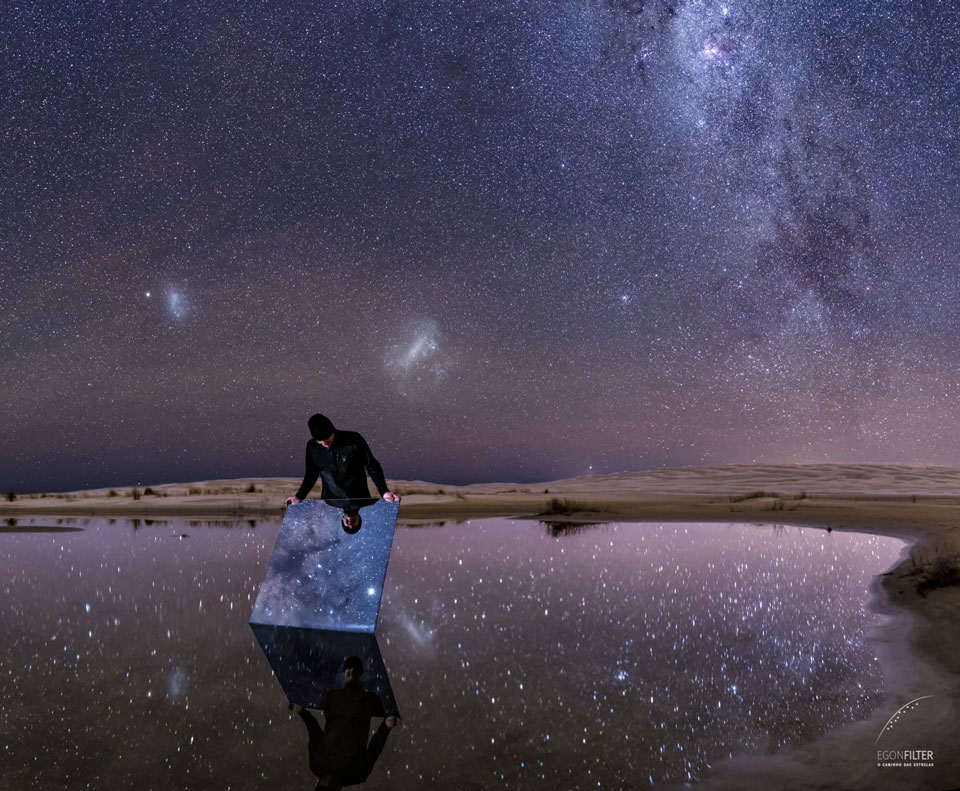
Night Sky Reflected


What’s that in the mirror? In the featured image of the dark southern sky, the three brightest galaxies of the night are all relatively easy to identify. Starting from the left, these are the Small Magellanic Cloud (SMC), the Large Magellanic Cloud (LMC), and part of the central band of our Milky Way Galaxy. All three are also seen reflected in a shallow pool of water. But what is seen in the mirror being positioned by the playful astrophotographer? Dust clouds near the center of our Milky Way — and the planet Jupiter. The composite was carefully planned and composed from images captured from the same camera in the same location and during the same night in mid-2019 in Mostardas, south Brazil. The picture won first place in the Connecting to the Dark division of the International Dark-Sky Association‘s Capture the Dark contest for 2021.

from NASA https://ift.tt/3A7gTPc
via IFTTT

A Spiral Aurora over Iceland


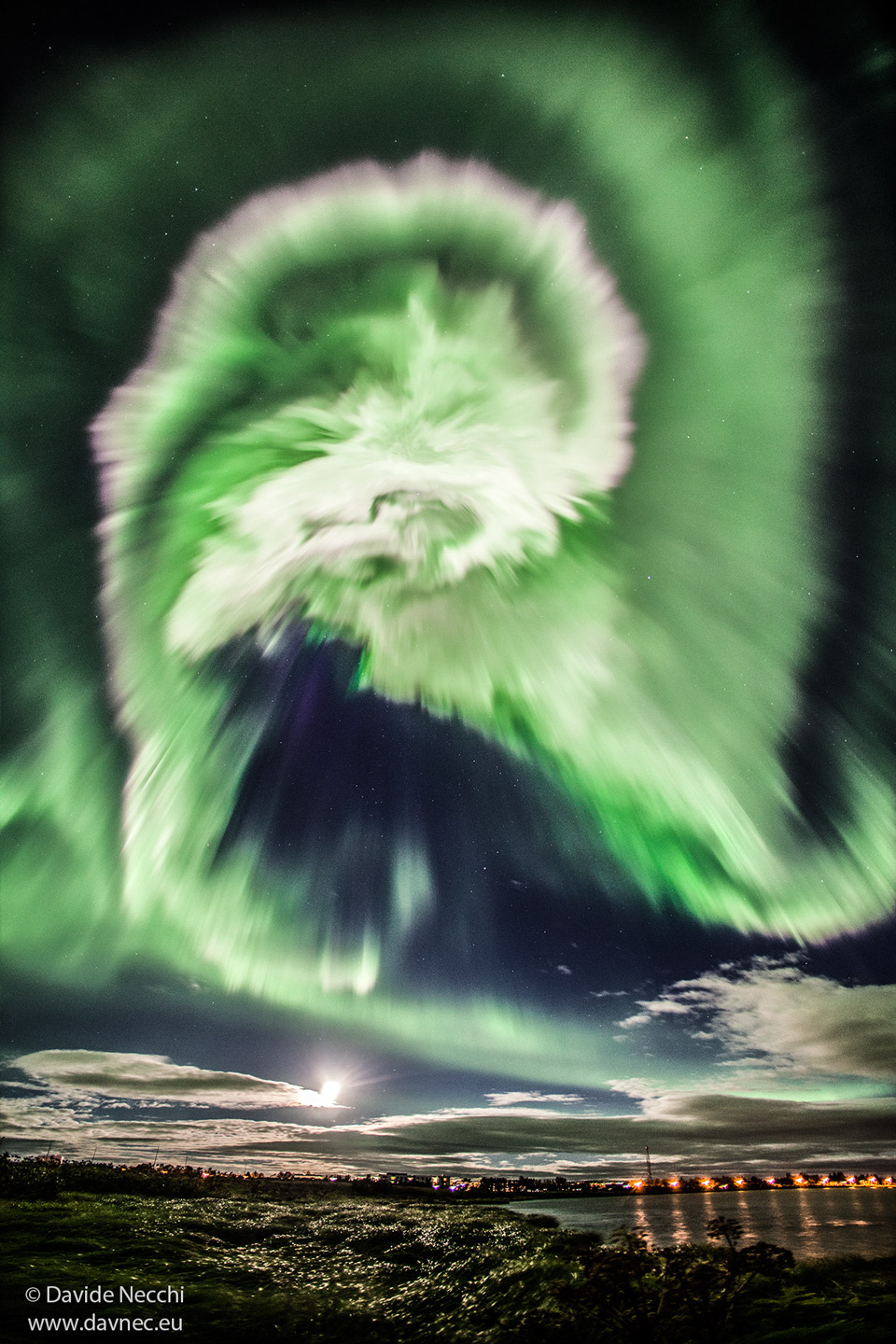
What’s happened to the sky? Aurora! Captured in 2015, this aurora was noted by Icelanders for its great brightness and quick development. The aurora resulted from a solar storm, with high energy particles bursting out from the Sun and through a crack in Earth’s protective magnetosphere a few days later. Although a spiral pattern can be discerned, creative humans might imagine the complex glow as an atmospheric apparition of any number of common icons. In the foreground of the featured image is the Ölfusá River while the lights illuminate a bridge in Selfoss City. Just beyond the low clouds is a nearly full Moon. The liveliness of the Sun — and likely the resulting auroras on Earth — is slowly increasing as the Sun emerges from a Solar minimum, a historically quiet period in its 11-year cycle.

from NASA https://ift.tt/2XgnyIE
via IFTTT

Saturn at Night


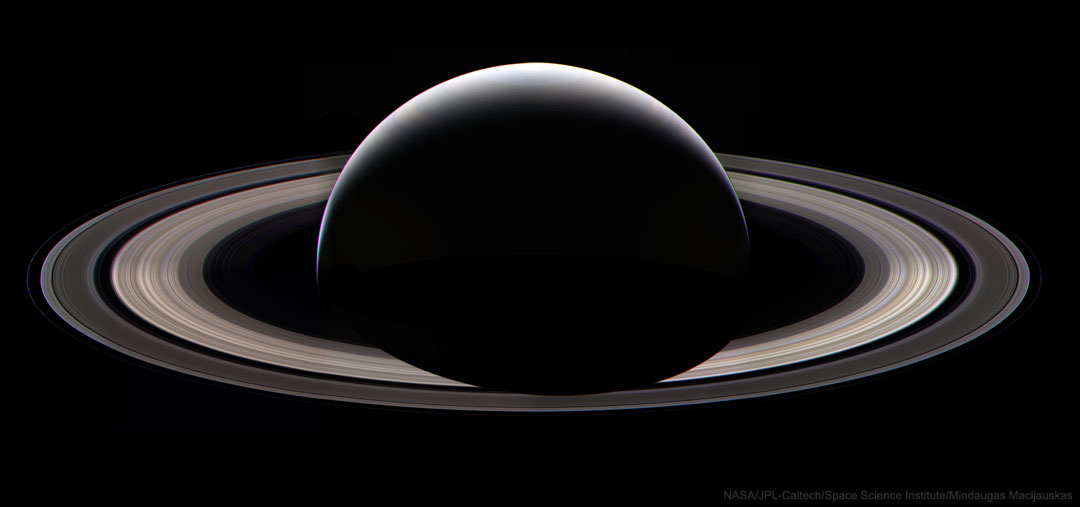
Still bright in planet Earth’s night skies, good telescopic views of Saturn and its beautiful rings often make it a star at star parties. But this stunning view of Saturn’s rings and night side just isn’t possible from telescopes closer to the Sun than the outer planet. They can only bring Saturn’s day into view. In fact, this image of Saturn’s slender sunlit crescent with night’s shadow cast across its broad and complex ring system was captured by the Cassini spacecraft. A robot spacecraft from planet Earth, Cassini called Saturn orbit home for 13 years before it was directed to dive into the atmosphere of the gas giant on September 15, 2017. This magnificent mosaic is composed of frames recorded by Cassini’s wide-angle camera only two days before its grand final plunge. Saturn’s night will not be seen again until another spaceship from Earth calls.

from NASA https://ift.tt/3E7x1m1
via IFTTT

Rosetta’s Comet in View


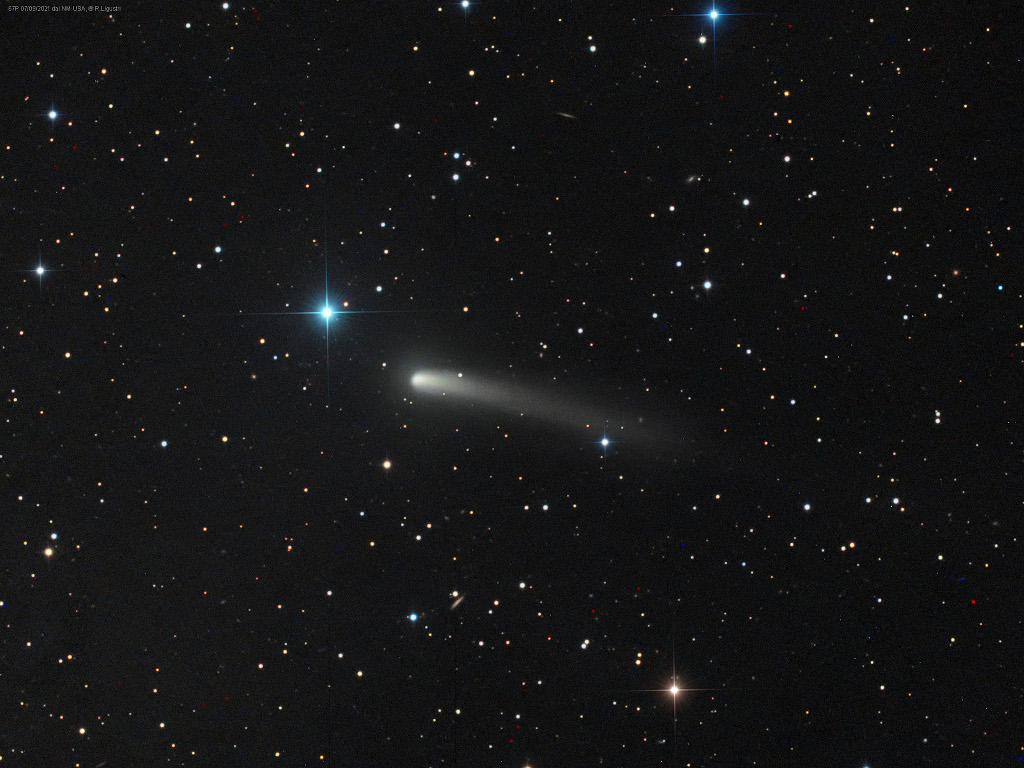
Faint comet Churyumov-Gerasimenko (67P) sweeps past background stars in the constellation Taurus and even fainter distant galaxies in this telescopic frame from September 7. About 5 years ago, this comet’s 4 kilometer spanning, double-lobed nucleus became the final resting place of robots from planet Earth, following the completion of the historic Rosetta mission to the comet. After wandering out beyond the orbit of Jupiter, Churyumov-Gerasimenko is now returning along its 6.4 year periodic orbit toward its next perihelion or closest approach to the Sun, on November 2. On November 12, the comet’s perigee, its closest approach to Earth, will bring it within about 0.42 astronomical units. Telescopes should still be required to view it even at its brightest, predicted to be in late November and December. On September 7 Rosetta’s comet was about 0.65 astronomical units away or about 5.4 light-minutes from our fair planet.

from NASA https://ift.tt/2X8PsWr
via IFTTT

M16 Close Up


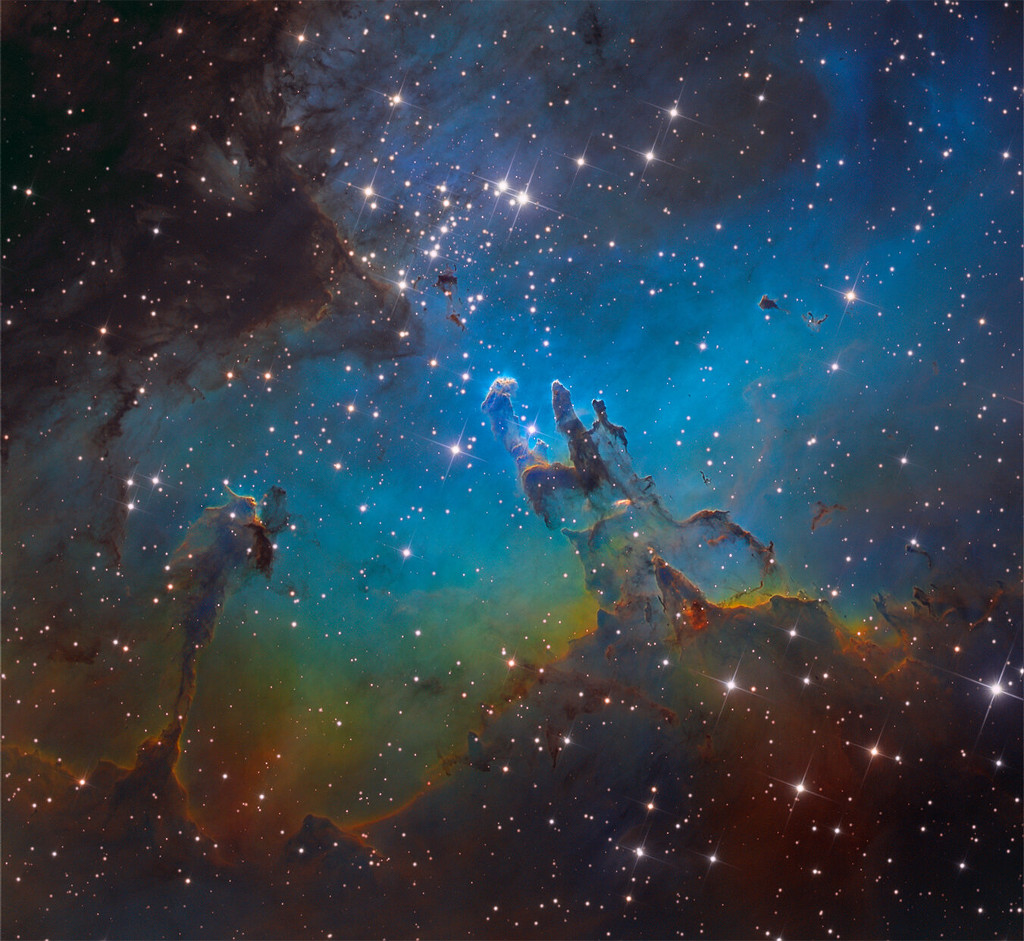
A star cluster around 2 million years young surrounded by natal clouds of dust and glowing gas, M16 is also known as The Eagle Nebula. This beautifully detailed image of the region adopts the colorful Hubble palette and includes cosmic sculptures made famous in Hubble Space Telescope close-ups of the starforming complex. Described as elephant trunks or Pillars of Creation, dense, dusty columns rising near the center are light-years in length but are gravitationally contracting to form stars. Energetic radiation from the cluster stars erodes material near the tips, eventually exposing the embedded new stars. Extending from the ridge of bright emission left of center is another dusty starforming column known as the Fairy of Eagle Nebula. M16 lies about 7,000 light-years away, an easy target for binoculars or small telescopes in a nebula rich part of the sky toward the split constellation Serpens Cauda (the tail of the snake).

from NASA https://ift.tt/2YEyAYC
via IFTTT

The Deep Sky Toward Andromeda


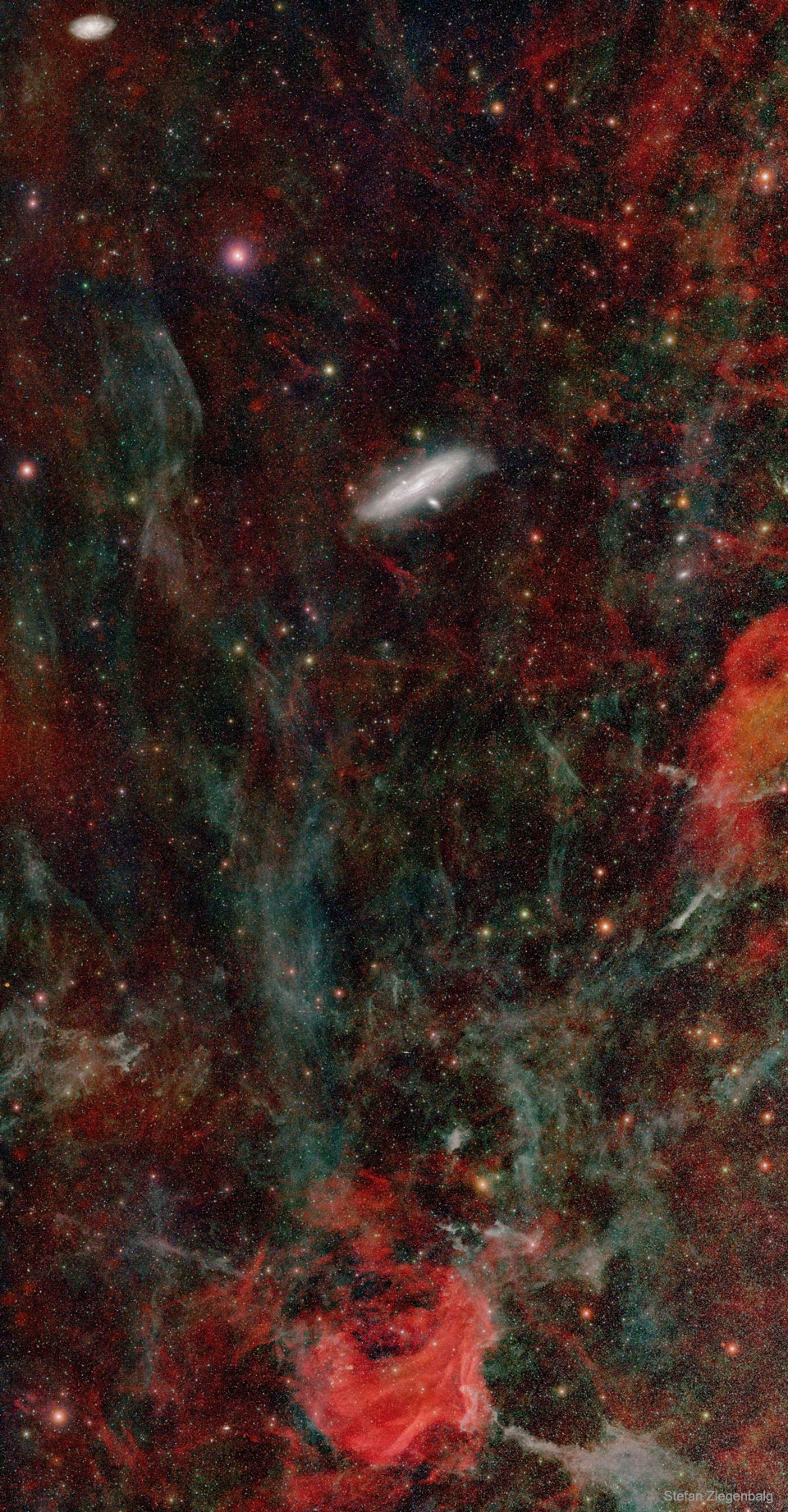
What surrounds the Andromeda galaxy? Out in space, Andromeda (M31) is closely surrounded by several small satellite galaxies, and further out it is part of the Local Group of Galaxies — of which our Milky Way galaxy is also a member. On the sky, however, gas clouds local to our Milky Way appear to surround M31 — not unlike how water clouds in Earth’s atmosphere may appear to encompass our Moon. The gas clouds toward Andromeda, however, are usually too faint to see. Enter the featured 45-degree long image — one of the deeper images yet taken of the broader Andromeda region. This image, sensitive to light specifically emitted by hydrogen gas, shows these faint and unfamiliar clouds in tremendous detail. But the image captures more. At the image top is the Triangulum galaxy (M33), the third largest galaxy in the Local Group and the furthest object that can be seen with the unaided eye. Below M33 is the bright Milky-Way star Mirach. The image is the digital accumulation of several long exposures taken from 2018 to 2021 from Pulsnitz, Germany.

from NASA https://ift.tt/3yUhaUj
via IFTTT

NGC 520: Colliding Galaxies from Hubble


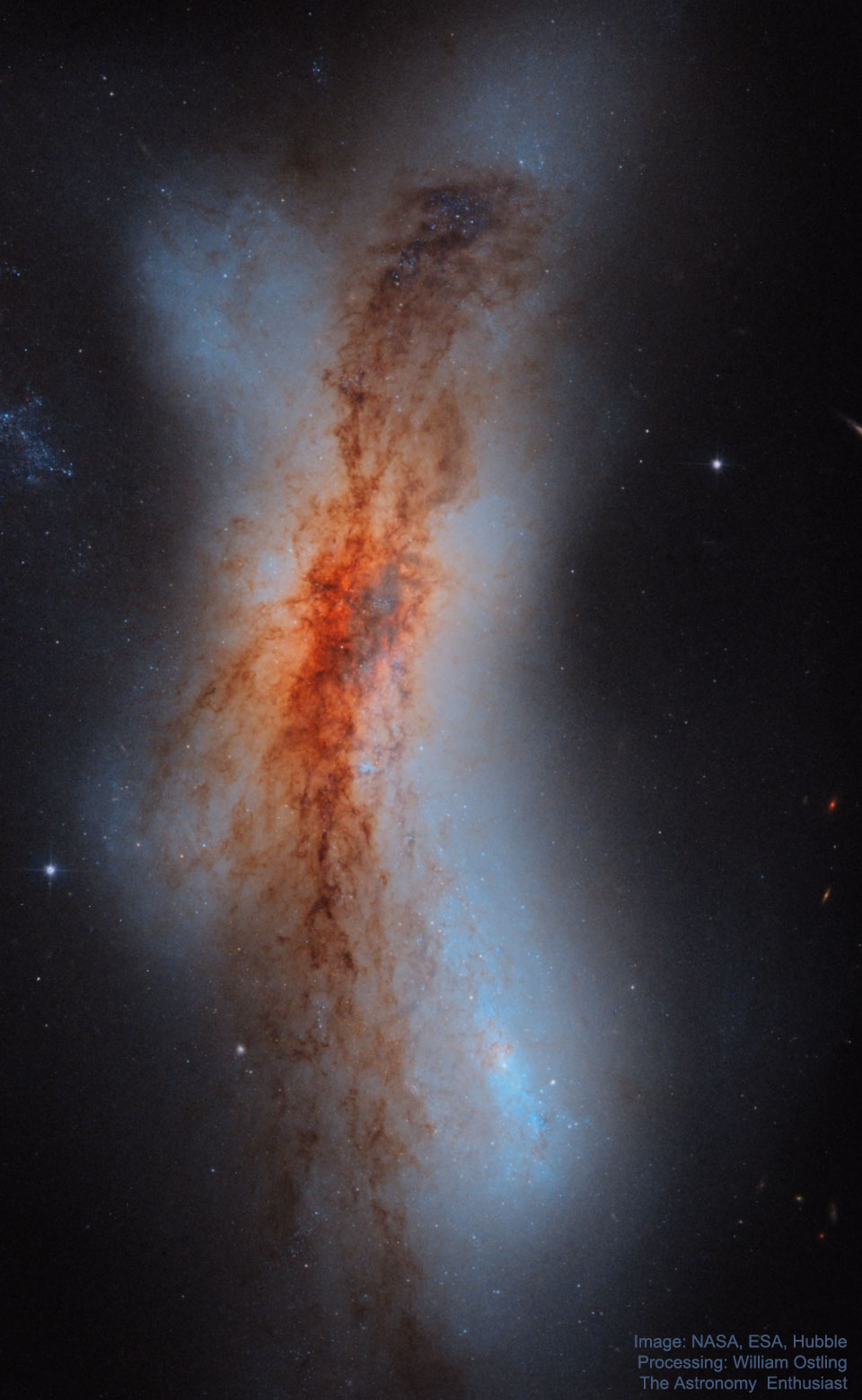
Is this one galaxy or two? The jumble of stars, gas, and dust that is NGC 520 is now thought to incorporate the remains of two separate disk galaxies. A defining component of NGC 520 — as seen in great detail in the featured image from the Hubble Space Telescope — is its band of intricately interlaced dust running vertically down the spine of the colliding galaxies. A similar looking collision might be expected in a few billion years when our disk Milky Way Galaxy to collides with our large-disk galactic neighbor Andromeda (M31). The collision that defines NGC 520 started about 300 million years ago. Also known as Arp 157, NGC 520 lies about 100 million light years distant, spans about 100 thousand light years, and can be seen with a small telescope toward the constellation of the Fish (Pisces). Although the speeds of stars in NGC 520 are fast, the distances are so vast that the battling pair will surely not change its shape noticeably during our lifetimes.

from NASA https://ift.tt/3kZejob
via IFTTT

Firefly Milky Way over Russia


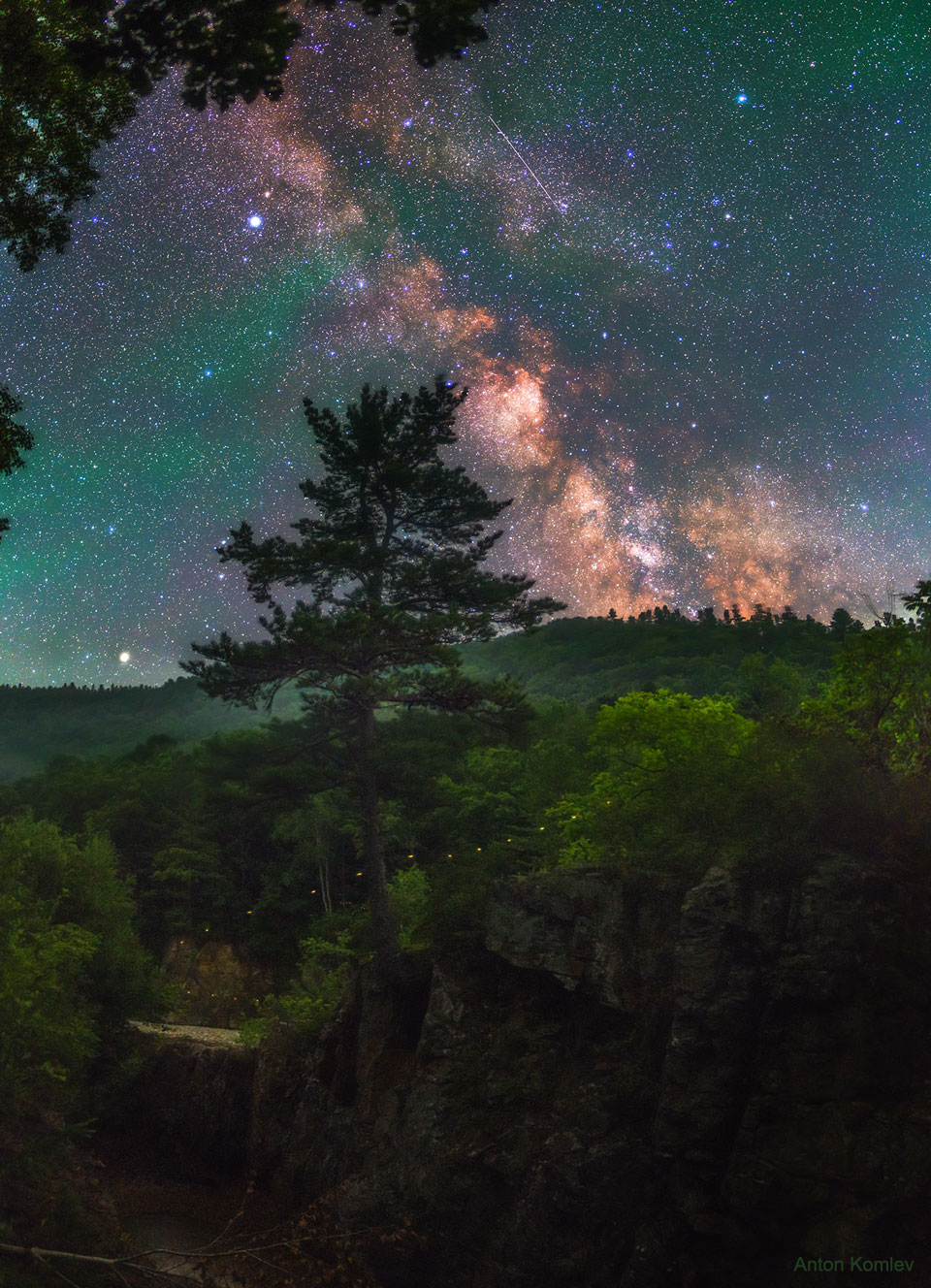
It started with a pine tree. The idea was to photograph a statuesque pine in front of the central band of our Milky Way Galaxy. And the plan, carried out two months ago, was successful — they both appear prominently. But the resulting 3-frame panorama captured much more. Colorful stars, for example, dot the distant background, with bright Altair visible on the upper left. The planet Saturn, a bit closer, was captured just over the horizon on the far left. Just beyond the Earth’s atmosphere, seen in the upper right, an Earth-orbiting satellite was caught leaving a streak during the 25-second exposure. The Earth’s atmosphere itself was surprisingly visible — as green airglow across the image top. Finally, just by chance, there was a firefly. Do you see it? Near the image bottom, the firefly blinked in yellow several times as it fluttered before the rolling hills above Milogradovka River in Primorsky Krai, Russia.

from NASA https://ift.tt/3tk4K76
via IFTTT

Earth and Moon


The Earth and Moon are rarely photographed together. One of most spectacular times this occurred was about 30 years ago when the Jupiter-bound Galileo spacecraft zoomed past our home planetary system. Then, robotic Galileo watched from about 15-times the Earth-Moon separation as our only natural satellite glided past our home world. The featured video combines 52 historic color-enhanced images. Although our Moon may appear small next to the Earth, no other planet in our Solar System has a satellite so comparable in size . The Sun, far off to the right, illuminated about half of each sphere, and shows the spinning Earth’s white clouds, blue oceans, and tan continents.

from NASA https://ift.tt/3DMqwoB
via IFTTT