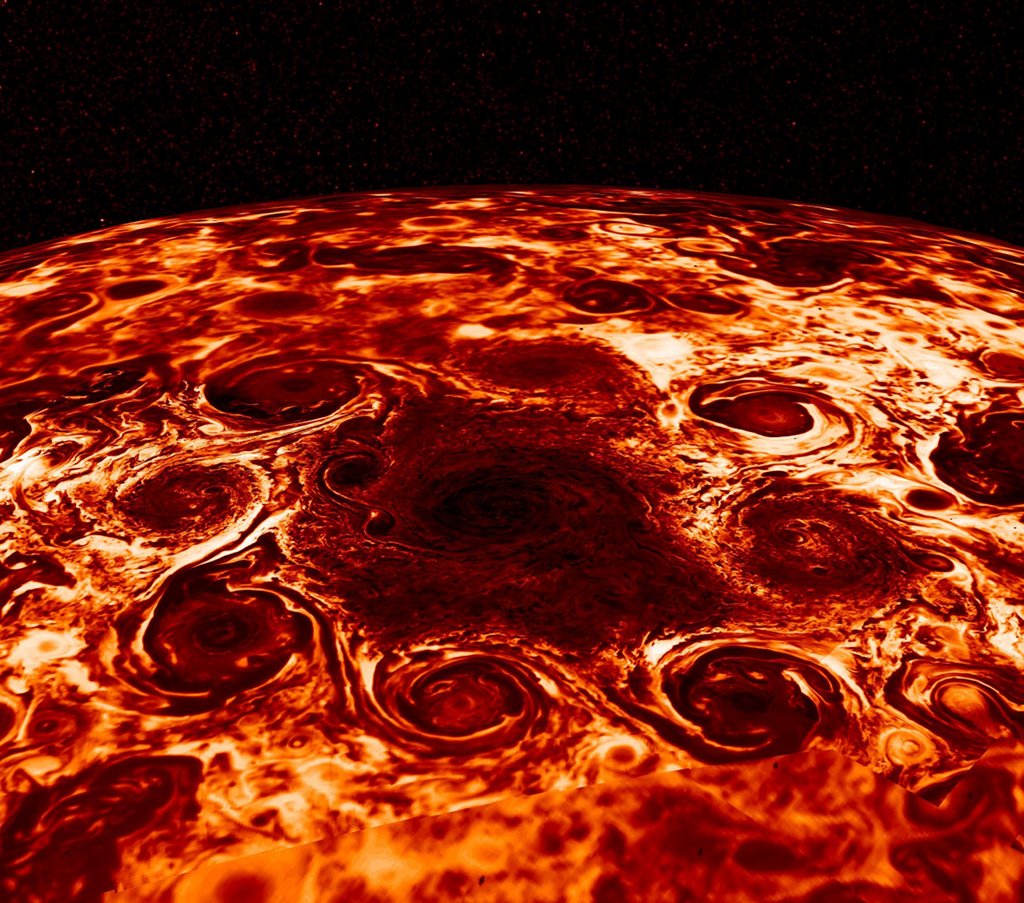
Cyclones at Jupiter s North Pole


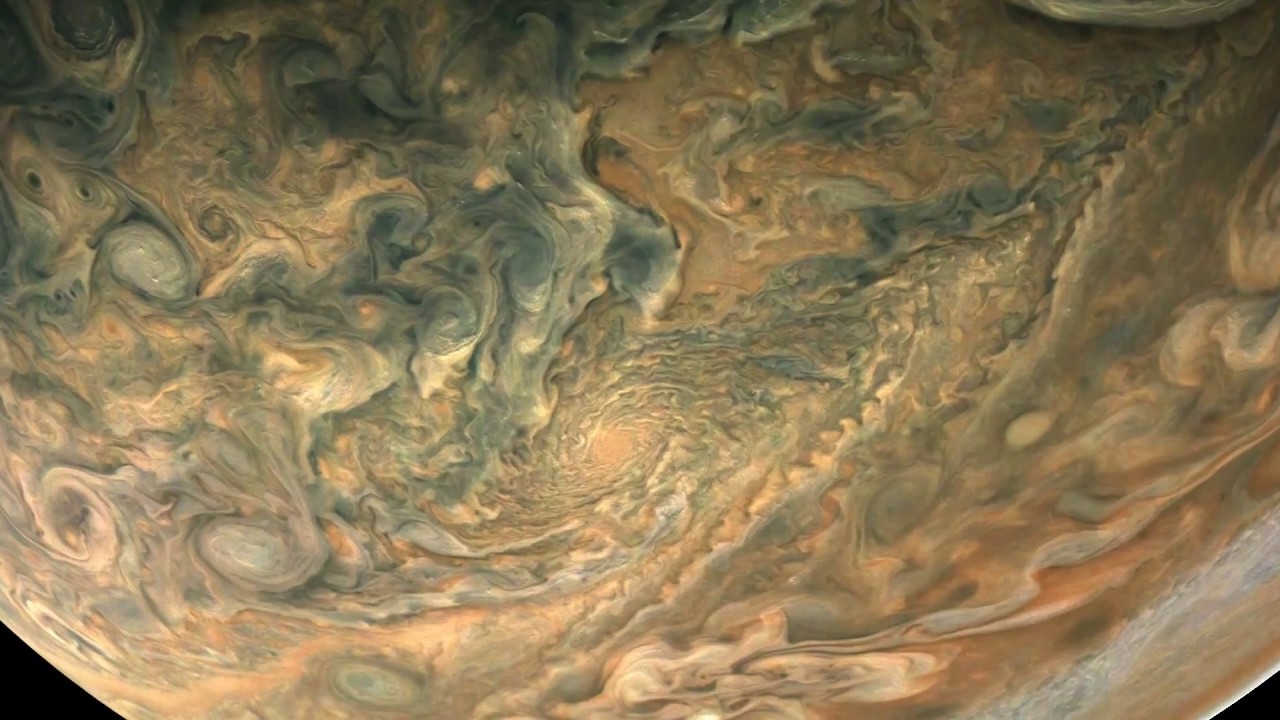
Juno’s Jovian Infrared Auroral Mapper data was used to construct this stunning view of cyclones at Jupiter’s North Pole. Measuring the thermal emission from Jovian cloud tops, the infrared the observations are not restricted to the hemisphere illuminated by sunlight. They reveal eight cyclonic features that surround a cyclone about 4,000 kilometers in diameter, just offset from the giant planet’s geographic North Pole. Similar data show a cyclone at the Jovian South Pole with five circumpolar cyclones. The South Pole cyclones are slightly larger than their northern cousins. Cassini data has shown that gas giant Saturn’s north and south poles each have a single cyclonic storm system.

from NASA http://ift.tt/2Fq3HIN
via IFTTT
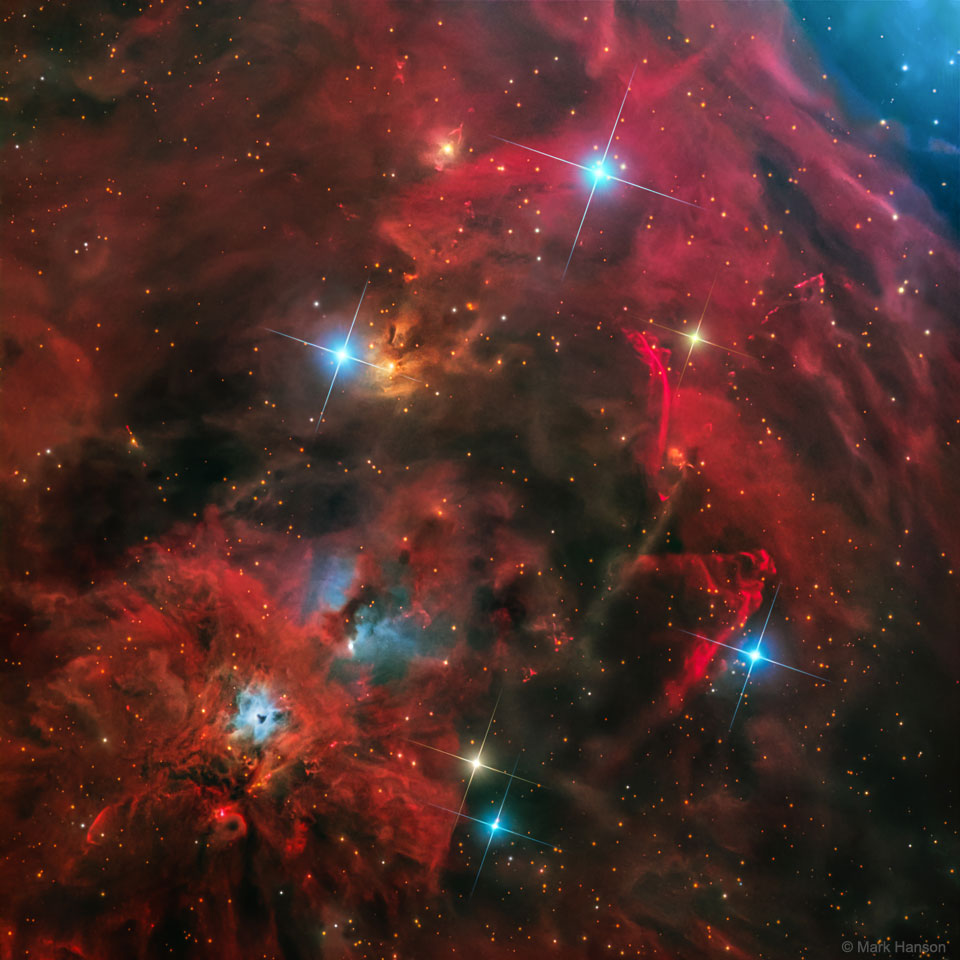
Arcs, Jets, and Shocks near NGC 1999


This tantalizing array of nebulas and stars can be found about two degrees south of the famous star-forming Orion Nebula. The region abounds with energetic young stars producing jets and outflows that push through the surrounding material at speeds of hundreds of kilometers per second. The interaction creates luminous shock waves known as Herbig-Haro (HH) objects. For example, the graceful, flowing arc just right of center is cataloged as HH 222, also called the Waterfall Nebula. Seen below the Waterfall, HH 401 has a distinctive cone shape. The bright bluish nebula below and left of center is NGC 1999, a dusty cloud reflecting light from an embedded variable star. The entire cosmic vista spans over 30 light-years, near the edge of the Orion Molecular Cloud Complex some 1,500 light-years distant.

from NASA http://ift.tt/2oPtLHf
via IFTTT

Colorful Airglow Bands Surround Milky Way


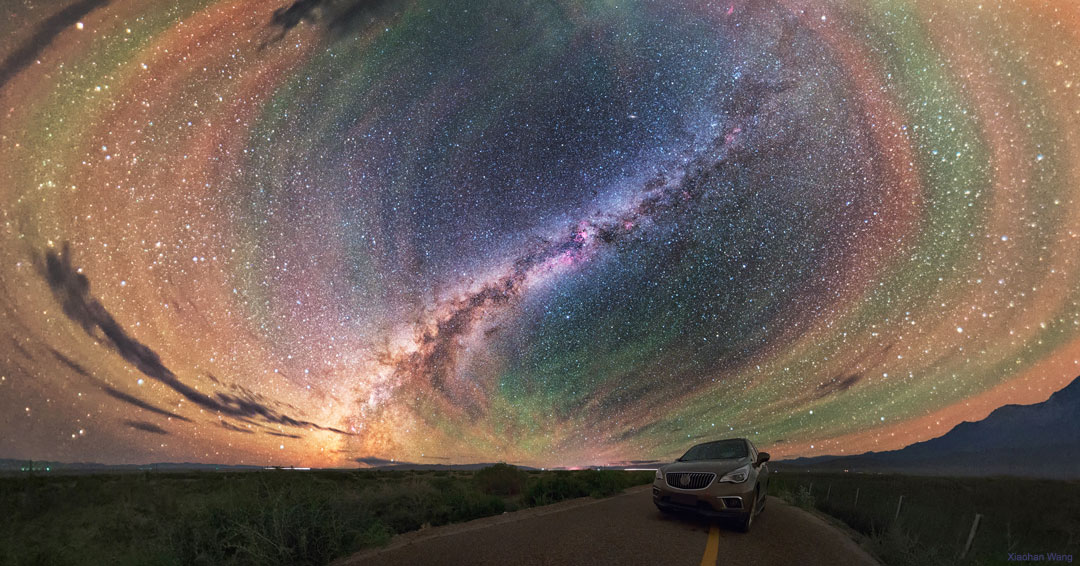
Why would the sky glow like a giant repeating rainbow? Airglow. Now air glows all of the time, but it is usually hard to see. A disturbance however — like an approaching storm — may cause noticeable rippling in the Earth’s atmosphere. These gravity waves are oscillations in air analogous to those created when a rock is thrown in calm water. Red airglow likely originates from OH molecules about 87-kilometers high, excited by ultraviolet light from the Sun, while orange and green airglow is likely caused by sodium and oxygen atoms slightly higher up. While driving near Keluke Lake in Qinghai Provence in China, the photographer originally noticed mainly the impressive central band of the Milky Way Galaxy. Stopping to photograph it, surprisingly, the resulting sensitive camera image showed airglow bands to be quite prominent and span the entire sky. The featured image has been digitally enhanced to make the colors more vibrant.

from NASA http://ift.tt/2FhJXqI
via IFTTT

Clouds, Birds, Moon, Venus


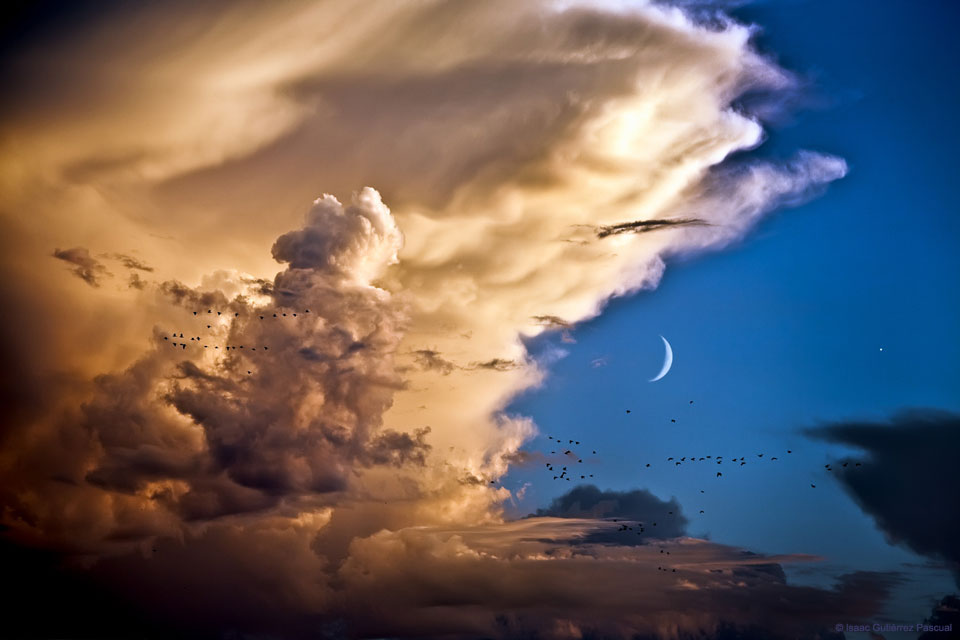
Sometimes the sky above can become quite a show. In early September of 2010, for example, the Moon and Venus converged, creating quite a sight by itself for sky enthusiasts around the globe. From some locations, though, the sky was even more picturesque. In the featured image taken in Spain, a crescent Moon and the planet Venus, on the far right, were captured during sunset posing against a deep blue sky. In the foreground, dark storm clouds loom across the image bottom, while a white anvil cloud shape appears above. Black specks dot the frame, caused by a flock of birds taking flight. Very soon after this picture was taken, however, the birds passed by, the storm ended, and Venus and the Moon set. Bright Venus is again visible just after sunset this month (2018 March) and will appear quite near Mercury tonight and the rest of this week.

from NASA http://ift.tt/2F7vb9Y
via IFTTT

Alborz Mountain Star Trails


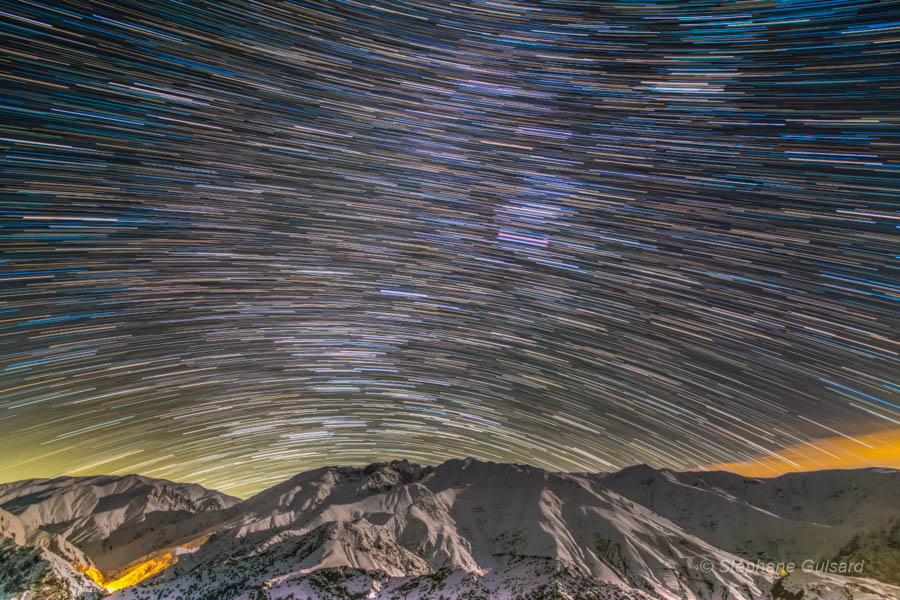
Colourful star trails arc through the night in this wide-angle mountain and skyscape. From a rotating planet, the digitally added consecutive exposures were made with a camera fixed to a tripod and looking south, over northern Iran’s Alborz Mountain range. The stars trace concentric arcs around the planet’s south celestial pole, below the scene’s rugged horizon. Combined, the many short exposures also bring out the pretty star colours. Bluish trails are from stars hotter than our Sun, while yellowish trails are from cooler stars. Near the center, the remarkably pinkish trail was traced by the star-forming Orion Nebula.

from NASA http://ift.tt/2oHRyrC
via IFTTT

The Lunar X


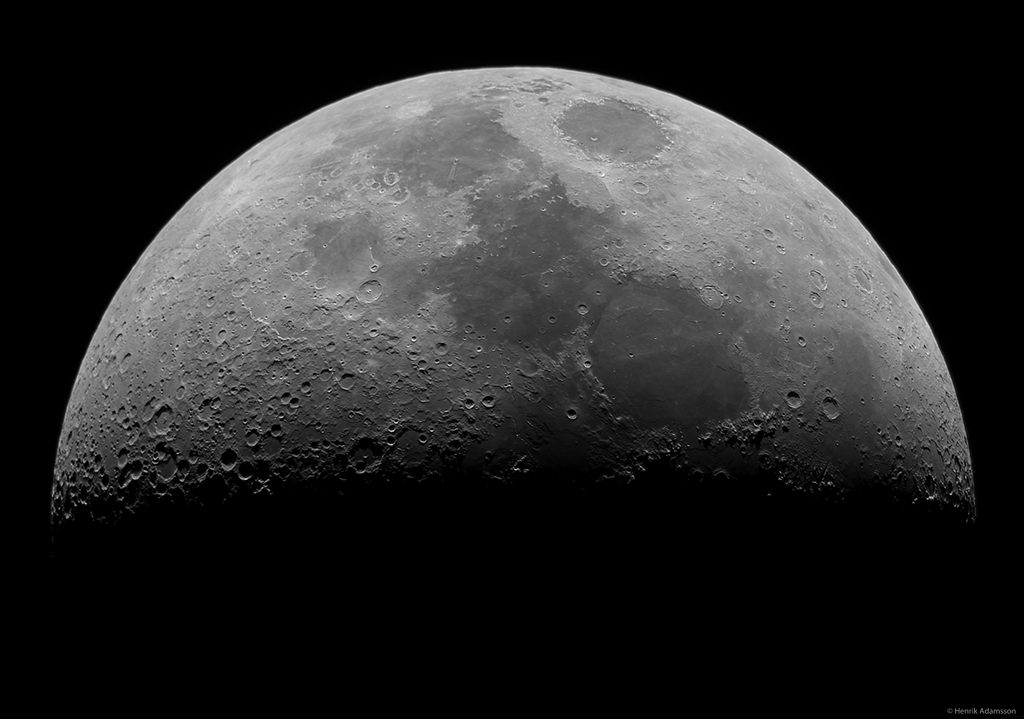
The striking X in this lunarscape is easily visible in binoculars or a small telescope, but not too many have seen it. The catch is, this lunar X is fleeting and only apparent in the hours before the Moon’s first quarter phase. Along the shadow line between lunar day and night, the X illusion is produced by a configuration of craters seen here toward the left, Blanchinus, La Caille and Purbach. Near the Moon’s first quarter phase, an astronaut standing close to the craters’ position would see the slowly rising Sun very near the horizon. Temporarily, crater walls would be in sunlight while crater floors would still be in darkness. Seen from planet Earth, contrasting sections of bright walls against the dark floors by chance look remarkably like an X. This sharp image of the Lunar X was captured on February 22nd. For extra credit, sweep your gaze along the lunar terminator and you can also spot the Lunar V.

from NASA http://ift.tt/2HSh71Q
via IFTTT

NGC 613 in Dust, Stars, and a Supernova


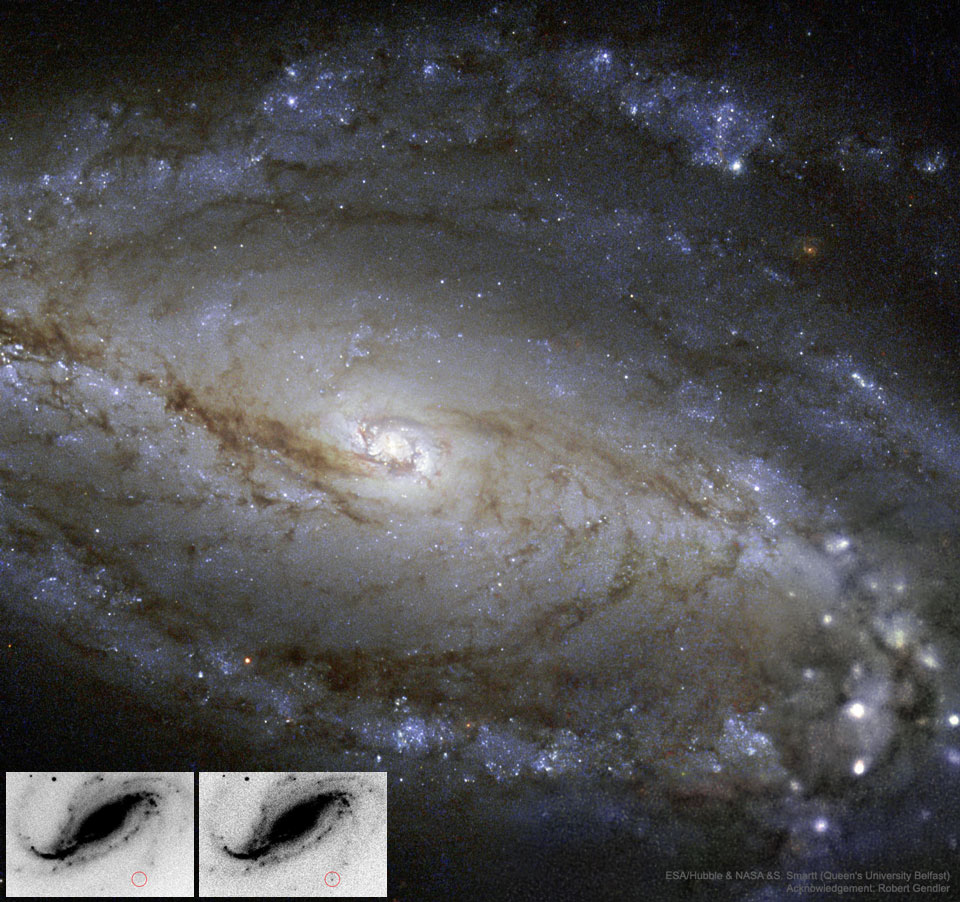
Where did that spot come from? Amateur astronomer Victor Buso was testing out a new camera on his telescope in 2016 when he noticed a curious spot of light appear — and remain. After reporting this unusual observation, this spot was determined to be light from a supernova just as it was becoming visible — in an earlier stage than had ever been photographed optically before. The discovery before and after images, taken about an hour apart, are shown in the inset of a more detailed image of the same spiral galaxy, NGC 613, taken by the Hubble Space Telescope. Follow-up observations show that SN 2016gkg was likely the explosion of a supergiant star, and Buso likely captured the stage where the outgoing detonation wave from the stellar core broke through the star’s surface. Since astronomers have spent years monitoring galaxies for supernovas without seeing such a “break out” event, the odds of Buso capturing this have been compared to winning a lottery.

from NASA http://ift.tt/2FGieBj
via IFTTT

Dueling Bands in the Night


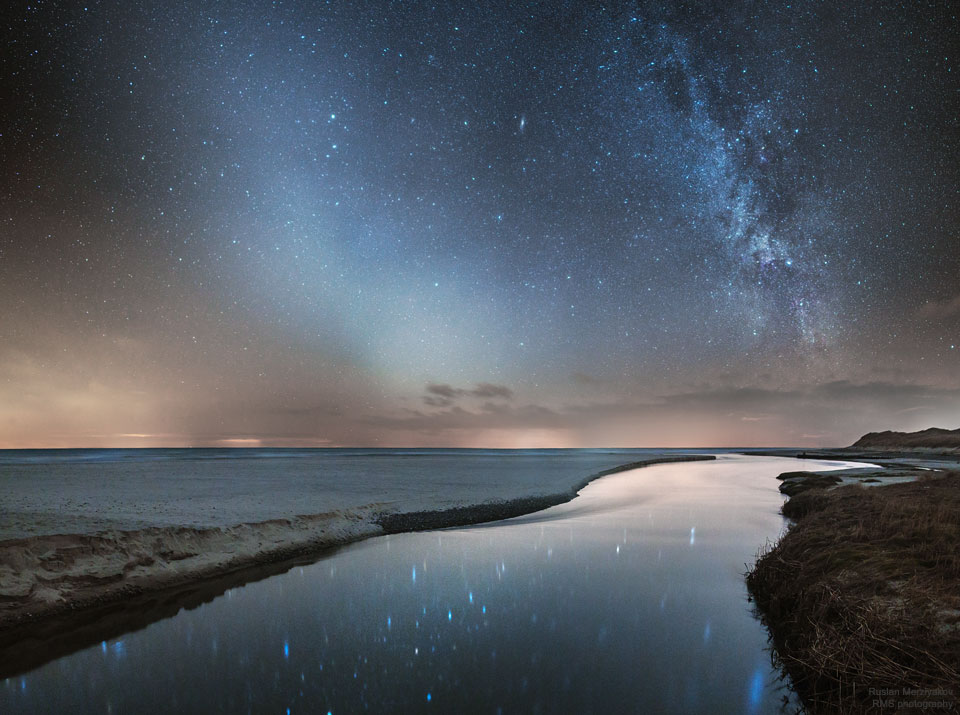
What are these two bands in the sky? The more commonly seen band is the one on the right and is the central band of our Milky Way galaxy. Our Sun orbits in the disk of this spiral galaxy, so that from inside, this disk appears as a band of comparable brightness all the way around the sky. The Milky Way band can also be seen all year — if out away from city lights. The less commonly seem band, on the left, is zodiacal light — sunlight reflected from dust orbiting the Sun in our Solar System. Zodiacal light is brightest near the Sun and so is best seen just before sunrise or just after sunset. On some evenings in the north, particularly during the months of March and April, this ribbon of zodiacal light can appear quite prominent after sunset. It has recently been determined that zodiacal dust was mostly expelled by comets that have passed near Jupiter. Only on certain times of the year will the two bands be seen side by side, in parts of the sky, like this. Here the two streaks of light appear like the continuation of the banks of the Liver River into the sky. The featured panorama of consecutive exposures was recorded about three weeks ago in North Jutland, Denmark.

from NASA http://ift.tt/2HNPwPt
via IFTTT

Passing Jupiter


Here comes Jupiter! NASA‘s robotic spacecraft Juno is continuing on its 53-day, highly-elongated orbits around our Solar System’s largest planet. The featured video is from perijove 11, the eleventh time Juno has passed near Jupiter since it arrived in mid-2016. This time-lapse, color-enhanced movie covers about four hours and morphs between 36 JunoCam images. The video begins with Jupiter rising as Juno approaches from the north. As Juno reaches its closest view — from about 3,500 kilometers over Jupiter’s cloud tops — the spacecraft captures the great planet in tremendous detail. Juno passes light zones and dark belt of clouds that circle the planet, as well as numerous swirling circular storms, many of which are larger than hurricanes on Earth. After the perijove, Jupiter recedes into the distance, now displaying the unusual clouds that appear over Jupiter’s south. To get desired science data, Juno swoops so close to Jupiter that its instruments may soon fail due to exposure to high levels of radiation. Because of this, in part, the Juno mission is currently schedule to conclude in mid-2018, at perijove 14, when the spacecraft will be directed to dive into Jupiter’s atmosphere and melt.

from NASA http://ift.tt/2FvQzTt
via IFTTT

AE Aurigae and the Flaming Star Nebula


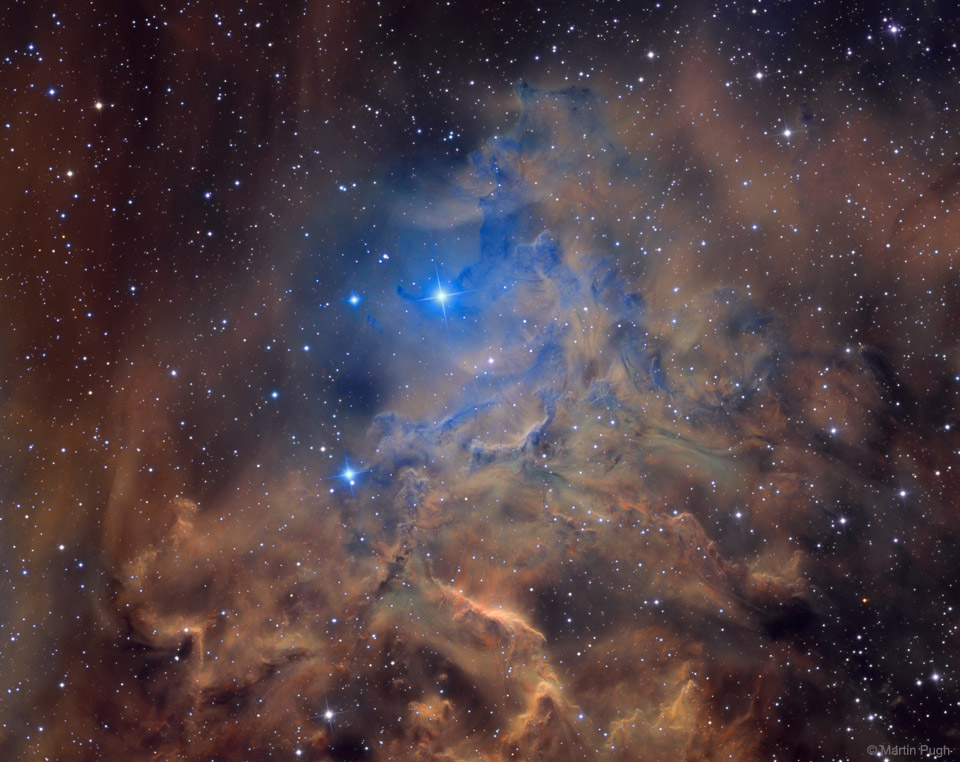
Why is AE Aurigae called the flaming star? For one reason, the surrounding nebula IC 405 is named the Flaming Star Nebula because the region seems to harbor smoke, even though nothing is on fire, including interior star AE Aurigae. Fire, typically defined as the rapid molecular acquisition of oxygen, happens only when sufficient oxygen is present and is not important in such high-energy, low-oxygen environments. The material that appears as smoke is mostly interstellar hydrogen, but does contain smoke-like dark filaments of carbon-rich dust grains. The bright star AE Aurigae is visible near the nebula center and is so hot it is blue, emitting light so energetic it knocks electrons away from atoms in the surrounding gas. When an atom recaptures an electron, light is emitted creating the surrounding emission nebula. The Flaming Star nebula lies about 1,500 light years distant, spans about 5 light years, and is visible with a small telescope toward the constellation of the Charioteer (Auriga).

from NASA http://ift.tt/2oAo2UP
via IFTTT