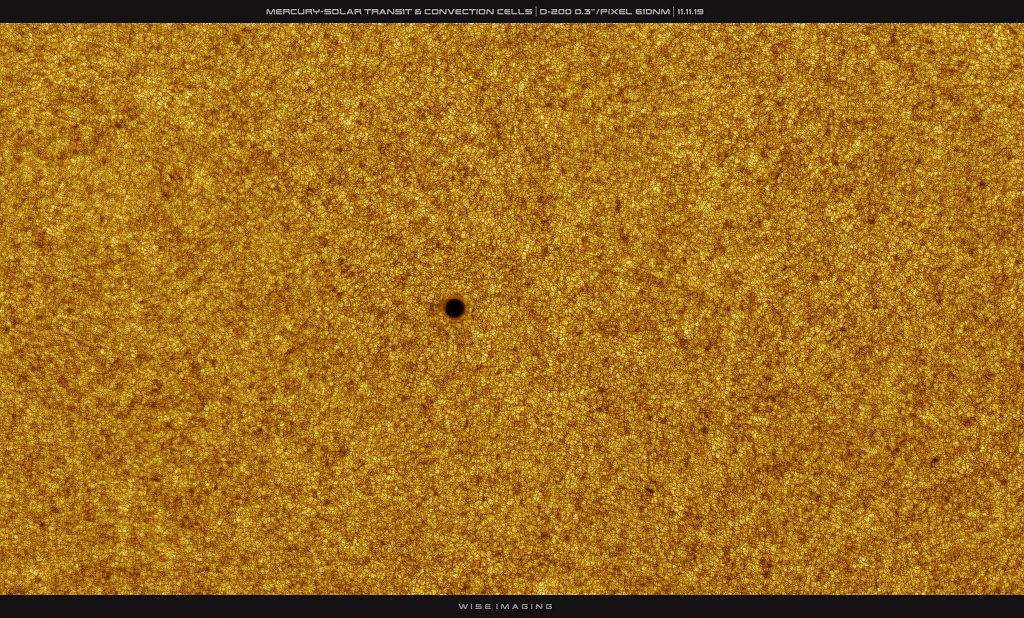
Mercury in Silhouette


The small, dark, round spot in this solar close up is planet Mercury. In the high resolution telescopic image, a colorized stack of 61 sharp video frames, a turbulent array of photospheric convection cells tile the bright solar surface. Mercury’s more regular silhouette still stands out though. Of course, only inner planets Mercury and Venus can transit the Sun to appear in silhouette when viewed from planet Earth. For this November 11, 2019 transit of Mercury, the innermost planet’s silhouette was a mere 1/200th the solar diameter. So even under clear daytime skies it was difficult to see without the aid of a safe solar telescope. Following its transit in 2016, this was Mercury’s 4th of 14 transits across the solar disk in the 21st century. The next transit of Mercury will be on November 13, 2032.

from NASA https://ift.tt/34ZcihQ
via IFTTT
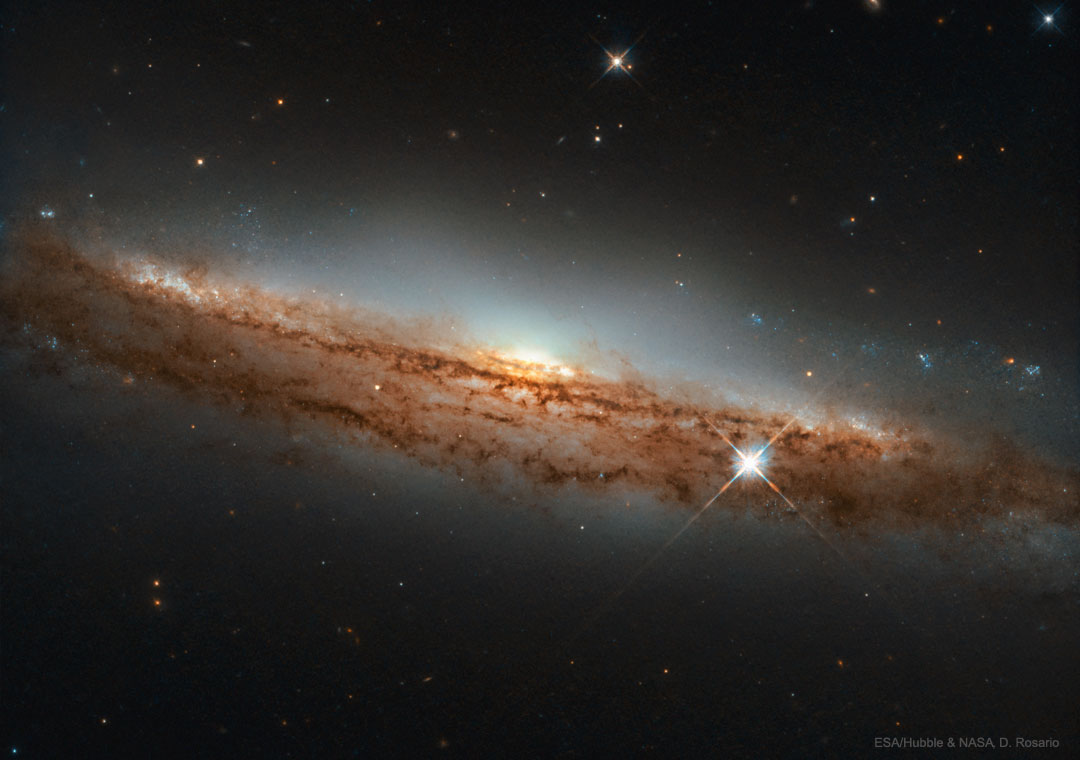
NGC 3717: A Nearly Sideways Spiral Galaxy


Some spiral galaxies are seen nearly sideways. Most bright stars in spiral galaxies swirl around the center in a disk, and seen from the side, this disk can be appear quite thin. Some spiral galaxies appear even thinner than NGC 3717, which is actually seen tilted just a bit. Spiral galaxies form disks because the original gas collided with itself and cooled as it fell inward. Planets may orbit in disks for similar reasons. The featured image by the Hubble Space Telescope shows a light-colored central bulge composed of older stars beyond filaments of orbiting dark brown dust. NGC 3717 spans about 100,000 light years and lies about 60 million light years away toward the constellation of the Water Snake (Hydra).

from NASA https://ift.tt/2CyVwdB
via IFTTT

Lunar Craters Langrenus and Petavius


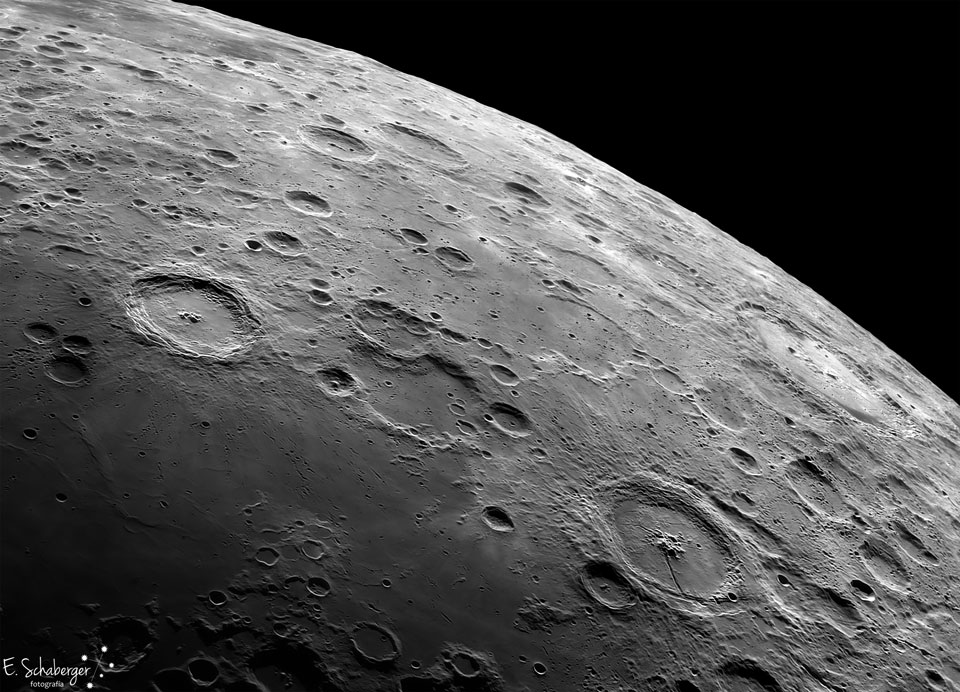
The history of the Moon is partly written in its craters. Pictured here is a lunar panorama taken from Earth featuring the large craters Langrenus, toward the left, and Petavius, toward the right. The craters formed in separate impacts. Langrenus spans about 130 km, has a terraced rim, and sports a central peak rising about 3 km. Petavius is slightly larger with a 180 km diameter and has a distinctive fracture that runs out from its center. Although it is known that Petravius crater is about 3.9 billion years old, the origin of its large fracture is unknown. The craters are best visible a few days after a new Moon, when shadows most greatly accentuate vertical walls and hills. The featured image is a composite of the best of thousands of high-resolution, infrared, video images taken through a small telescope. Although mountains on Earth will likely erode into soil over a billion years, lunar craters Langrenus and Petavius will likely survive many billions more years, possibly until the Sun expands and engulfs both the Earth and Moon.

from NASA https://ift.tt/2Q5qEcp
via IFTTT

Saturn the Giant


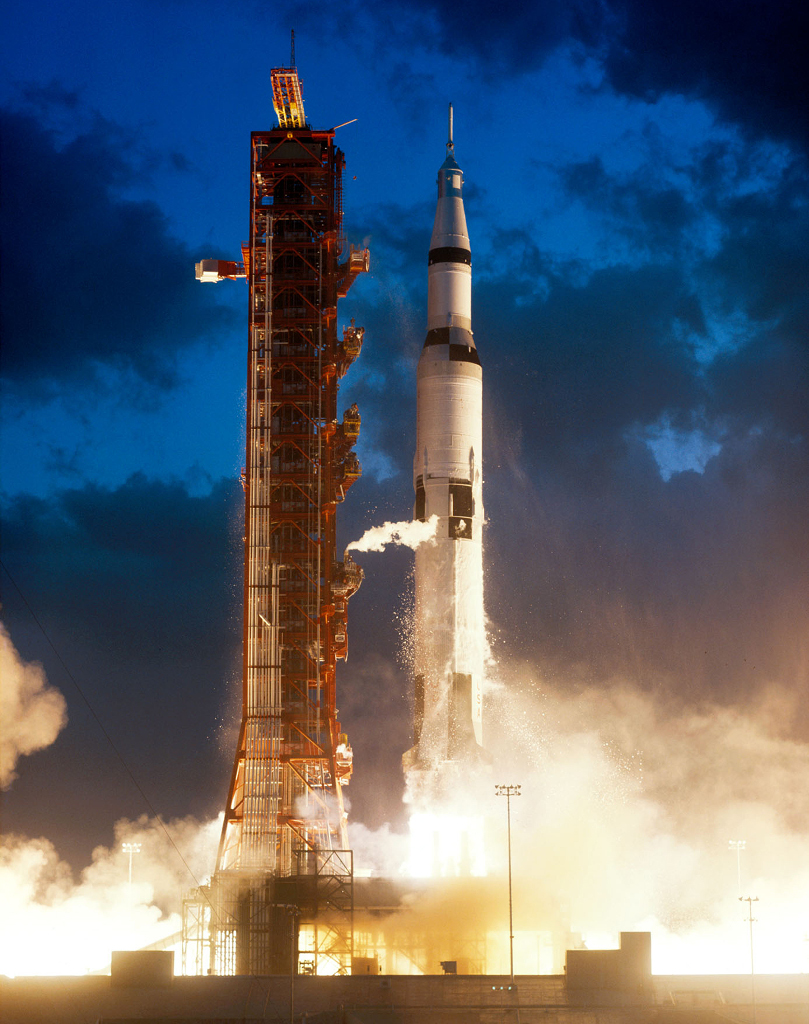
On May 25, 1961 U.S. president John Kennedy announced the goal of landing astronauts on the Moon by the end of the decade. By November 9, 1967 this Saturn V rocket was ready for launch and the first full test of its capabilities on the Apollo 4 mission. Its development directed by rocket pioneer Wernher Von Braun, the three stage Saturn V stood over 36 stories tall. It had a cluster of five first stage engines fueled by liquid oxygen and kerosene which together were capable of producing 7.9 million pounds of thrust. Giant Saturn V rockets ultimately hurled nine Apollo missions to the Moon and back again with six landing on the lunar surface. The first landing mission, Apollo 11, achieved Kennedy’s goal on July 20, 1969.

from NASA https://ift.tt/2NV0oyU
via IFTTT

NGC 3572 and the Southern Tadpoles


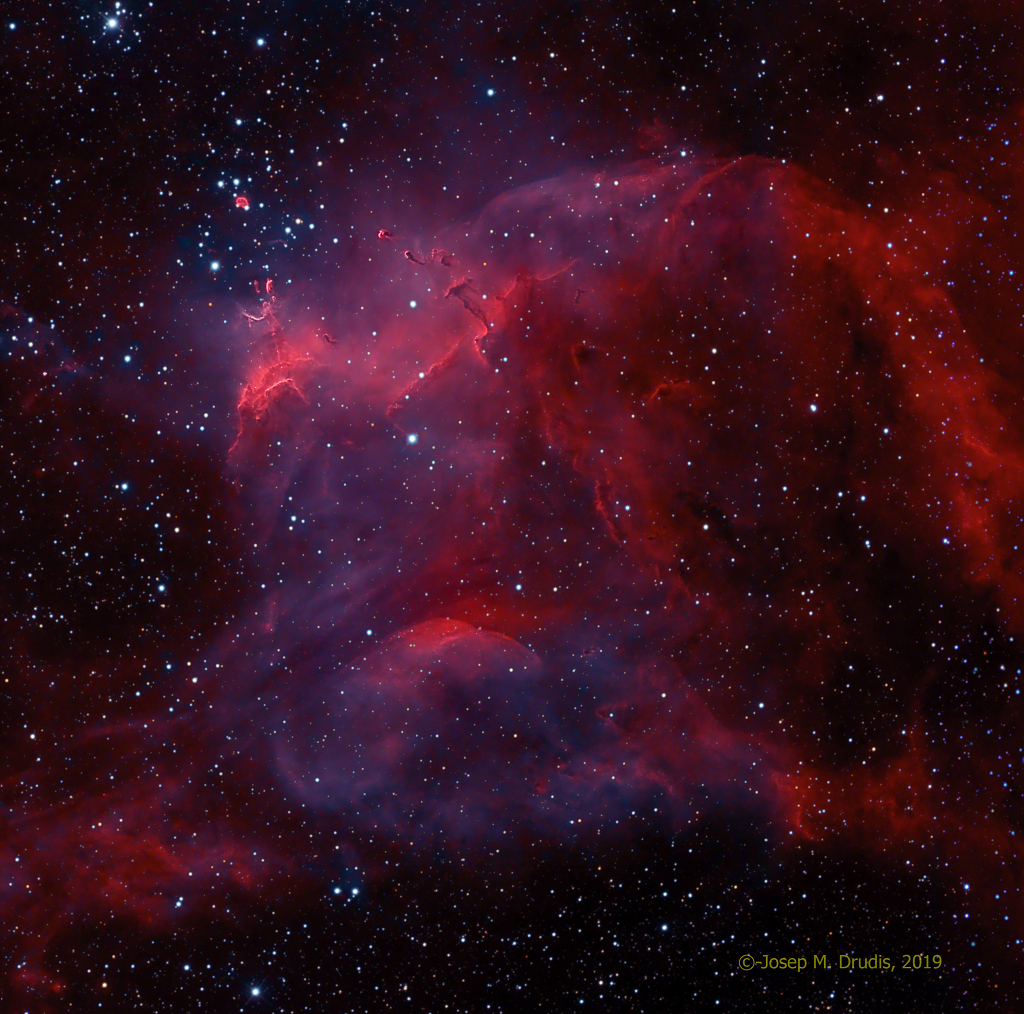
This cosmic skyscape features glowing gas and dark dust clouds along side the young stars of NGC 3572. A beautiful emission nebula and star cluster in far southern skies, the region is often overlooked by astroimagers in favor of its brighter neighbor, the nearby Carina Nebula. Stars from NGC 3572 are toward the upper left in the telescopic frame that would measure about 100 light-years across at the cluster’s estimated distant of 9,000 light-years. The visible interstellar gas and dust is part of the star cluster’s natal molecular cloud. Dense streamers of material within the nebula, eroded by stellar winds and radiation, clearly trail away from the energetic young stars. They are likely sites of ongoing star formation with shapes reminiscent of the cosmic Tadpoles of IC 410 better known to northern skygazers. In the coming tens to hundreds of millions of years, gas and stars in the cluster will be dispersed though, by gravitational tides and by violent supernova explosions that end the short lives of the massive cluster stars.

from NASA https://ift.tt/33sRsah
via IFTTT

Messier 45: The Daughters of Atlas and Pleione


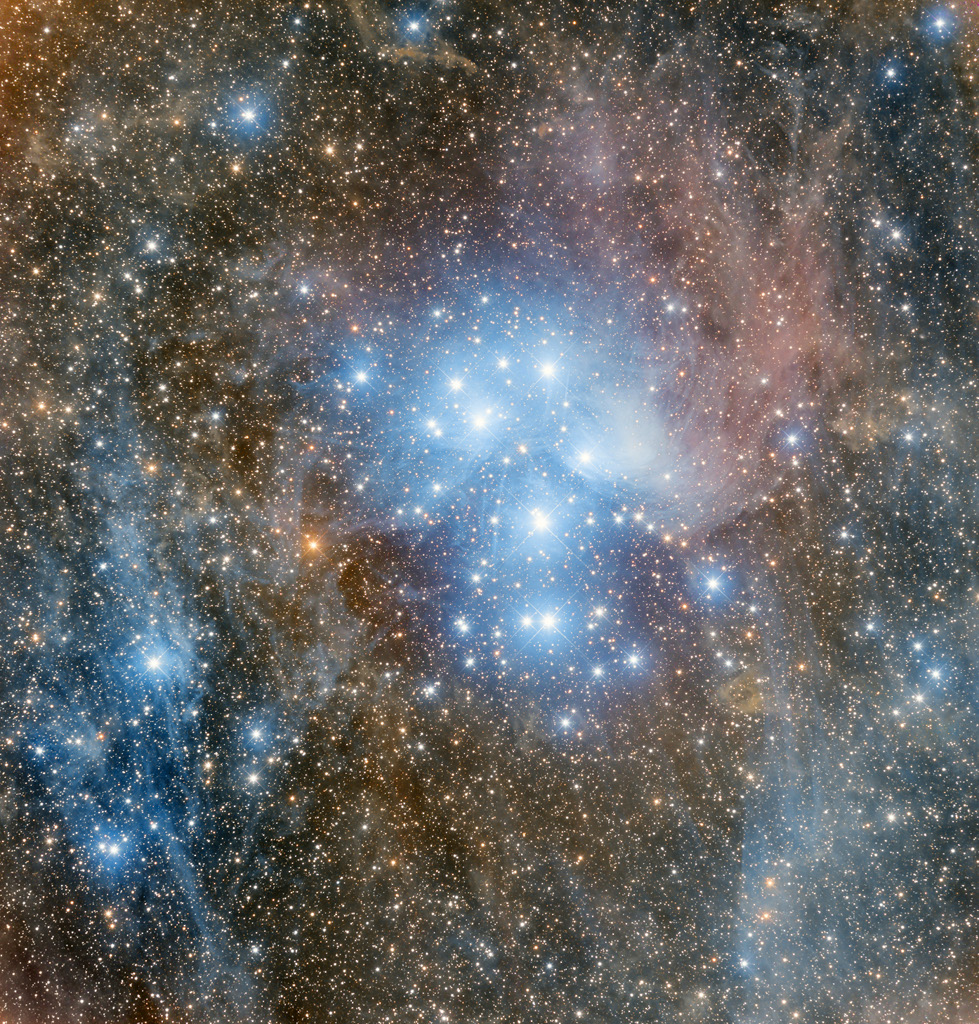
Hurtling through a cosmic dust cloud a mere 400 light-years away, the lovely Pleiades or Seven Sisters open star cluster is well-known for its striking blue reflection nebulae. It lies in the night sky toward the constellation Taurus and the Orion Arm of our Milky Way Galaxy. The sister stars and cosmic dust cloud are not related though, they just happen to be passing through the same region of space. Known since antiquity as a compact grouping of stars, Galileo first sketched the star cluster viewed through his telescope with stars too faint to be seen by eye. Charles Messier recorded the position of the cluster as the 45th entry in his famous catalog of things which are not comets. In Greek myth, the Pleiades were seven daughters of the astronomical Titan Atlas and sea-nymph Pleione. Their parents names are included in the cluster’s nine brightest stars. This deep and wide telescopic image spans over 20 light-years across the Pleides star cluster.

from NASA https://ift.tt/2Nn4ikQ
via IFTTT

21st Century M101


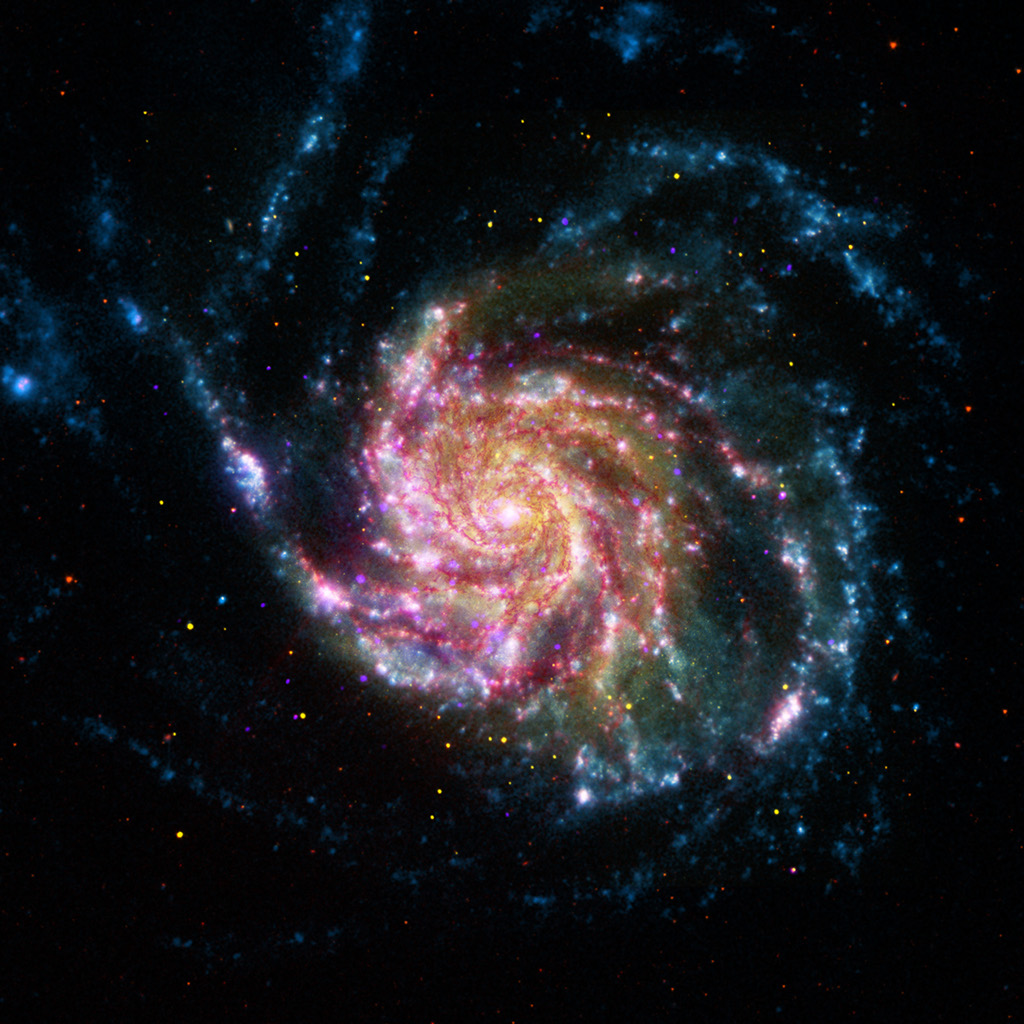
One of the last entries in Charles Messier’s famous catalog, big, beautiful spiral galaxy M101 is definitely not one of the least. About 170,000 light-years across, this galaxy is enormous, almost twice the size of our own Milky Way Galaxy. M101 was also one of the original spiral nebulae observed with Lord Rosse’s large 19th century telescope, the Leviathan of Parsonstown. In contrast, this multiwavelength view of the large island universe is a composite of images recorded by space-based telescopes in the 21st century. Color coded from X-rays to infrared wavelengths (high to low energies), the image data was taken from the Chandra X-ray Observatory (purple), the Galaxy Evolution Explorer (blue), Hubble Space Telescope(yellow), and the Spitzer Space Telescope(red). While the X-ray data trace the location of multimillion degree gas around M101’s exploded stars and neutron star and black hole binary star systems, the lower energy data follow the stars and dust that define M101’s grand spiral arms. Also known as the Pinwheel Galaxy, M101 lies within the boundaries of the northern constellation Ursa Major, about 25 million light-years away.

from NASA https://ift.tt/2pJL4gg
via IFTTT

Spiral Galaxies Spinning Super Fast


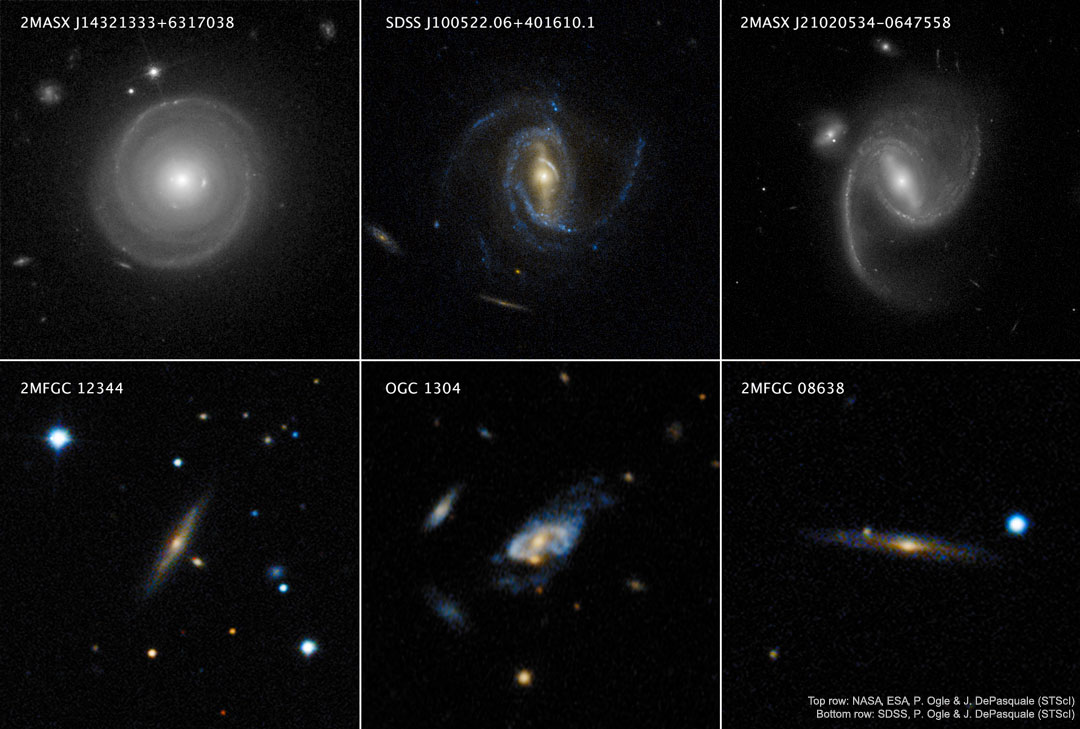
Why are these galaxies spinning so fast? If you estimated each spiral‘s mass by how much light it emits, their fast rotations should break them apart. The leading hypothesis as to why these galaxies don’t break apart is dark matter — mass so dark we can’t see it. But these galaxies are even out-spinning this break-up limit — they are the fastest rotating disk galaxies known. It is therefore further hypothesized that their dark matter halos are so massive — and their spins so fast — that it is harder for them to form stars than regular spirals. If so, then these galaxies may be among the most massive spirals possible. Further study of surprising super-spirals like these will continue, likely including observations taken by NASA‘s James Webb Space Telescope scheduled for launch in 2021.

from NASA https://ift.tt/2NT3raX
via IFTTT

Near the Center of the Lagoon Nebula


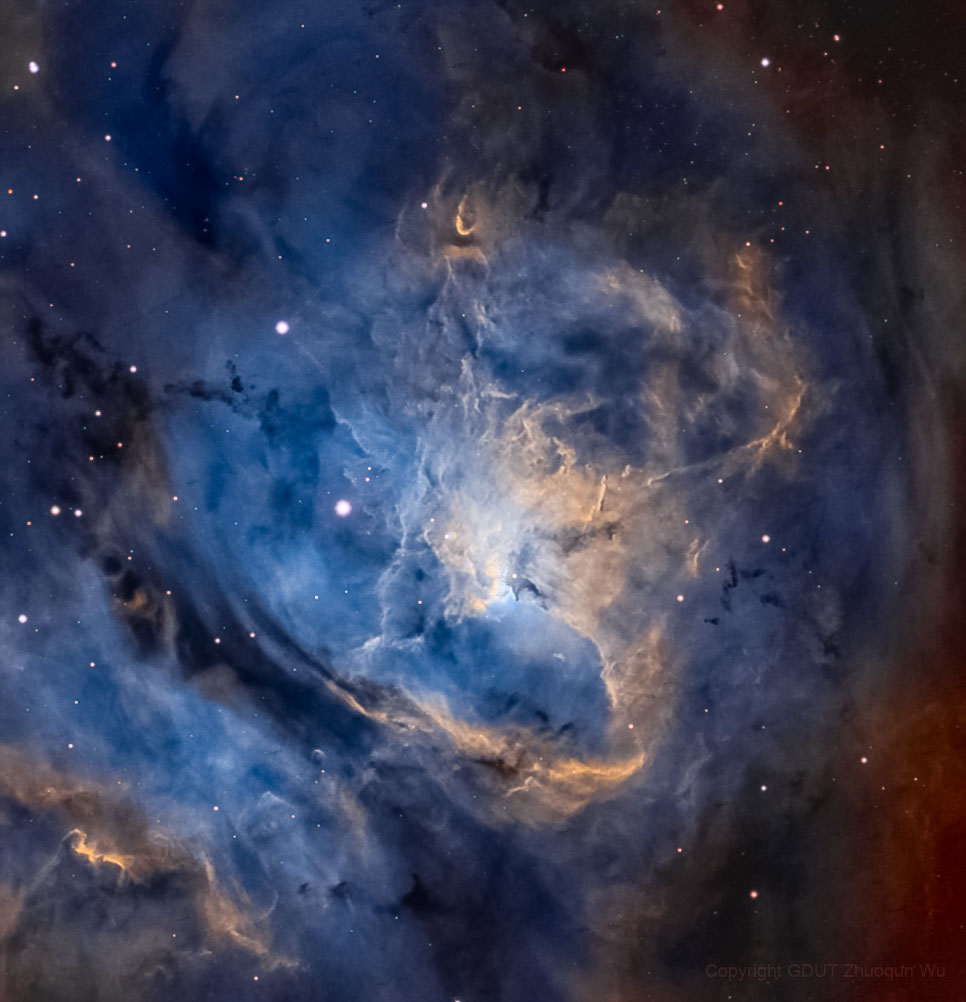
Stars are battling gas and dust in the Lagoon Nebula but the photographers are winning. Also known as M8, this photogenic nebula is visible even without binoculars towards the constellation of the Archer (Sagittarius). The energetic processes of star formation create not only the colors but the chaos. The glowing gas results from high-energy starlight striking interstellar hydrogen gas and trace amounts of sulfur, and oxygen gases. The dark dust filaments that lace M8 were created in the atmospheres of cool giant stars and in the debris from supernovae explosions. The light from M8 we see today left about 5,000 years ago. Light takes about 50 years to cross this section of M8.

from NASA https://ift.tt/2NDZqXr
via IFTTT

M42: Inside the Orion Nebula


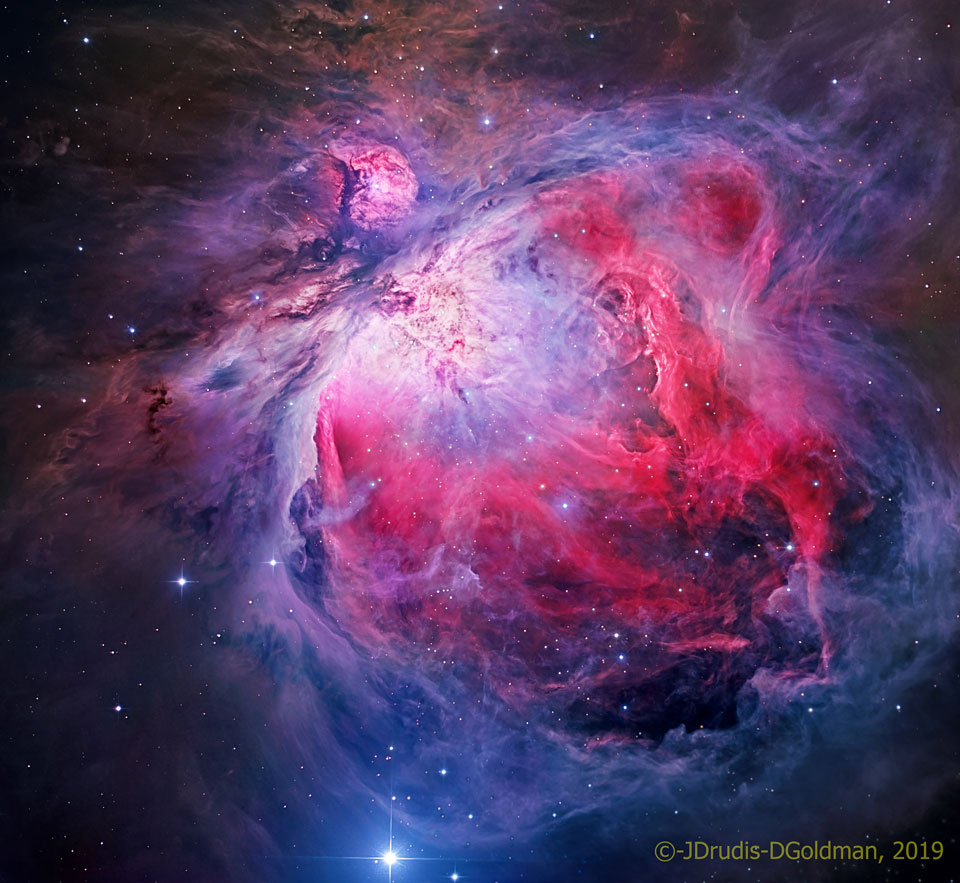
The Great Nebula in Orion, an immense, nearby starbirth region, is probably the most famous of all astronomical nebulas. Here, glowing gas surrounds hot young stars at the edge of an immense interstellar molecular cloud only 1500 light-years away. In the featured deep image in assigned colors highlighted by emission in oxygen and hydrogen, wisps and sheets of dust and gas are particularly evident. The Great Nebula in Orion can be found with the unaided eye near the easily identifiable belt of three stars in the popular constellation Orion. In addition to housing a bright open cluster of stars known as the Trapezium, the Orion Nebula contains many stellar nurseries. These nurseries contain much hydrogen gas, hot young stars, proplyds, and stellar jets spewing material at high speeds. Also known as M42, the Orion Nebula spans about 40 light years and is located in the same spiral arm of our Galaxy as the Sun.

from NASA https://ift.tt/2NjuSu4
via IFTTT