In, Through, and Beyond Saturn’s Rings


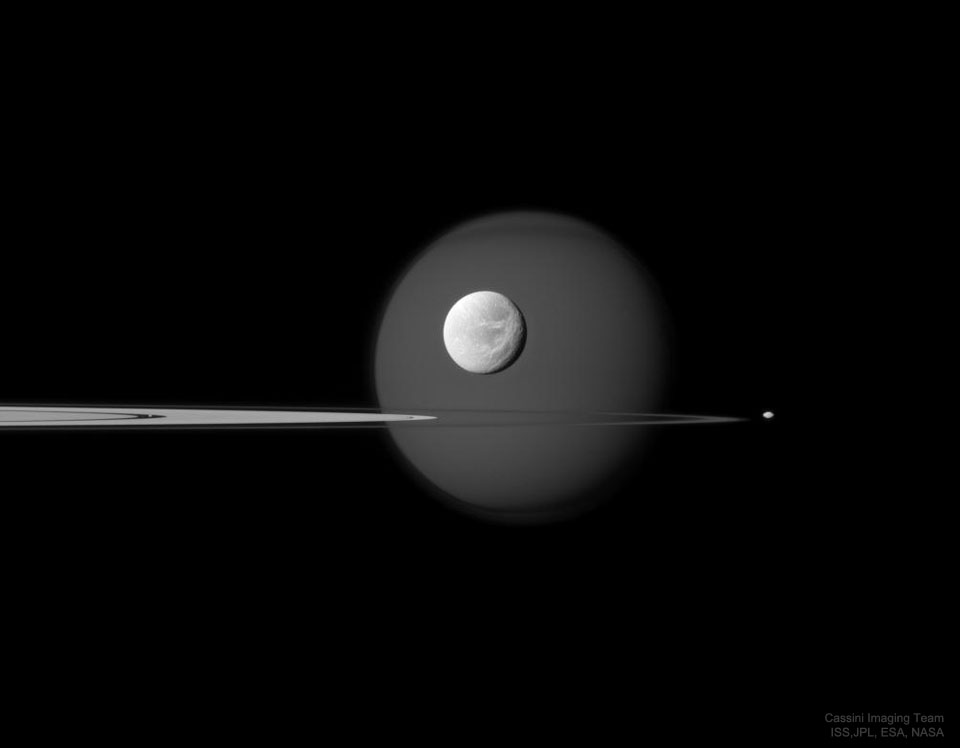
Four moons are visible on the featured image — can you find them all? First — and farthest in the background — is Titan, the largest moon of Saturn and one of the larger moons in the Solar System. The dark feature across the top of this perpetually cloudy world is the north polar hood. The next most obvious moon is bright Dione, visible in the foreground, complete with craters and long ice cliffs. Jutting in from the left are several of Saturn’s expansive rings, including Saturn’s A ring featuring the dark Encke Gap. On the far right, just outside the rings, is Pandora, a moon only 80-kilometers across that helps shepherd Saturn’s F ring. The fourth moon? If you look closely inside Saturn’s rings, in the Encke Gap, you will find a speck that is actually Pan. Although one of Saturn’s smallest moons at 35-kilometers across, Pan is massive enough to help keep the Encke gap relatively free of ring particles. After more than a decade of exploration and discovery, the Cassini spacecraft ran low on fuel in 2017 and was directed to enter Saturn’s atmosphere, where it surely melted.

from NASA https://ift.tt/39HnCEd
via IFTTT
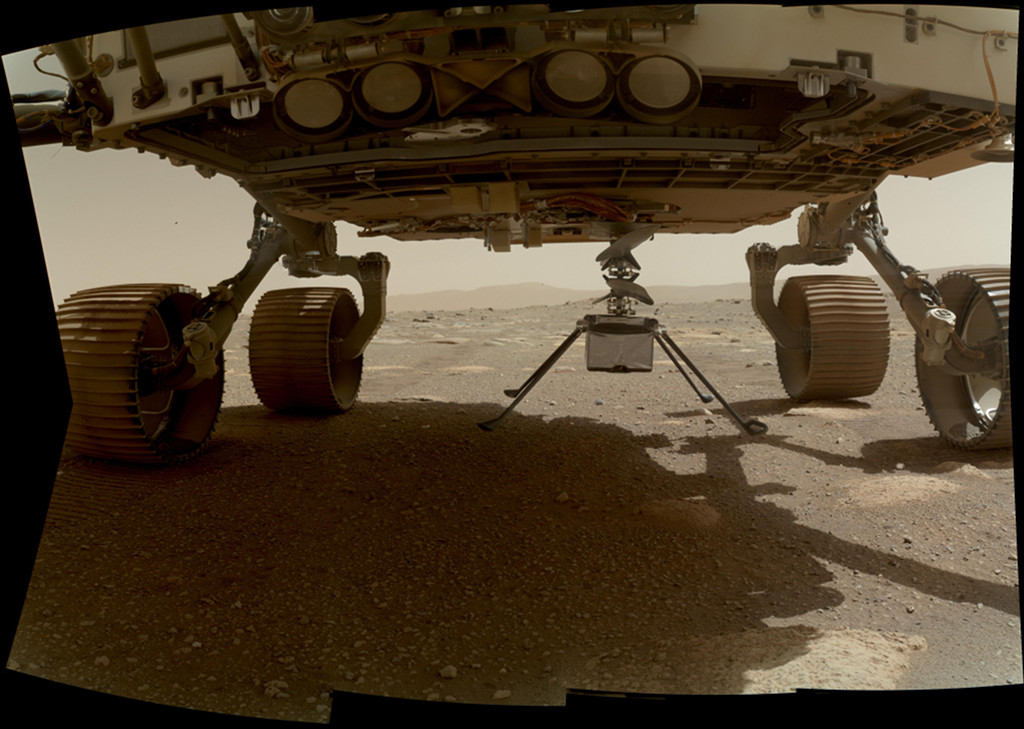
Ingenuity on Sol 39


The Mars Ingenuity Helicopter, all four landing legs down, was captured here on sol 39 (March 30) slung beneath the belly of the Perseverance rover. The near ground level view is a mosaic of images from the WATSON camera on the rover’s SHERLOC robotic arm. Near the center of the frame the experimental helicopter is suspended just a few centimeters above the martian surface. Tracks from Perseverance extend beyond the rover’s wheels with the rim of Jezero crater visible about 2 kilometers in the distance. Ingenuity has a weight of 1.8 kilograms or 4 pounds on Earth. That corresponds to a weight of 0.68 kilograms or 1.5 pounds on Mars. With rotor blades spanning 1.2 meters it will attempt to make the first powered flight of an aircraft on another planet in the thin martian atmosphere, 1 percent as dense as Earth’s, no earlier than sol 48 (April 8).

from NASA https://ift.tt/2Py4BgL
via IFTTT

NGC 3521: Galaxy in a Bubble


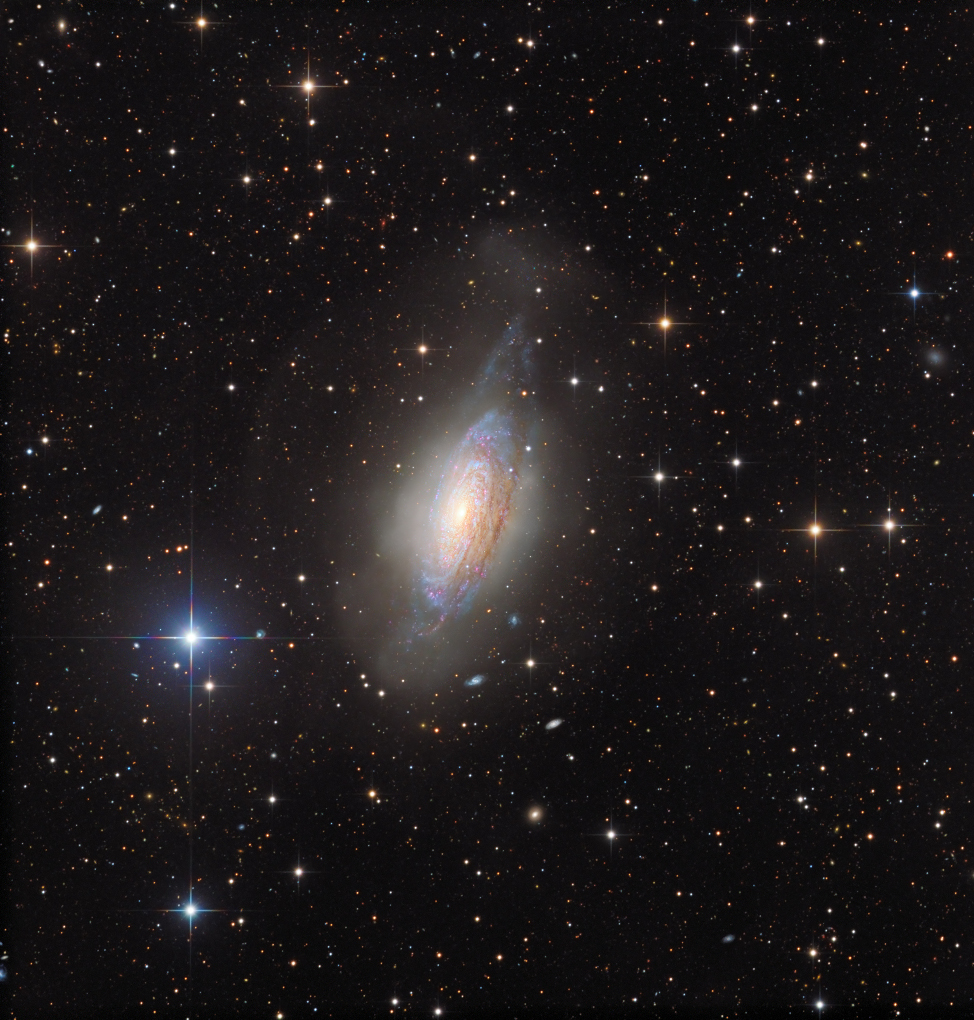
Gorgeous spiral galaxy NGC 3521 is a mere 35 million light-years away, toward the constellation Leo. Relatively bright in planet Earth’s sky, NGC 3521 is easily visible in small telescopes but often overlooked by amateur imagers in favor of other Leo spiral galaxies, like M66 and M65. It’s hard to overlook in this colorful cosmic portrait, though. Spanning some 50,000 light-years the galaxy sports characteristic patchy, irregular spiral arms laced with dust, pink star forming regions, and clusters of young, blue stars. Remarkably, this deep image also finds NGC 3521 embedded in gigantic bubble-like shells. The shells are likely tidal debris, streams of stars torn from satellite galaxies that have undergone mergers with NGC 3521 in the distant past.

from NASA https://ift.tt/39Cs6fn
via IFTTT

Rocket Launch as Seen from the Space Station


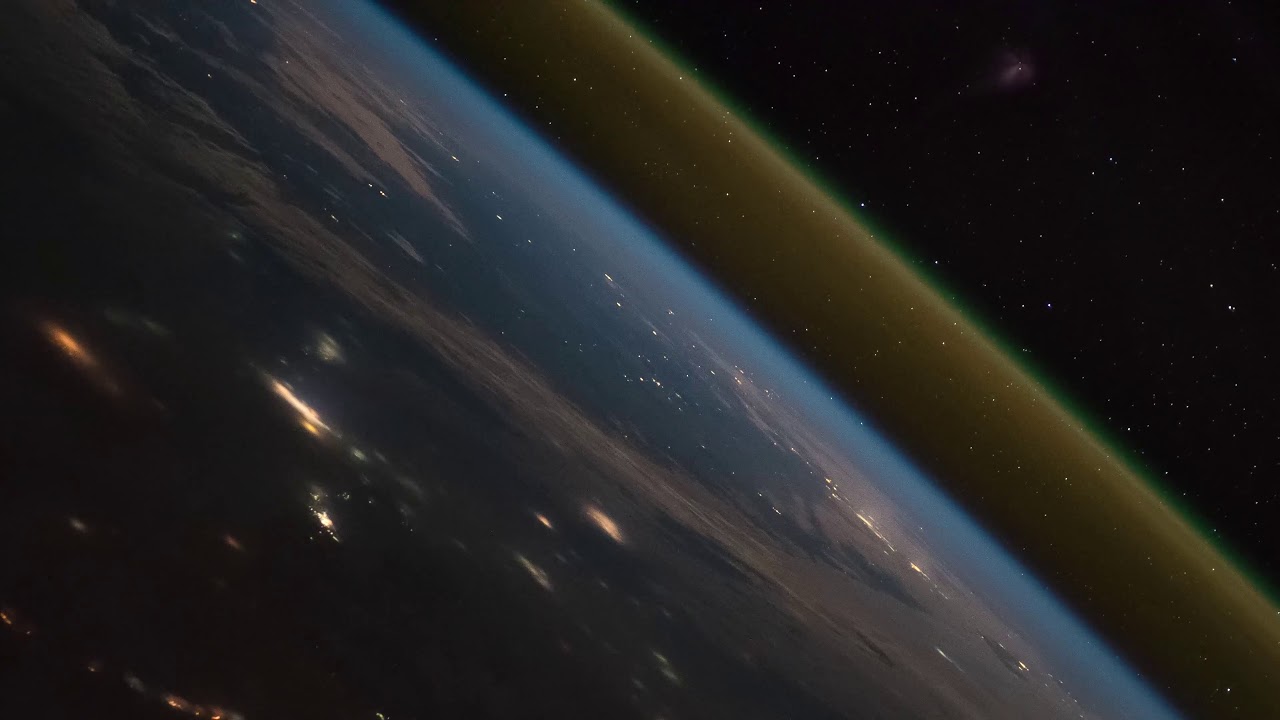
Have you ever seen a rocket launch — from space? A close inspection of the featured time-lapse video will reveal a rocket rising to Earth orbit as seen from the International Space Station (ISS). The Russian Soyuz-FG rocket was launched in November 2018 from the Baikonur Cosmodrome in Kazakhstan, carrying a Progress MS-10 (also 71P) module to bring needed supplies to the ISS. Highlights in the 90-second video (condensing about 15-minutes) include city lights and clouds visible on the Earth on the lower left, blue and gold bands of atmospheric airglow running diagonally across the center, and distant stars on the upper right that set behind the Earth. A lower stage can be seen falling back to Earth as the robotic supply ship fires its thrusters and begins to close on the ISS, a space laboratory that celebrated its 20th anniversary in 2018. Astronauts who live aboard the Earth-orbiting ISS conduct, among more practical duties, numerous science experiments that expand human knowledge and enable future commercial industry in low Earth orbit.

from NASA https://ift.tt/3rB9jqR
via IFTTT

M87s Central Black Hole in Polarized Light


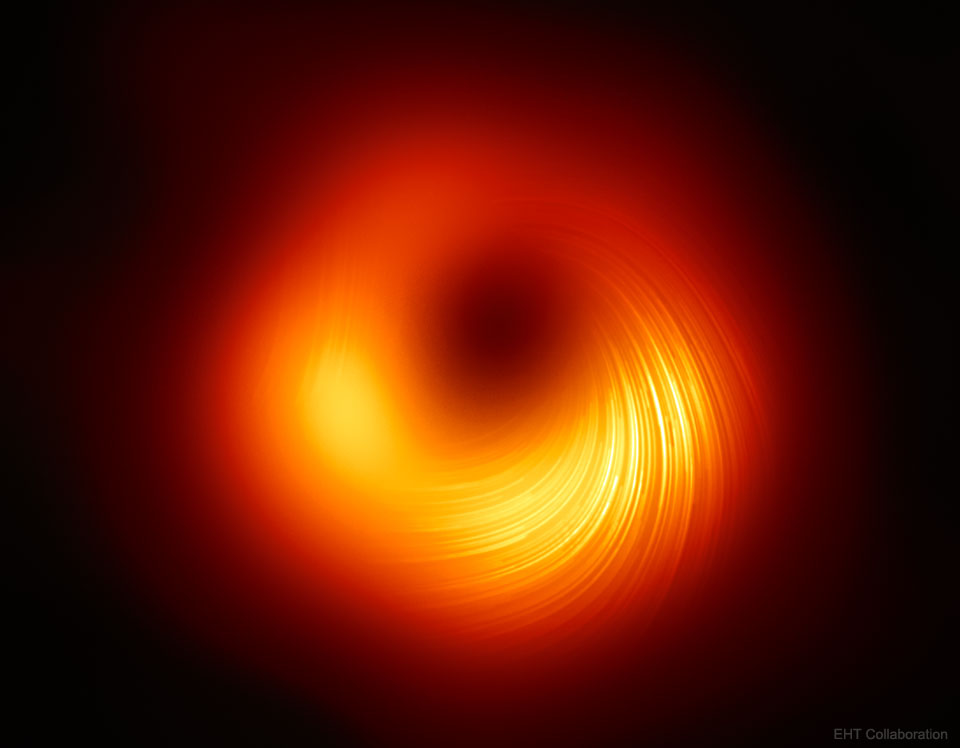
To play on Carl Sagan��������s famous words “If you wish to make black hole jets, you must first create magnetic fields.” The featured image represents the detected intrinsic spin direction (polarization) of radio waves. The polarizationi is produced by the powerful magnetic field surrounding the supermassive black hole at the center of elliptical galaxy M87. The radio waves were detected by the Event Horizon Telescope (EHT), which combines data from radio telescopes distributed worldwide. The polarization structure, mapped using computer generated flow lines, is overlaid on EHT��������s famous black hole image, first published in 2019. The full 3-D magnetic field is complex. Preliminary analyses indicate that parts of the field circle around the black hole along with the accreting matter, as expected. However, another component seemingly veers vertically away from the black hole. This component could explain how matter resists falling in and is instead launched into M87��������s jet.

from NASA https://ift.tt/2PmPRkz
via IFTTT

Red Sprite Lightning over the Andes


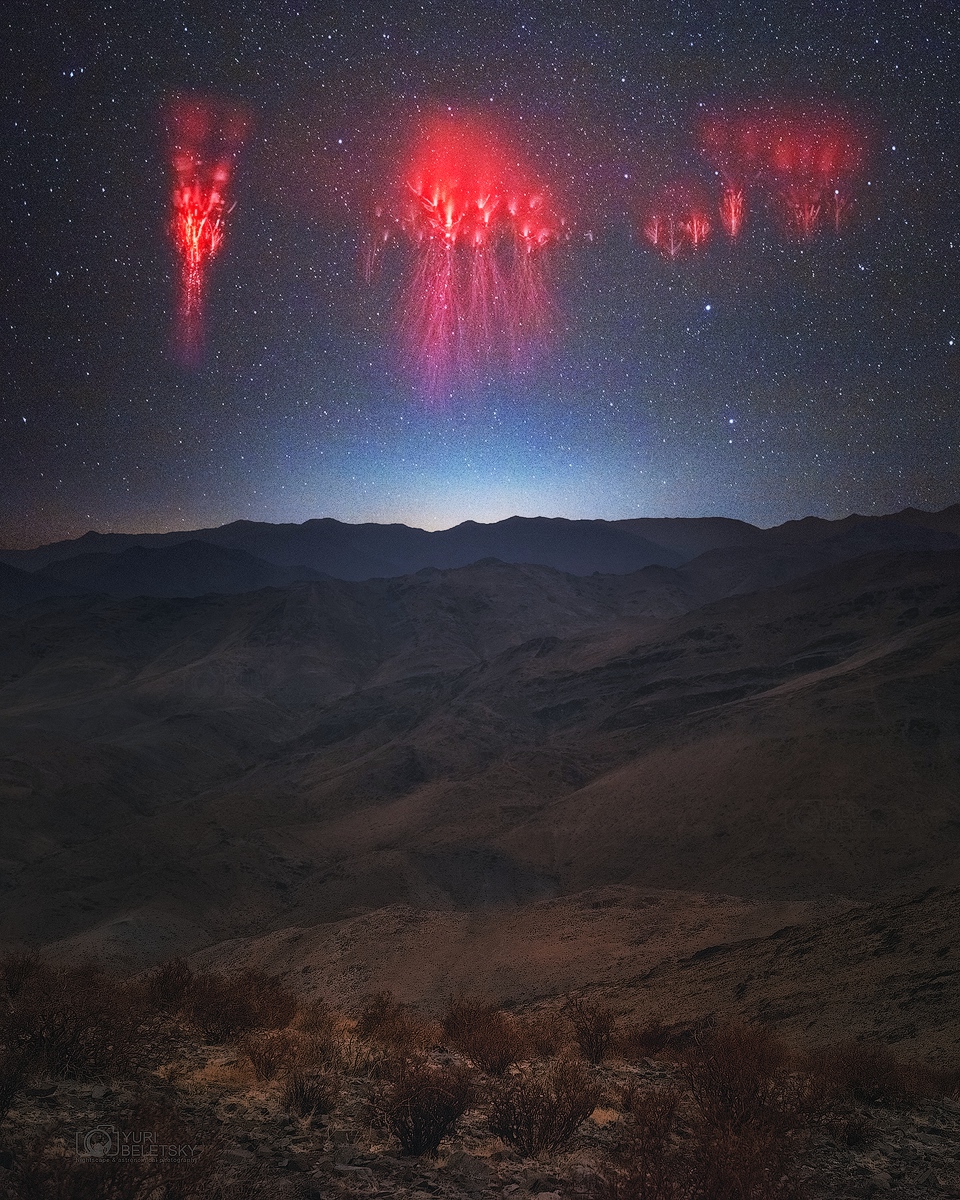
What are those red filaments in the sky? They are a rarely seen form of lightning confirmed only about 30 years ago: red sprites. Recent research has shown that following a powerful positive cloud-to-ground lightning strike, red sprites may start as 100-meter balls of ionized air that shoot down from about 80-km high at 10 percent the speed of light. They are quickly followed by a group of upward streaking ionized balls. The featured image was taken earlier this year from Las Campanas observatory in Chile over the Andes Mountains in Argentina. Red sprites take only a fraction of a second to occur and are best seen when powerful thunderstorms are visible from the side.

from NASA https://ift.tt/3ryEV0t
via IFTTT

M64: The Evil Eye Galaxy


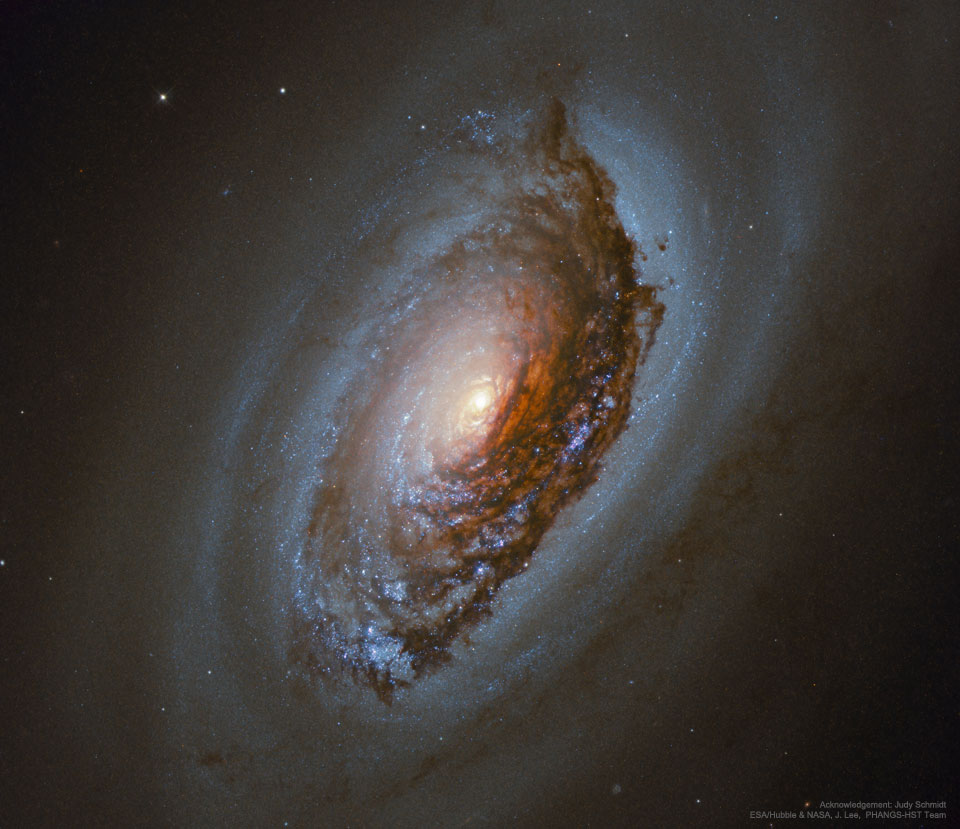
Who knows what evil lurks in the eyes of galaxies? The Hubble knows — or in the case of spiral galaxy M64 — is helping to find out. Messier 64, also known as the Evil Eye or Sleeping Beauty Galaxy, may seem to have evil in its eye because all of its stars rotate in the same direction as the interstellar gas in the galaxy’s central region, but in the opposite direction in the outer regions. Captured here in great detail by the Earth-orbiting Hubble Space Telescope, enormous dust clouds obscure the near-side of M64‘s central region, which are laced with the telltale reddish glow of hydrogen associated with star formation. M64 lies about 17 million light years away, meaning that the light we see from it today left when the last common ancestor between humans and chimpanzees roamed the Earth. The dusty eye and bizarre rotation are likely the result of a billion-year-old merger of two different galaxies.

from NASA https://ift.tt/3dd8fo0
via IFTTT

SuitSat 1: A Spacesuit Floats Free


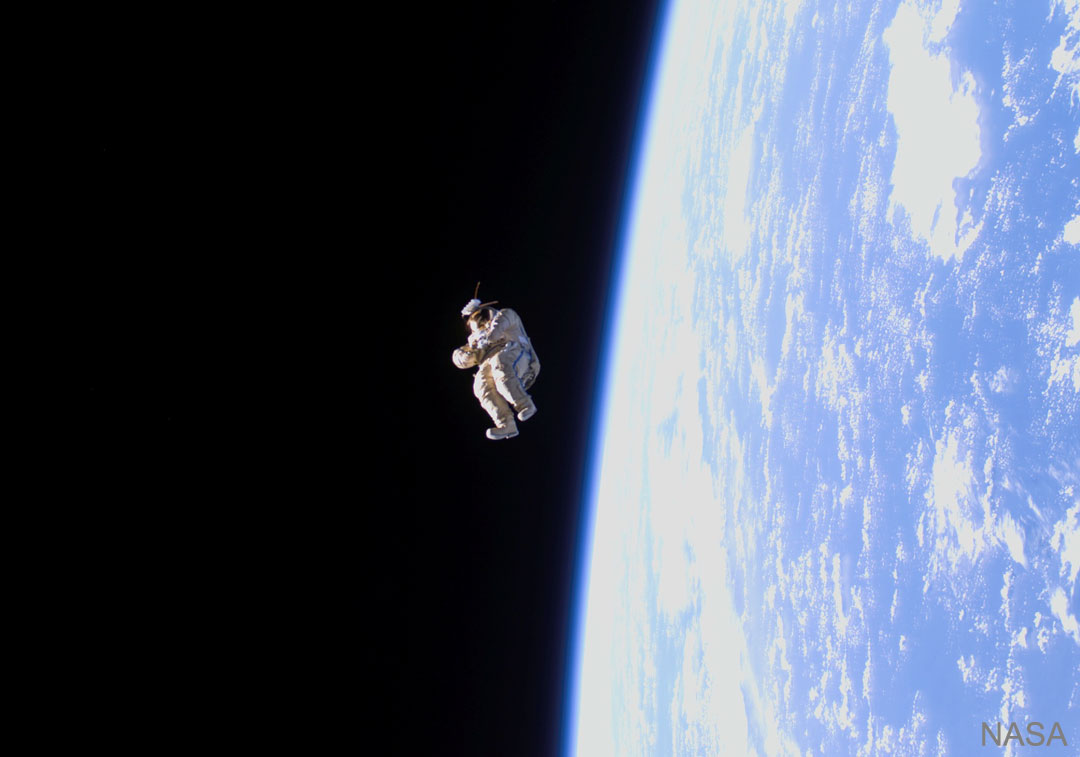
A spacesuit floated away from the International Space Station 15 years ago, but no investigation was conducted. Everyone knew that it was pushed by the space station crew. Dubbed Suitsat-1, the unneeded Russian Orlan spacesuit filled mostly with old clothes was fitted with a faint radio transmitter and released to orbit the Earth. The suit circled the Earth twice before its radio signal became unexpectedly weak. Suitsat-1 continued to orbit every 90 minutes until it burned up in the Earth’s atmosphere after a few weeks. Pictured, the lifeless spacesuit was photographed in 2006 just as it drifted away from space station.

from NASA https://ift.tt/3u5MMnX
via IFTTT

Exploring the Antennae


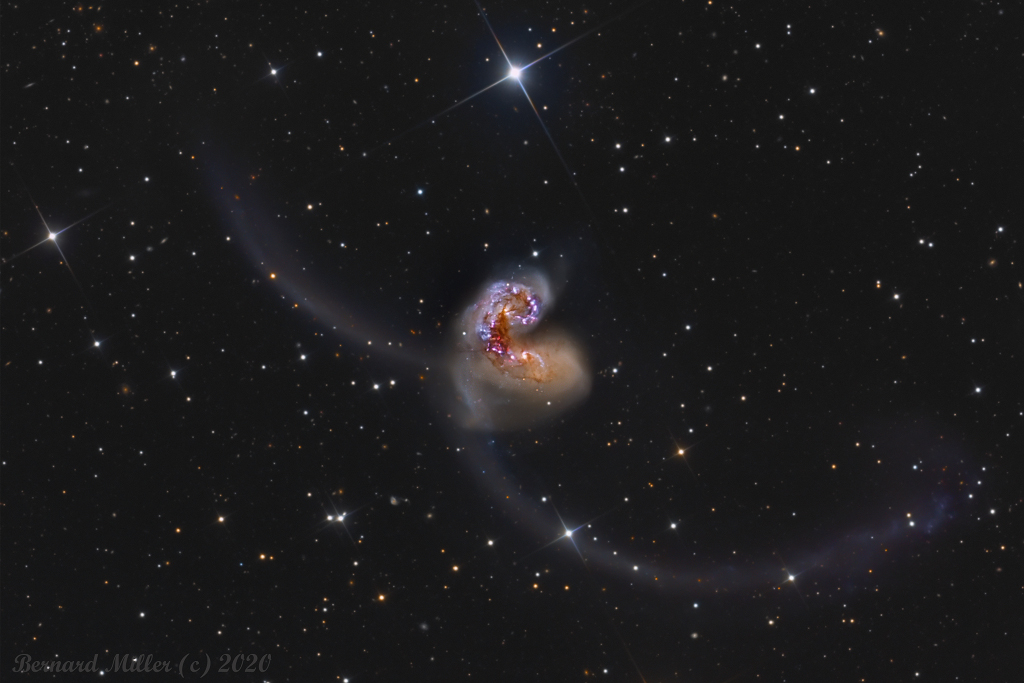
Some 60 million light-years away in the southerly constellation Corvus, two large galaxies are colliding. Stars in the two galaxies, cataloged as NGC 4038 and NGC 4039, very rarely collide in the course of the ponderous cataclysm that lasts for hundreds of millions of years. But the galaxies’ large clouds of molecular gas and dust often do, triggering furious episodes of star formationi near the center of the cosmic wreckage. Spanning over 500 thousand light-years, this stunning view also reveals new star clusters and matter flung far from the scene of the accident by gravitational tidal forces. The remarkably sharp ground-based image includes narrowband data that highlights the characteristic red glow of atomic hydrogen gas in star-forming regions. The suggestive overall visual appearance of the extended arcing structures gives the galaxy pair its popular name – The Antennae.

from NASA https://ift.tt/3w5bPJl
via IFTTT

The Medusa Nebula


Braided and serpentine filaments of glowing gas suggest this nebula’s popular name, The Medusa Nebula. Also known as Abell 21, this Medusa is an old planetary nebula some 1,500 light-years away in the constellation Gemini. Like its mythological namesake, the nebula is associated with a dramatic transformation. The planetary nebula phase represents a final stage in the evolution of low mass stars like the sun as they transform themselves from red giants to hot white dwarf stars and in the process shrug off their outer layers. Ultraviolet radiation from the hot star powers the nebular glow. The Medusa’s transforming star is the faint one near the center of the overall bright crescent shape. In this deep telescopic view, fainter filaments clearly extend above and right of the bright crescent region. The Medusa Nebula is estimated to be over 4 light-years across.

from NASA https://ift.tt/3ssudK7
via IFTTT