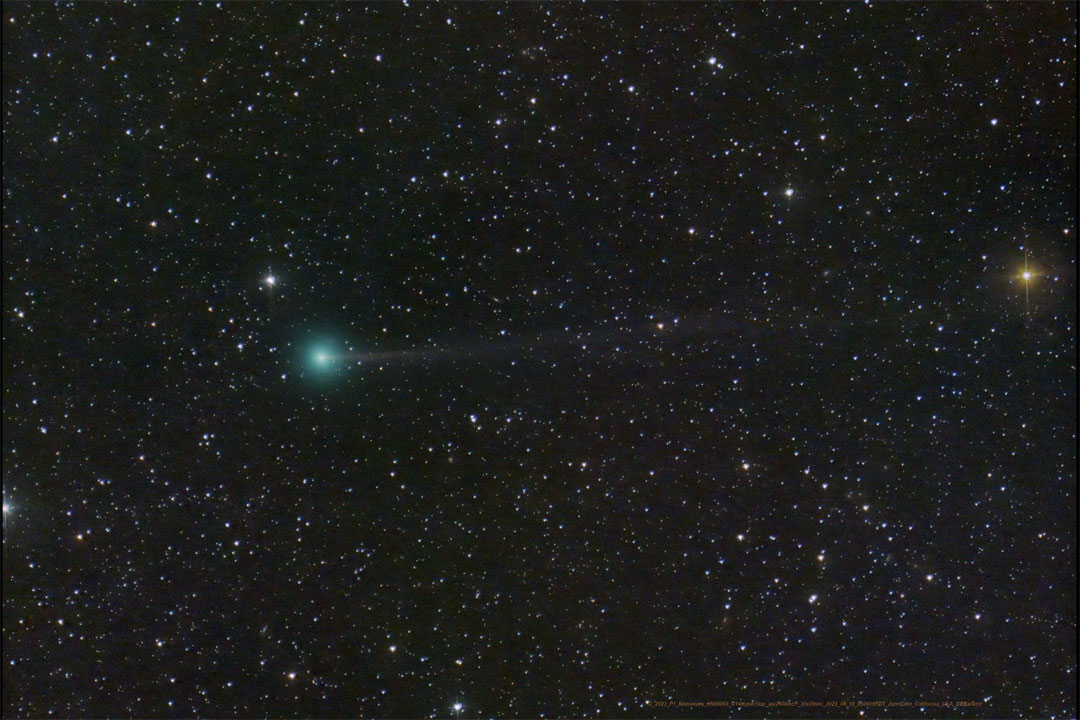
Will Comet Nishimura become visible to the unaided eye? Given the unpredictability of comets, no one can say for sure, but it currently seems like a good bet. The comet was discovered only ten days ago by Hideo Nishimura during 30-second exposures with a standard digital camera. Since then, C/2023 P1 Nishimura has increased in brightness and its path across the inner Solar System determined. As the comet dives toward the Sun, it will surely continue to intensify and possibly become a naked-eye object in early September. A problem is that the comet will also be angularly near the Sun, so it will only be possible to see it near sunset or sunrise. The comet will get so close to the Sun — inside the orbit of planet Mercury — that its nucleus may break up. Pictured, Comet Nishimura was imaged three days ago from June Lake, California, USA while sporting a green coma and a thin tail.

from NASA https://ift.tt/E17wZRi
via IFTTT
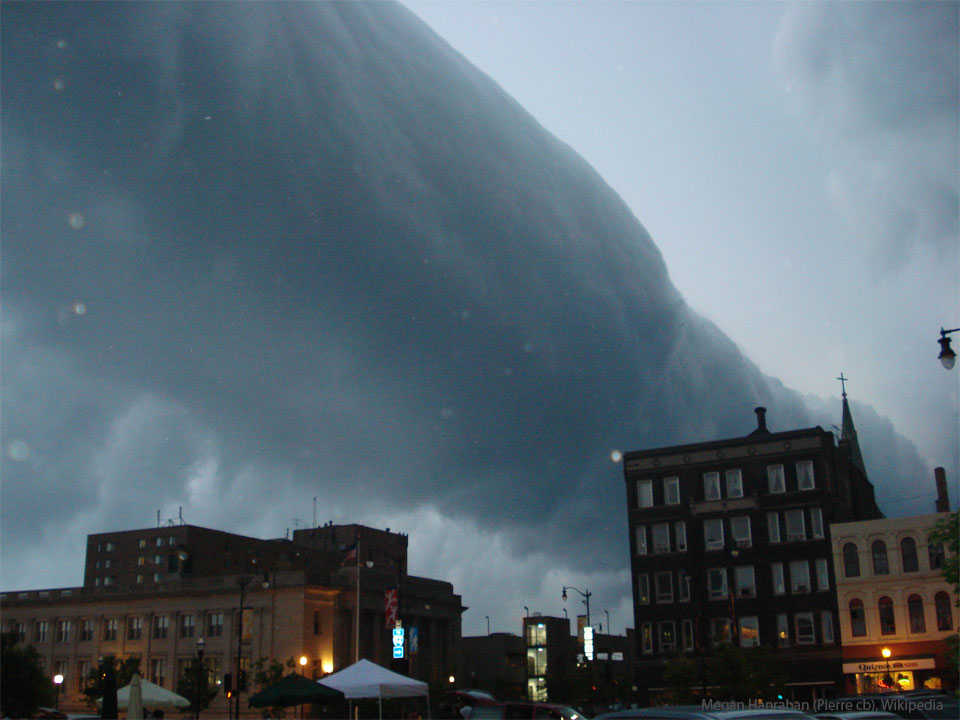

What kind of cloud is this? A type of arcus cloud called a roll cloud. These rare long clouds may form near advancing cold fronts. In particular, a downdraft from an advancing storm front can cause moist warm air to rise, cool below its dew point, and so form a cloud. When this happens uniformly along an extended front, a roll cloud may form. Roll clouds may actually have air circulating along the long horizontal axis of the cloud. A roll cloud is not thought to be able to morph into a tornado. Unlike a similar shelf cloud, a roll cloud is completely detached from their parent cumulonimbus cloud. Pictured here, a roll cloud extends far into the distance as a storm approaches in 2007 in Racine, Wisconsin, USA.

from NASA https://ift.tt/jq0GrXy
via IFTTT

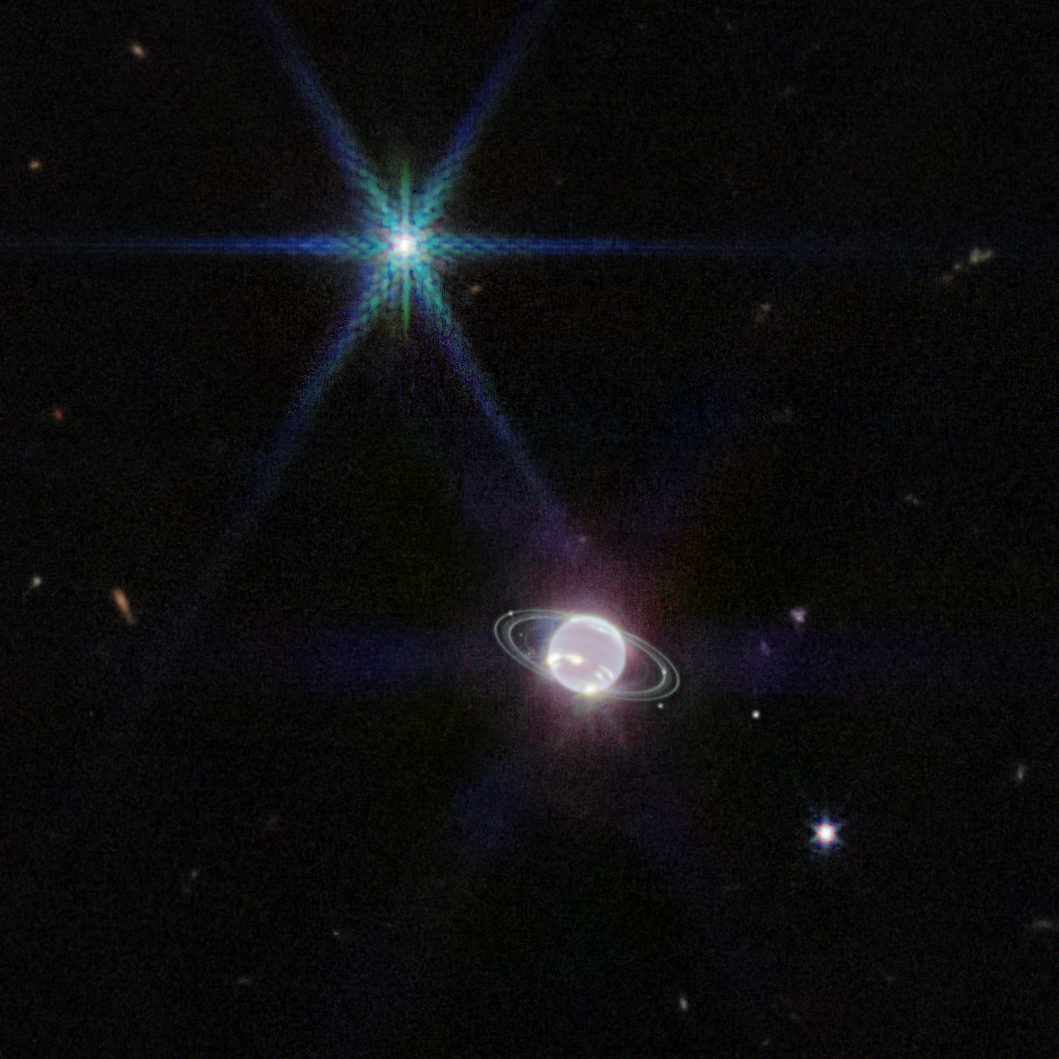
Ringed Ice Giant Neptune


Ringed ice giant Neptune lies near the center of this sharp near-infrared image from the James Webb Space Telescope. The dim and distant world is the farthest planet from the Sun, about 30 times farther away than planet Earth. But in the stunning Webb view, the planet’s dark and ghostly appearance is due to atmospheric methane that absorbs infrared light. High altitude clouds that reach above most of Neptune’s absorbing methane easily stand out in the image though. Coated with frozen nitrogen, Neptune’s largest moon Triton is brighter than Neptune in reflected sunlight, seen at the upper left sporting the Webb telescope’s characteristic diffraction spikes. Including Triton, seven of Neptune’s 14 known moons can be identified in the field of view. Neptune’s faint rings are striking in this space-based planetary portrait. Details of the complex ring system are seen here for the first time since Neptune was visited by the Voyager 2 spacecraft in August 1989.

from NASA https://ift.tt/RCnPUaK
via IFTTT

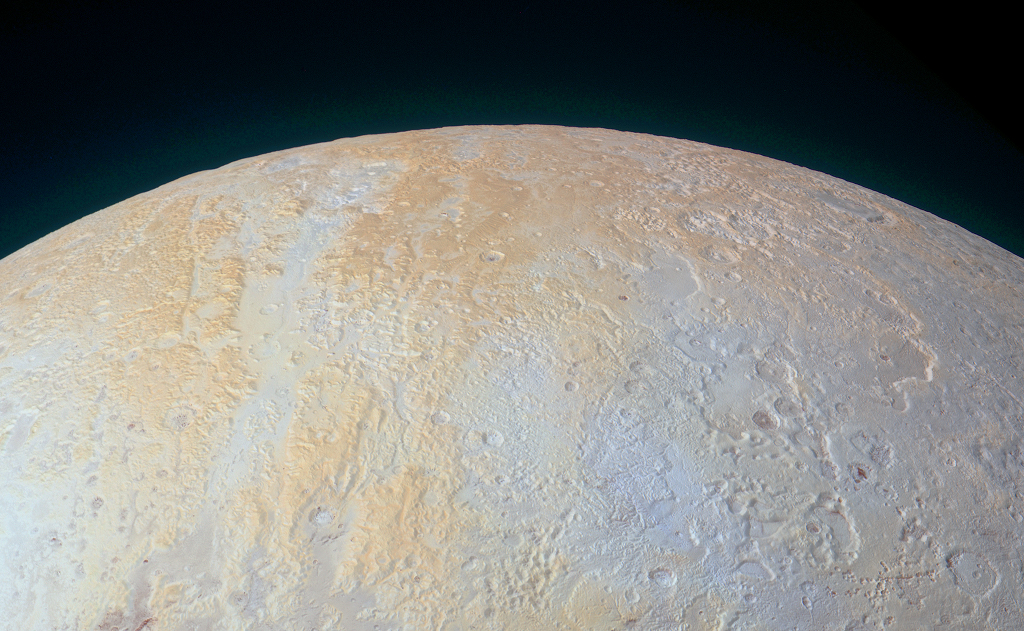
Northern Pluto


Gaze across the frozen canyons of northern Pluto in this contrast enhanced color scene. The image data used to construct it was acquired in July 2015 by the New Horizons spacecraft as it made the first reconnaissance flight through the remote Pluto system six billion kilometers from the Sun. Now known as Lowell Regio, the region was named for Percival Lowell, founder of the Lowell Observatory. Also famous for his speculation that there were canals on Mars, Lowell started the search that ultimately led to Pluto’s discovery in 1930 by Clyde Tombaugh. In this frame Pluto’s North Pole is above and left of center. The pale bluish floor of the broad canyon on the left is about 70 kilometers (45 miles) wide, running vertically toward the south. Higher elevations take on a yellowish hue. New Horizon’s measurements were used to determine that in addition to nitrogen ice, methane ice is abundant across Lowell Regio. So far, Pluto is the only Solar System world named by an 11-year-old girl.

from NASA https://ift.tt/pfrlYe5
via IFTTT

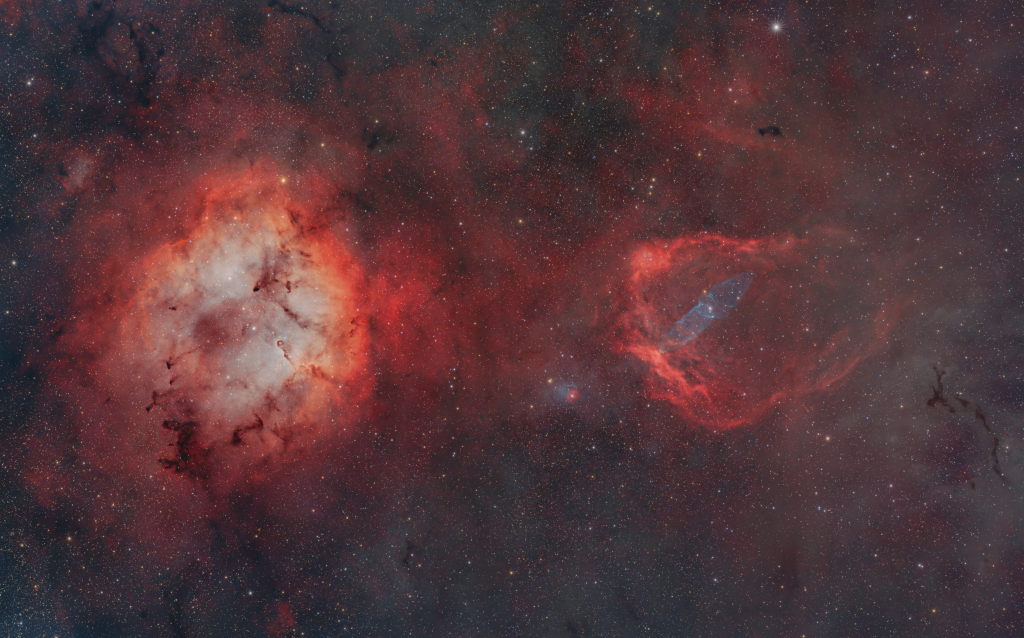
A Cosmic Zoo in Cepheus


Sprawling emission nebulae IC 1396 and Sh2-129 mix glowing interstellar gas and dark dust clouds in this nearly 12 degree wide field of view toward the northern constellation Cepheus the King. Energized by its central star IC 1396 (left), is hundreds of light-years across and some 3,000 light-years distant. The nebula’s intriguing dark shapes include a winding dark cloud popularly known as the Elephant’s Trunk below and right of center. Tens of light-years long, it holds the raw material for star formation and is known to hide protostars within. Located a similar distance from planet Earth, the bright knots and swept back ridges of emission of Sh2-129 on the right suggest its popular name, the Flying Bat Nebula. Within the Flying Bat, the most recently recognized addition to this royal cosmic zoo is the faint bluish emission from Ou4, the Giant Squid Nebula. Near the lower right edge of the frame, the suggestive dark marking on the sky cataloged as Barnard 150 is also known as the dark Seahorse Nebula.

from NASA https://ift.tt/G8gn17l
via IFTTT

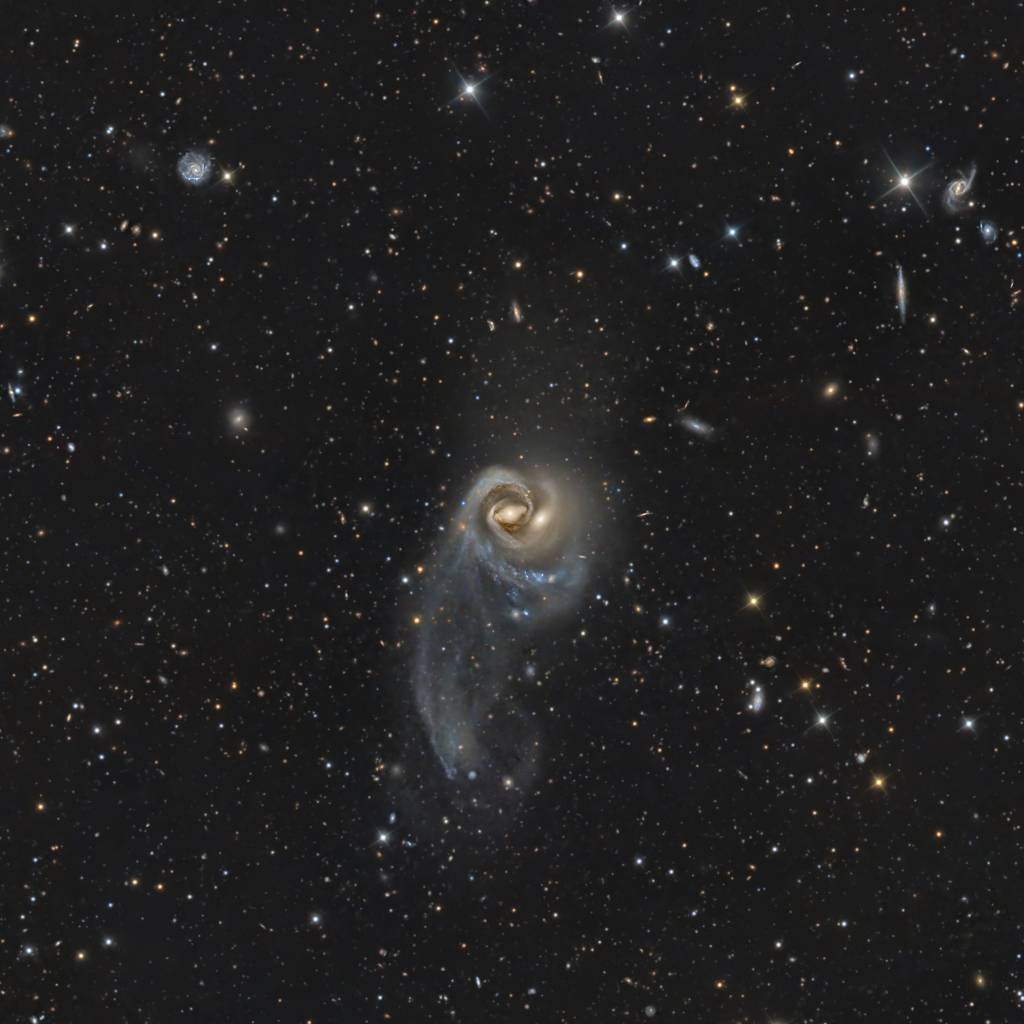
Arp 93: A Cosmic Embrace


Locked in a cosmic embrace, two large galaxies are merging at the center of this sharp telescopic field of view. The interacting system cataloged as Arp 93 is some 200 million light-years distant toward the constellation Aquarius in planet Earth’s sky. Individually the galaxies are identified as NGC 7285 (right) and NGC 7284. Their bright cores are still separated by about 20,000 light-years or so, but a massive tidal stream, a result of their ongoing gravitational interaction, extends over 200,000 light-years toward the bottom of the frame. Interacting galaxies do look peculiar, but are now understood to be common in the Universe. In fact, closer to home, the large spiral Andromeda Galaxy is known to be approaching the Milky Way. Arp 93 may well present an analog of their distant future cosmic embrace.

from NASA https://ift.tt/yNxjeUB
via IFTTT


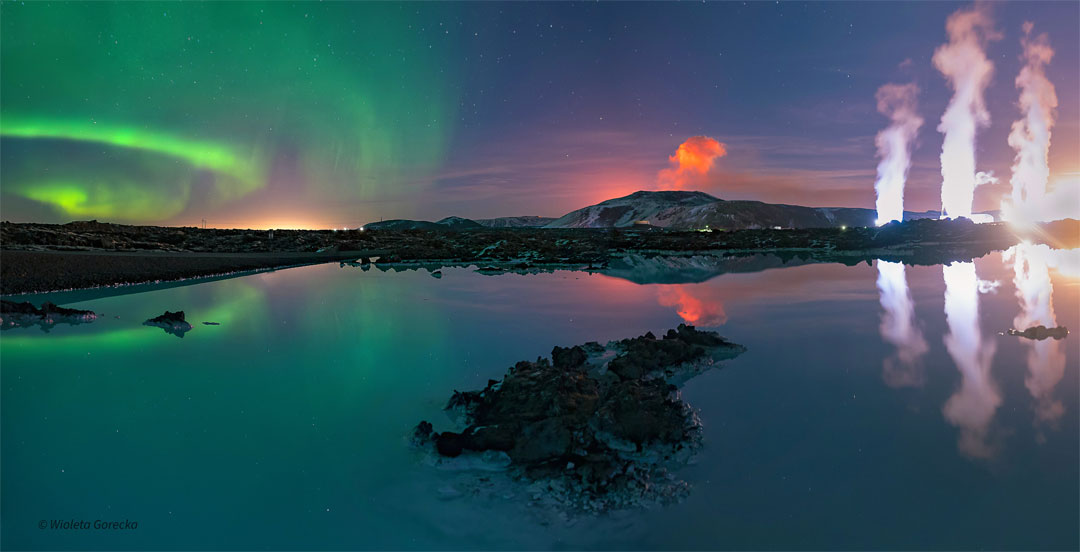
The Sun is not the quiet place it seems. It expels an unsteady stream of energetic electrons and protons known as the solar wind. These charged particles deform the Earth’s magnetosphere, change paths, and collide with atoms in Earth’s atmosphere, causing the generation of light in auroras like that visible in green in the image left. Earth itself is also geologically active and covered with volcanoes. For example, Fagradalsfjall volcano in Iceland, seen emitting hot gas in orange near the image center. Iceland is one of the most geologically active places on Earth. On the far right is the Svartsengi geothermal power plant which creates the famous human-made Blue Lagoon, shown emitting white gas plumes. The featured composition therefore highlights three different sky phenomena, including both natural and human-made phenomena.

from NASA https://ift.tt/lUen4qT
via IFTTT


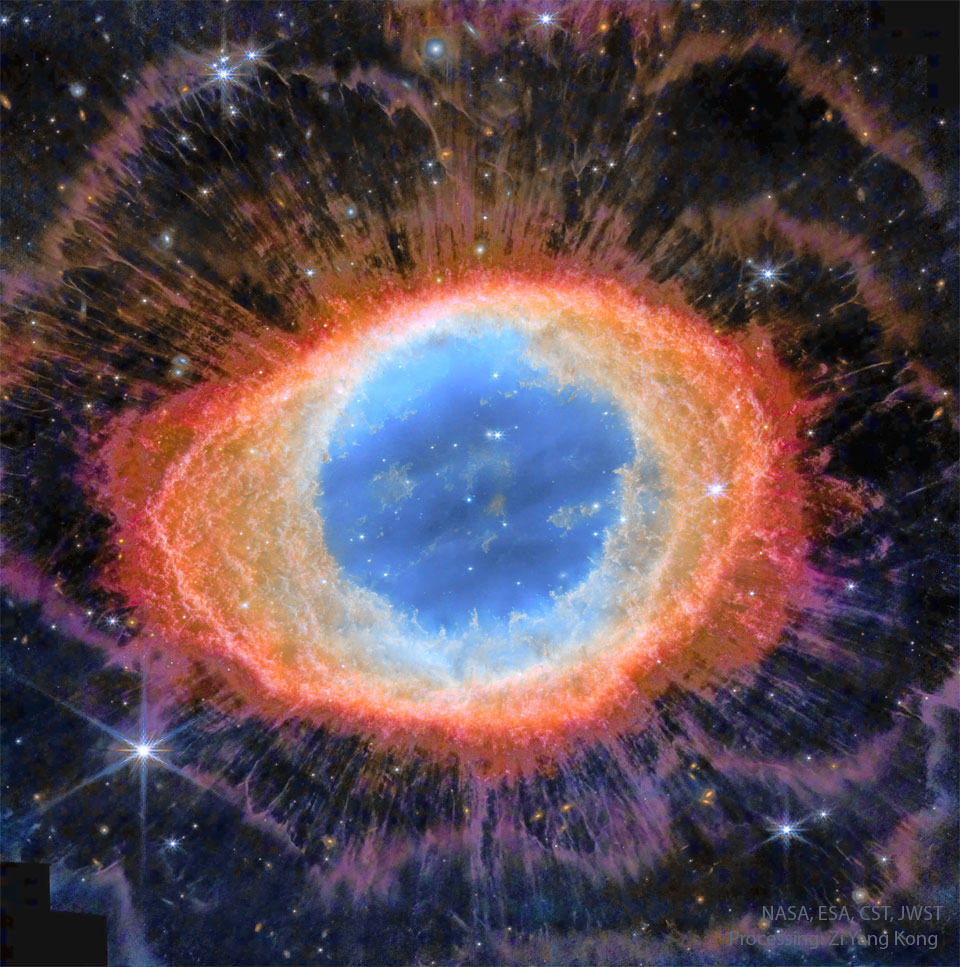
The Ring Nebula (M57), is more complicated than it appears through a small telescope. The easily visible central ring is about one light-year across, but this remarkable exposure by the James Webb Space Telescope explores this popular nebula with a deep exposure in infrared light. Strings of gas, like eyelashes around a cosmic eye, become evident around the Ring in this digitally enhanced featured image in assigned colors. These long filaments may be caused by shadowing of knots of dense gas in the ring from energetic light emitted within. The Ring Nebula is an elongated planetary nebula, a type of gas cloud created when a Sun-like star evolves to throw off its outer atmosphere to become a white dwarf star. The central oval in the Ring Nebula lies about 2,500 light-years away toward the musical constellation Lyra.

from NASA https://ift.tt/uRT20DQ
via IFTTT


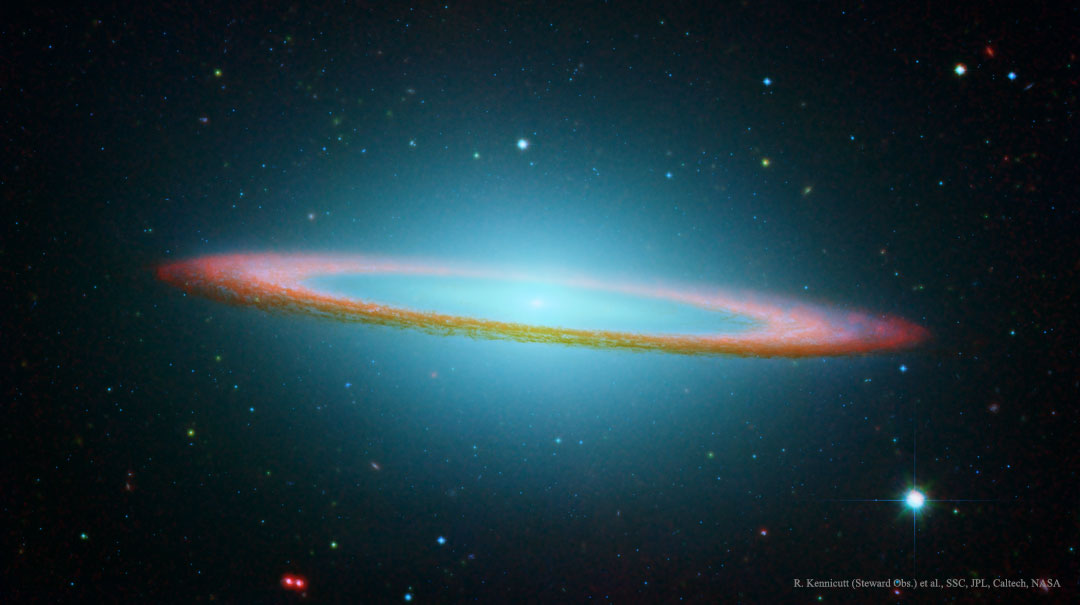
This floating ring is the size of a galaxy. In fact, it is a galaxy — or at least part of one: the photogenic Sombrero Galaxy, one of the largest galaxies in the nearby Virgo Cluster of Galaxies. The dark band of dust that obscures the mid-section of the Sombrero Galaxy in optical light actually glows brightly in infrared light. The featured image, digitally sharpened, shows the infrared glow, recently recorded by the orbiting Spitzer Space Telescope, superposed in false-color on an existing image taken by NASA’s Hubble Space Telescope in visible light. The Sombrero Galaxy, also known as M104, spans about 50,000 light years across and lies 28 million light years away. M104 can be seen with a small telescope in the direction of the constellation Virgo.

from NASA https://ift.tt/UD1Ci08
via IFTTT

Ghirigori Star Scribbles


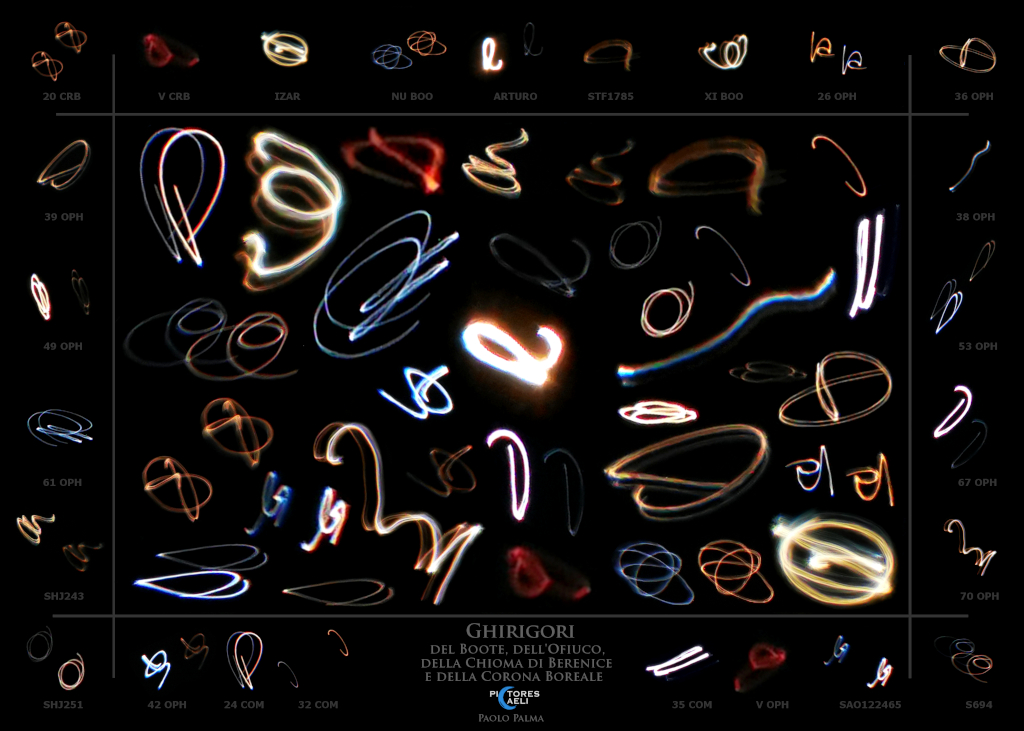
It’s fun to scribble on the canvas of the sky. You can use a creative photographic technique to cause the light of point-like stars to dance across a digital image by tapping lightly on the telescope while making an exposure. The result will be a squiggly line traced by the star (or two squiggles traced by binary stars) that can reveal the star’s color. Colorful lines, dubbed Ghirigori, made from stars found in the northern sky constellations Bootes, Corona Borealis, Ophiucus, and Coma Berenices, are captured in this artistic mosaic. The 25 stars creating the varied and colorful squiggles are identified around the border. Of course, temperature determines the color of a star. While whitish stars tend to be close to the Sun’s temperature, stars with bluer hues are hotter, and yellow and red colors are cooler than the Sun.

from NASA https://ift.tt/cQxb3m5
via IFTTT