Pluto in True Color


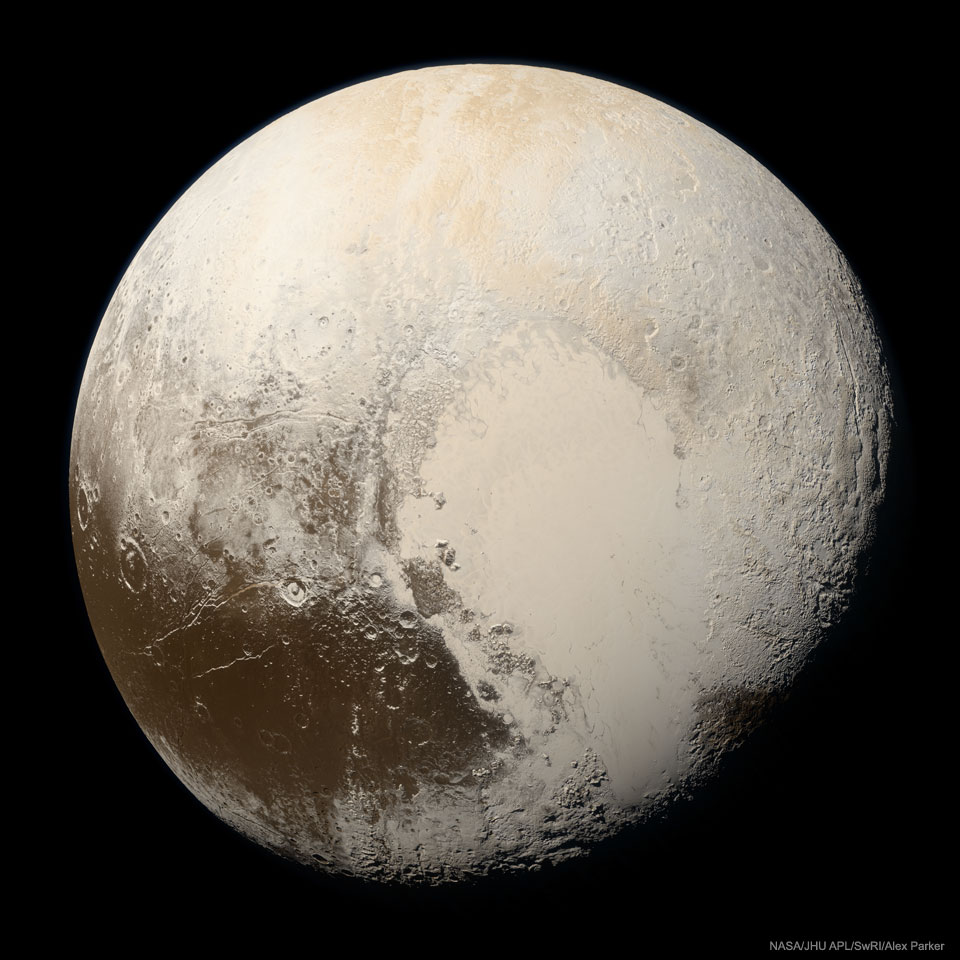
What color is Pluto, really? It took some effort to figure out. Even given all of the images sent back to Earth when the robotic New Horizons spacecraft sped past Pluto in 2015, processing these multi-spectral frames to approximate what the human eye would see was challenging. The result featured here, released three years after the raw data was acquired by New Horizons, is the highest resolution true color image of Pluto ever taken. Visible in the image is the light-colored, heart-shaped, Tombaugh Regio, with the unexpectedly smooth Sputnik Planitia, made of frozen nitrogen, filling its western lobe. New Horizons found the dwarf-planet to have a surprisingly complex surface composed of many regions having perceptibly different hues. In total, though, Pluto is mostly brown, with much of its muted color originating from small amounts of surface methane energized by ultraviolet light from the Sun.

from NASA https://ift.tt/2Aae3vf
via IFTTT
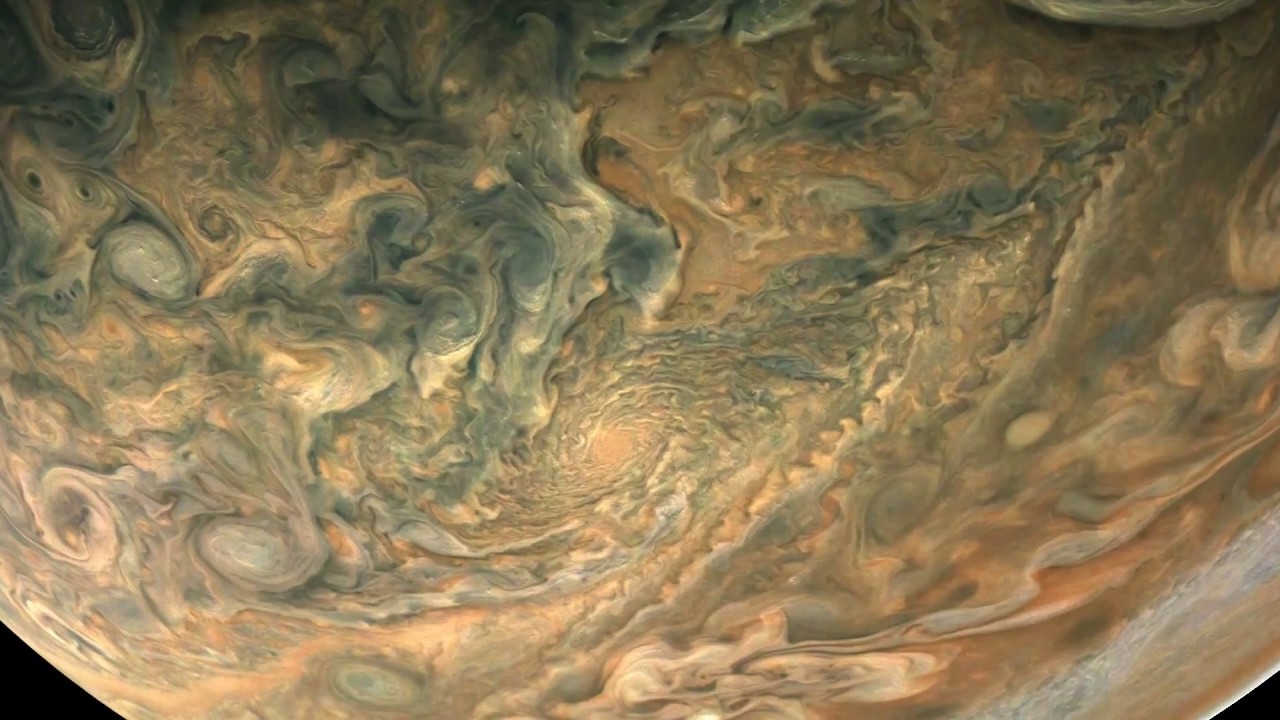
Perijove 11: Passing Jupiter


Here comes Jupiter! NASA‘s robotic spacecraft Juno is continuing on its 53-day, highly-elongated orbits around our Solar System’s largest planet. The featured video is from perijove 11 in early 2018, the eleventh time Juno has passed near Jupiter since it arrived in mid-2016. This time-lapse, color-enhanced movie covers about four hours and morphs between 36 JunoCam images. The video begins with Jupiter rising as Juno approaches from the north. As Juno reaches its closest view — from about 3,500 kilometers over Jupiter’s cloud tops — the spacecraft captures the great planet in tremendous detail. Juno passes light zones and dark belt of clouds that circle the planet, as well as numerous swirling circular storms, many of which are larger than hurricanes on Earth. After the perijove, Jupiter recedes into the distance, now displaying the unusual clouds that appear over Jupiter’s south. To get desired science data, Juno swoops so close to Jupiter that its instruments are exposed to very high levels of radiation.

from NASA https://ift.tt/2I8jgZh
via IFTTT

In Wolf s Cave


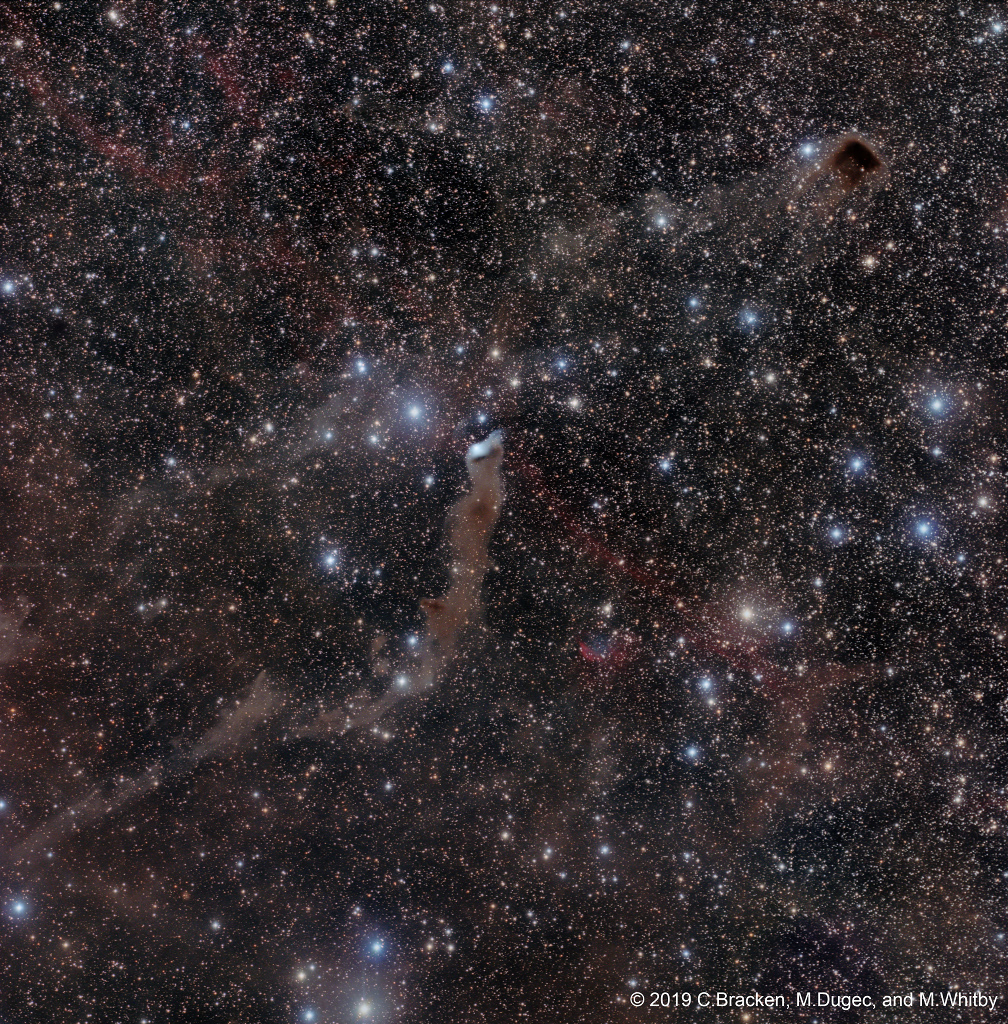
The mysterious blue reflection nebula found in catalogs as VdB 152 or Ced 201 really is very faint. It lies at the tip of the long dark nebula Barnard 175 in a dusty complex that has also been called Wolf’s Cave. At the center of this deep and widefield telescopic view, the cosmic apparitions are nearly 1,400 light-years away along the northern Milky Way in the royal constellation Cepheus. Near the edge of a large molecular cloud, pockets of interstellar dust in the region block light from background stars or scatter light from the embedded bright star giving the the nebula its characteristic blue color. Ultraviolet light from the star is also thought to cause a dim reddish luminescence in the nebular dust. Though stars do form in molecular clouds, this star seems to have only accidentally wandered into the area, as its measured velocity through space is very different from the cloud’s velocity. Another dense, obscuring dark nebula, LDN 1221, is easy to spot at the upper right in the frame, while the more colorful planetary nebula Dengel-Hartl 5 is just below center. Faint reddish emission from an ancient supernova remnant can also be traced (lower right to upper left) against the dust-rich complex in Cepheus.

from NASA https://ift.tt/313KwPR
via IFTTT

Recycling Cassiopeia A


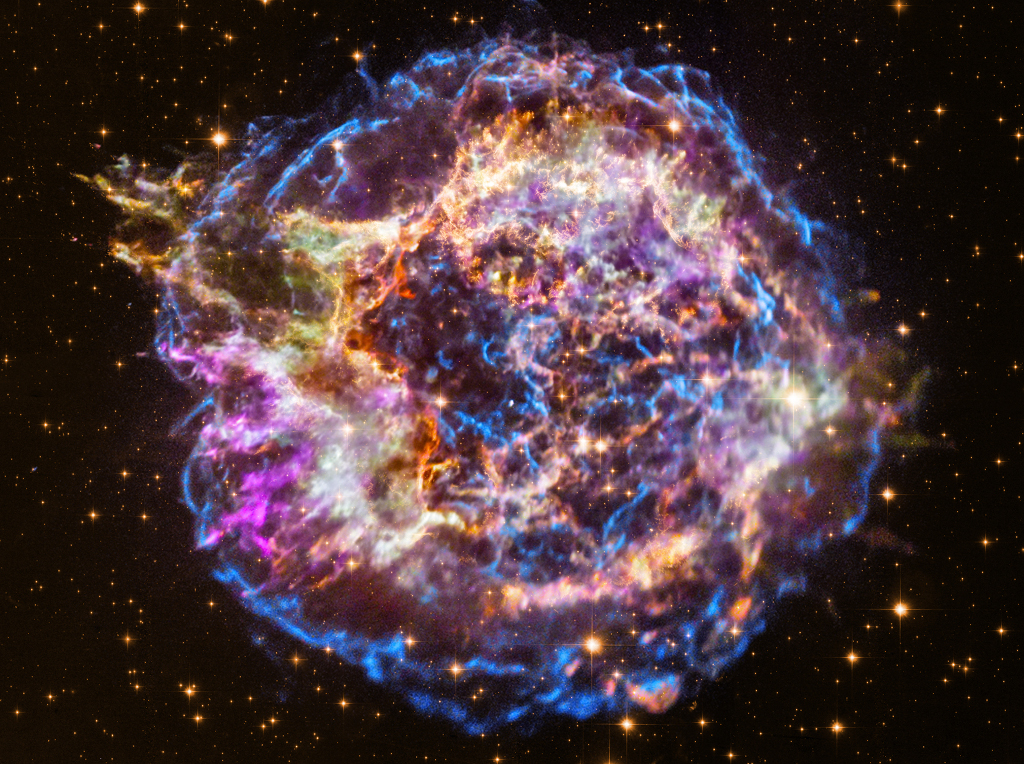
Massive stars in our Milky Way Galaxy live spectacular lives. Collapsing from vast cosmic clouds, their nuclear furnaces ignite and create heavy elements in their cores. After a few million years, the enriched material is blasted back into interstellar space where star formation can begin anew. The expanding debris cloud known as Cassiopeia A is an example of this final phase of the stellar life cycle. Light from the explosion which created this supernova remnant would have been first seen in planet Earth’s sky about 350 years ago, although it took that light about 11,000 years to reach us. This false-color image, composed of X-ray and optical image data from the Chandra X-ray Observatory and Hubble Space Telescope, shows the still hot filaments and knots in the remnant. It spans about 30 light-years at the estimated distance of Cassiopeia A. High-energy X-ray emission from specific elements has been color coded, silicon in red, sulfur in yellow, calcium in green and iron in purple, to help astronomers explore the recycling of our galaxy’s star stuff. Still expanding, the outer blast wave is seen in blue hues. The bright speck near the center is a neutron star, the incredibly dense, collapsed remains of the massive stellar core.

from NASA https://ift.tt/2UCmWav
via IFTTT

The Large Cloud of Magellan


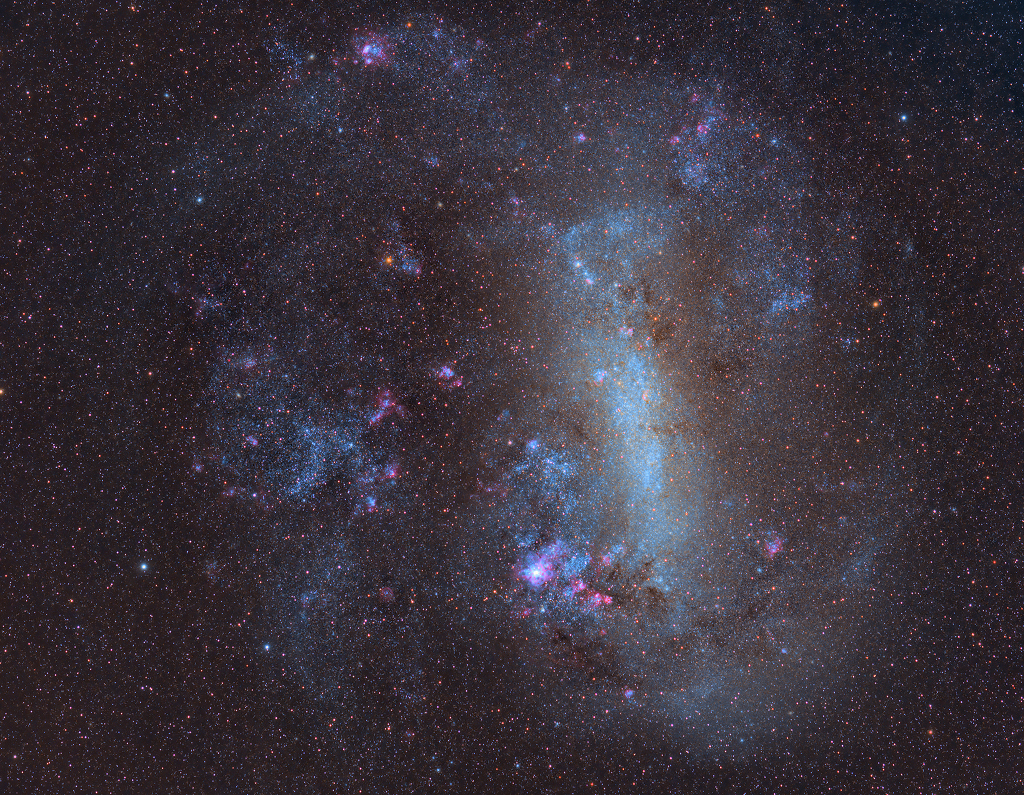
The 16th century Portuguese navigator Ferdinand Magellan and his crew had plenty of time to study the southern sky during the first circumnavigation of planet Earth. As a result, two fuzzy cloud-like objects easily visible to southern hemisphere skygazers are known as the Clouds of Magellan, now understood to be satellite galaxies of our much larger, spiral Milky Way galaxy. About 160,000 light-years distant in the constellation Dorado, the Large Magellanic Cloud (LMC) is seen here in a remarkably deep, colorful, image. Spanning about 15,000 light-years or so, it is the most massive of the Milky Way’s satellite galaxies and is the home of the closest supernova in modern times, SN 1987A. The prominent patch below center is 30 Doradus, also known as the magnificent Tarantula Nebula, a giant star-forming region about 1,000 light-years across.

from NASA https://ift.tt/2PKTBMt
via IFTTT

Unusual Signal Suggests Neutron Star Destroyed by Black Hole


What created this unusual explosion? Three weeks ago, gravitational wave detectors in the USA and Europe — the LIGO and Virgo detectors — detected a burst of gravitational radiation that had the oscillating pattern expected when a black hole destroys a neutron star. One object in event S190814sv was best fit with a mass greater than five times the mass of the Sun — making it a good candidate for a black hole, while the other object appeared to have a mass less than three times the mass of the Sun — making it a good candidate for a neutron star. No similar event had been detected with gravitational waves before. Unfortunately, no light was seen from this explosion, light that might have been triggered by the disrupting neutron star. It is theoretically possible that the lower mass object was also a black hole, even though no clear example of a black hole with such a low mass is known. The featured video was created to illustrate a previously suspected black hole – neutron star collision detected in light in 2005, specifically gamma-rays from the burst GRB 050724. The animated video starts with a foreground neutron star orbiting a black hole surrounded by an accretion disk. The black hole’s gravity then shreds the neutron star, creating a jet as debris falls into the black hole. S190814sv will continue to be researched, with clues about the nature of the objects involved possibly coming from future detections of similar systems.

from NASA https://ift.tt/2ZFu7DD
via IFTTT