Simulation: Two Black Holes Merge


Sit back and watch two black holes merge. Inspired by the first direct detection of gravitational waves in 2015, this simulation video plays in slow motion but would take about one third of a second if run in real time. Set on a cosmic stage the black holes are posed in front of stars, gas, and dust. Their extreme gravity lenses the light from behind them into Einstein rings as they spiral closer and finally merge into one. The otherwise invisible gravitational waves generated as the massive objects rapidly coalesce cause the visible image to ripple and slosh both inside and outside the Einstein rings even after the black holes have merged. Dubbed GW150914, the gravitational waves detected by LIGO are consistent with the merger of 36 and 31 solar mass black holes at a distance of 1.3 billion light-years. The final, single black hole has 63 times the mass of the Sun, with the remaining 3 solar masses converted into energy in gravitational waves. Since then the LIGO and VIRGO gravitational wave observatories have reported several more detections of merging massive systems, while last week the Event Horizon Telescope reported the first horizon-scale image of a black hole.

from NASA https://go.nasa.gov/2ZcnBkH
via IFTTT
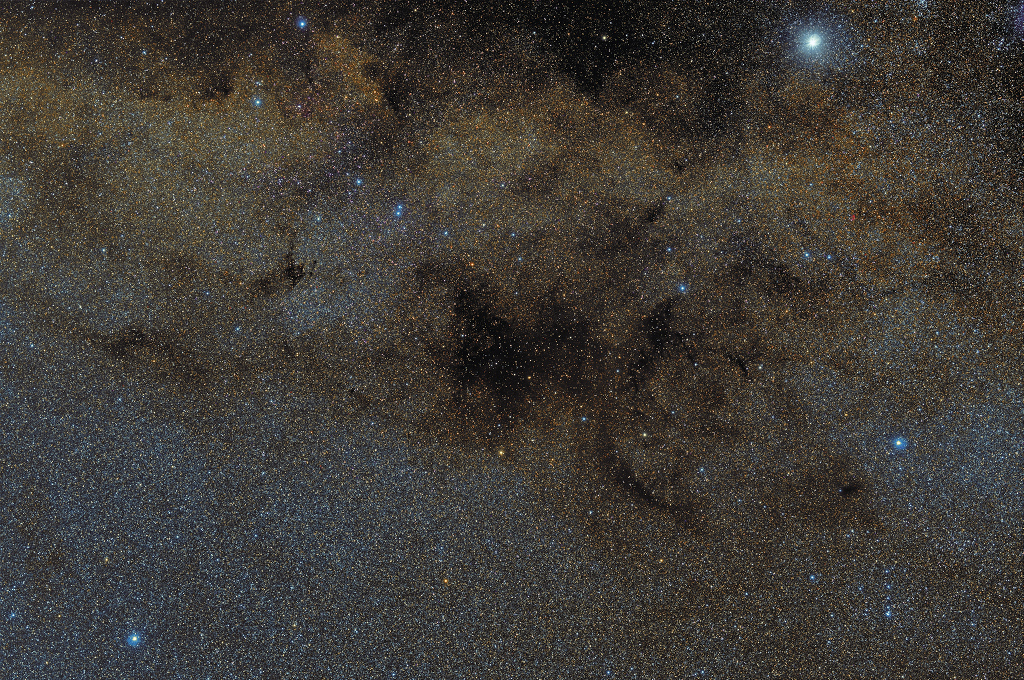
Rigil Kentaurus and Sandqvist 169


Rigil Kentaurus is the bright star near the top of this broad southern skyscape. Of course it’s probably better known as Alpha Centauri, nearest star system to the Sun. Below it sprawls a dark nebula complex. The obscuring interstellar dust clouds include Sandqvist catalog clouds 169 and 172 in silhouette against the rich starfields along the southern Milky Way. Rigil Kent is a mere 4.37 light-years away, but the dusty dark nebulae lie at the edge of the starforming Circinus-West molecular cloud about 2,500 light-years distant. The wide-field of view spans over 12 degrees (24 full moons) across southern skies.

from NASA https://go.nasa.gov/2DcAcei
via IFTTT

Martian Moon Phobos Crosses the Sun


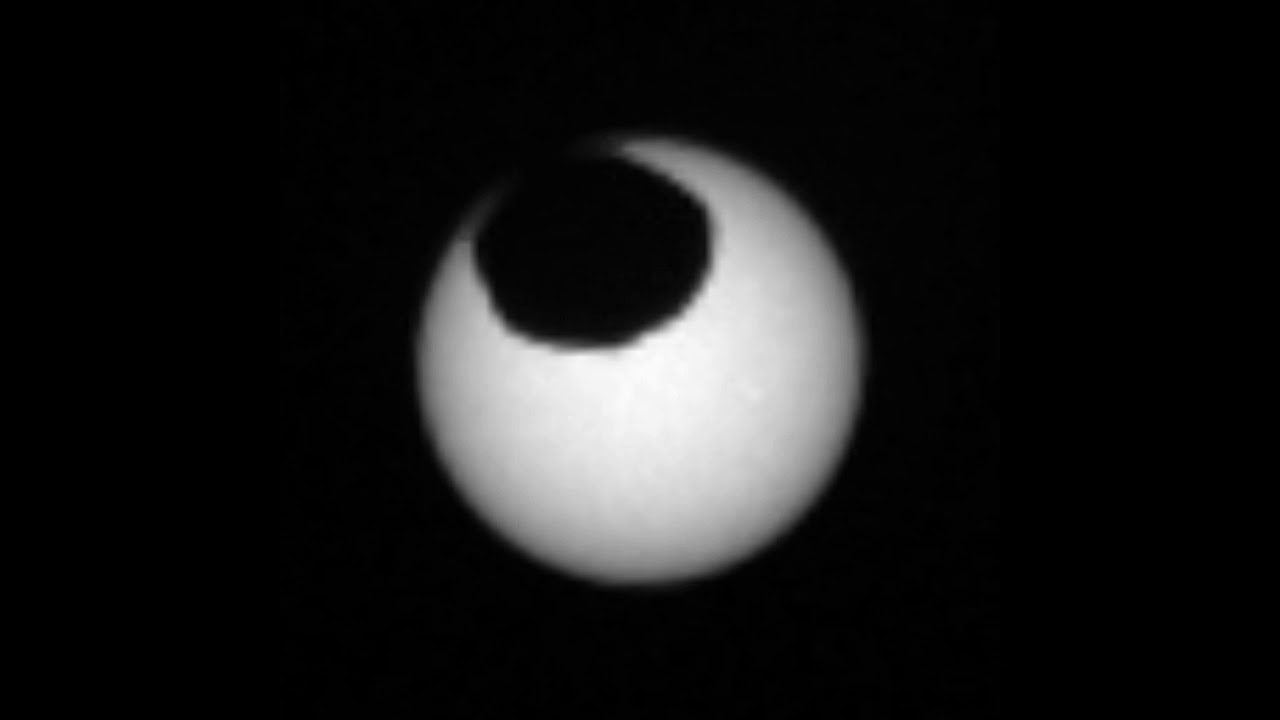
What’s that passing in front of the Sun? It looks like a moon, but it can’t be Earth’s Moon, because it isn’t round. It’s the Martian moon Phobos. The featured video was taken from the surface of Mars late last month by the Curiosity rover. Phobos, at 11.5 kilometers across, is 150 times smaller than Luna (our moon) in diameter, but also 50 times closer to its parent planet. In fact, Phobos is so close to Mars that it is expected to break up and crash into Mars within the next 50 million years. In the near term, the low orbit of Phobos results in more rapid solar eclipses than seen from Earth. The featured video has been sped up — the actual transit took about 35 seconds. A similar video was taken of Mars’ smaller and most distant moon Diemos transiting the Sun. The videographer — the robotic rover Curiosity — continues to explore Gale crater, most recently an area with stunning vistas and unusual rocks dubbed Glen Torridon.

from NASA https://go.nasa.gov/2UJ3Odj
via IFTTT

Moon Occults Saturn


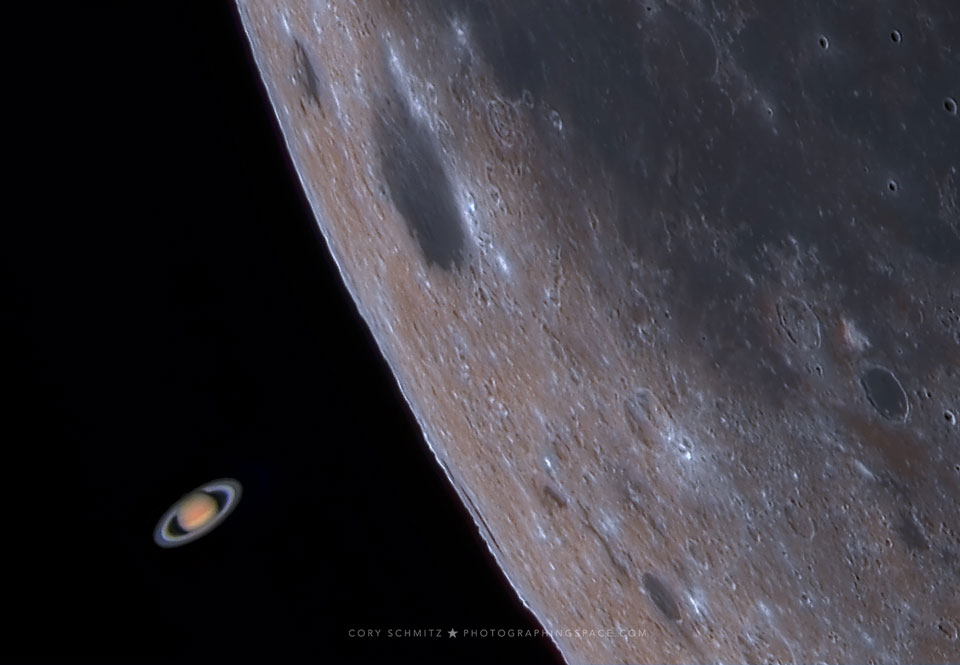
Sometimes Saturn disappears. It doesn’t really go away, though, it just disappears from view when our Moon moves in front. Such a Saturnian eclipse was visible along a small swath of Earth — from Brazil to Sri Lanka — near the end of last month. The featured color image is a digital fusion of the clearest images captured by successive videos of the event taken in red, green, and blue, and taken separately for Saturn and the comparative bright Moon. The exposures were taken from South Africa just before occultation — and also just before sunrise. When Saturn re-appeared on the other side of the Moon almost two hours later, the Sun had risen. This year, eclipses of Saturn by the Moon occur almost monthly, but, unfortunately, are visible only to those with the right location and with clear and dark skies.

from NASA https://go.nasa.gov/2KkdqaA
via IFTTT

AZURE Vapor Tracers over Norway


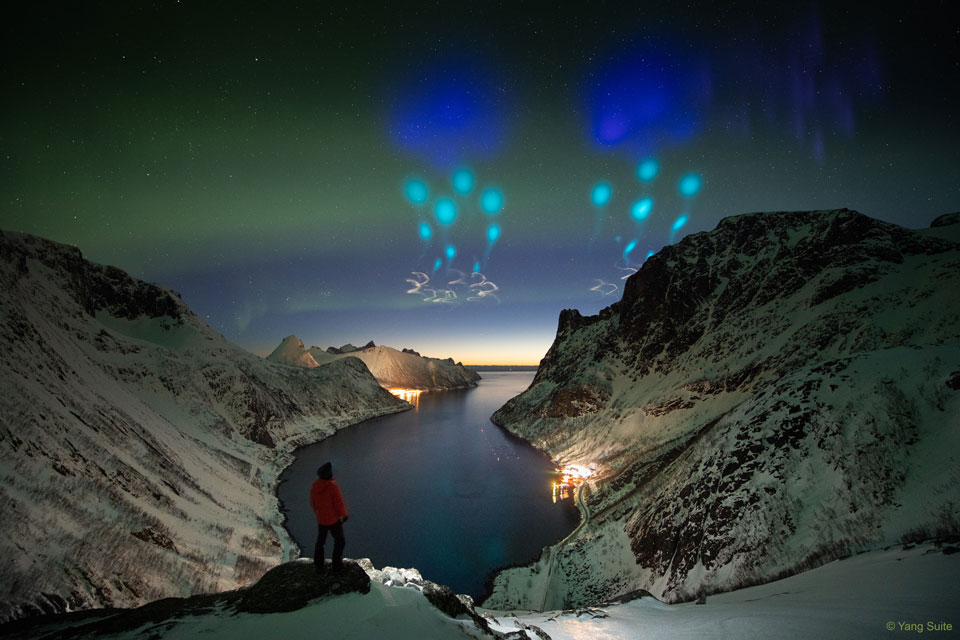
What’s happening in the sky? The atmosphere over northern Norway appeared quite strange for about 30 minutes last Friday when colorful clouds, dots, and plumes suddenly appeared. The colors were actually created by the NASA-funded Auroral Zone Upwelling Rocket Experiment (AZURE) which dispersed gas tracers to probe winds in Earth’s upper atmosphere. AZURE’s tracers originated from two short-lived sounding rockets launched from the Andøya Space Center in Norway. The harmless gases, trimethylaluminum and a barium/strontium mixture, were released into the ionosphere at altitudes of 115 and 250 km. The vapor trails were observed dispersing from several ground stations. Mapping how AZURE’s vapors dispersed should increase humanity’s understanding of how the solar wind transfers energy to the Earth and powers aurora.

from NASA https://go.nasa.gov/2IhWizG
via IFTTT

Wisps Surrounding the Horsehead Nebula


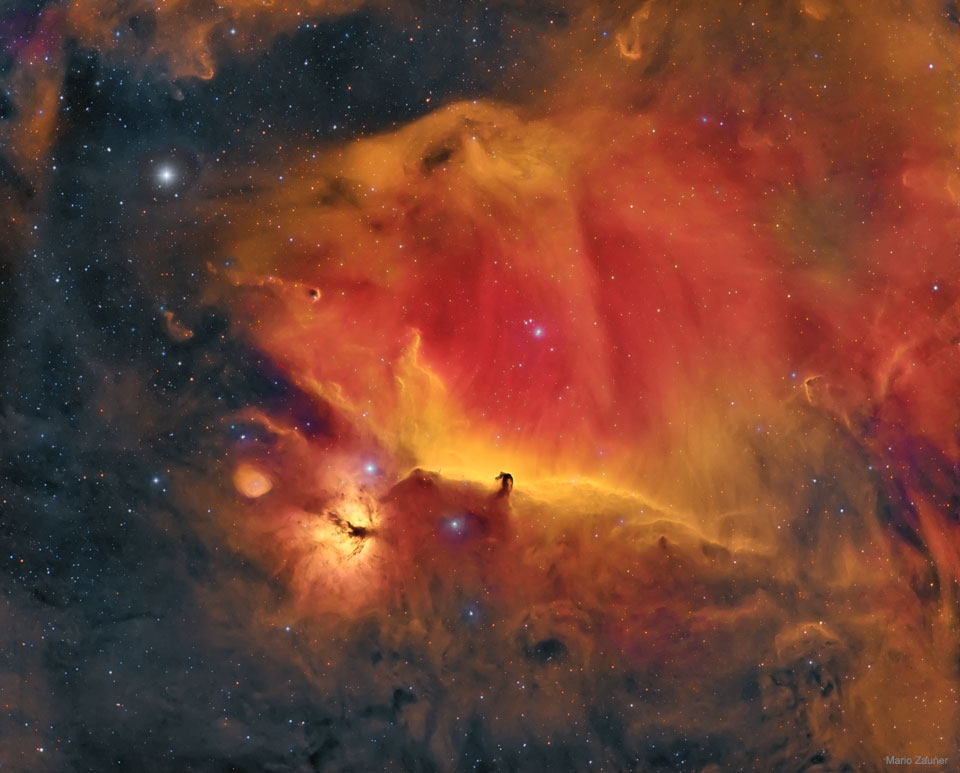
The famous Horsehead Nebula in Orion is not alone. A deep exposure shows that the dark familiar shaped indentation, visible just below center, is part of a vast complex of absorbing dust and glowing gas. To bring out details of the Horsehead’s pasture, an amateur astronomer used a backyard telescope in Austria to accumulate and artistically combine 7.5 hours of images in the light of Hydrogen (red), Oxygen (green), and Sulfur (blue). The resulting spectacular picture details an intricate tapestry of gaseous wisps and dust-laden filaments that were created and sculpted over eons by stellar winds and ancient supernovas. The Flame Nebula is visible just to the left of the Horsehead, while the bright star on the upper left is Alnilam, the central star in Orion’s Belt. The Horsehead Nebula lies 1,500 light years distant towards the constellation of Orion.

from NASA https://ift.tt/2FTCErX
via IFTTT