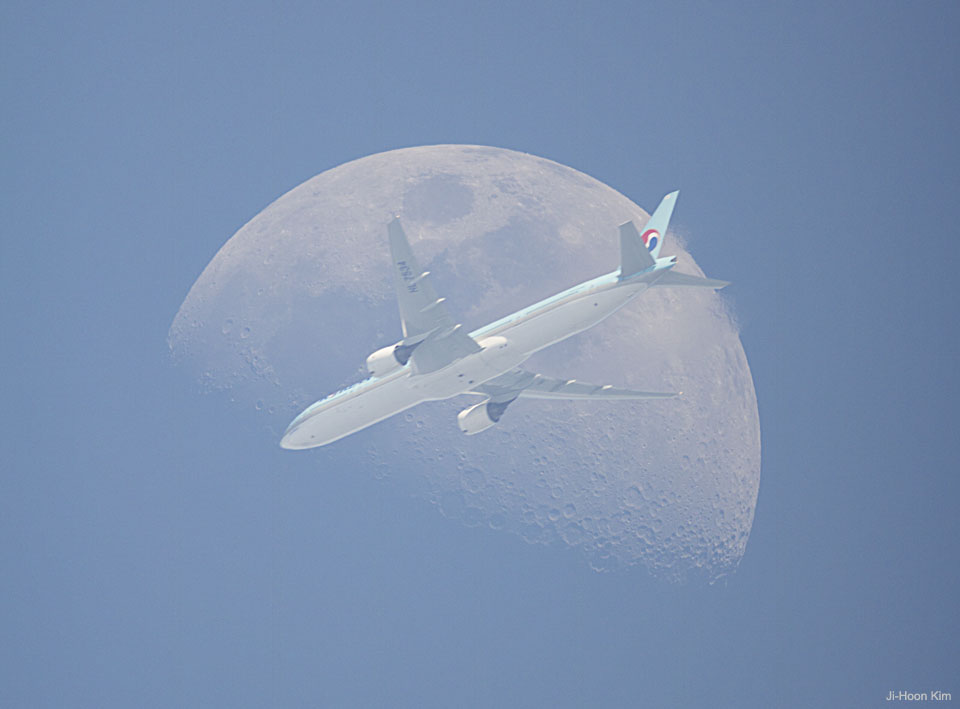
An Airplane in Front of the Moon


If you look closely at the Moon, you will see a large airplane in front of it. Well, not always. OK, hardly ever. Actually, to capture an image like this takes precise timing, an exposure fast enough to freeze the airplane and not overexpose the Moon — but slow enough to see both, a steady camera, and luck — because not every plane that approaches the Moon crosses in front. Helpful equipment includes a camera with fast continuous video mode and a mount that automatically tracks the Moon. The featured fleeting superposition was captured from Seoul, South Korea two weeks ago during a daytime waxing gibbous moonrise. Within 1/10th of a second, the airplane crossing was over.

from NASA https://ift.tt/2lQ8f3b
via IFTTT
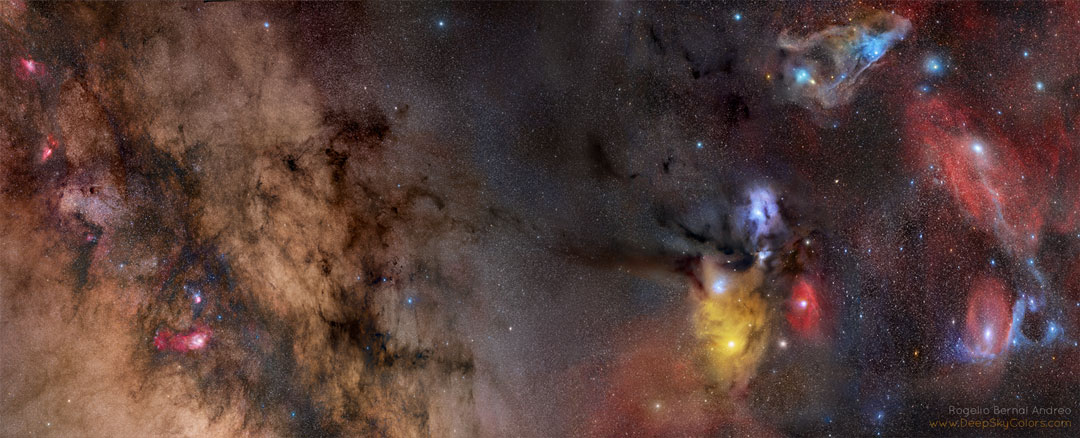
From the Galactic Plane through Antares


Behold one of the most photogenic regions of the night sky, captured impressively. Featured, the band of our Milky Way Galaxy runs diagonally along the far left, while the colorful Rho Ophiuchus region including the bright orange star Antares is visible just right of center, and the nebula Sharpless 1 (Sh2-1) appears on the far right. Visible in front of the Milk Way band are several famous nebulas including the Eagle Nebula (M16), the Trifid Nebula (M21), and the Lagoon Nebula (M8). Other notable nebulas include the Pipe and Blue Horsehead. In general, red emanates from nebulas glowing in the light of exited hydrogen gas, while blue marks interstellar dust preferentially reflecting the light of bright young stars. Thick dust appears otherwise dark brown. Large balls of stars visible include the globular clusters M4, M9, M19, M28, and M80, each marked on the annotated companion image. This extremely wide field — about 50 degrees across — spans the constellations of Sagittarius is on the lower left, Serpens on the upper left, Ophiuchus across the middle, and Scorpius on the right. It took over 100 hours of sky imaging, combined with meticulous planning and digital processing, to create this image.

from NASA https://ift.tt/2lOJXXf
via IFTTT

Fresh Tiger Stripes on Saturns Enceladus


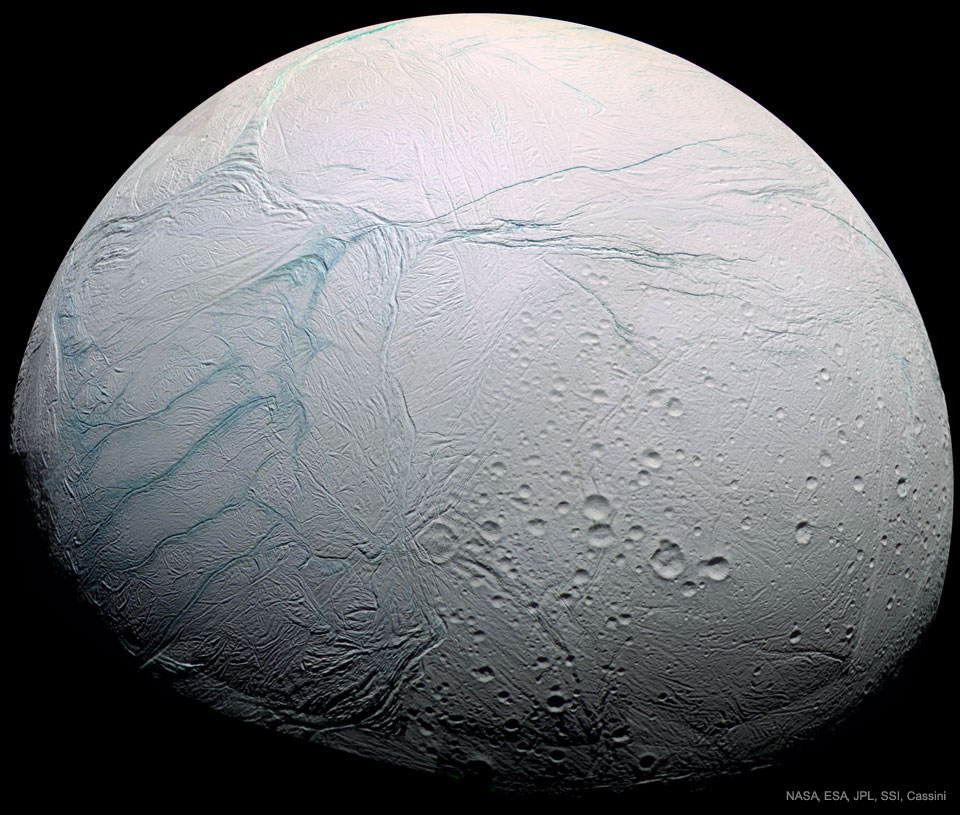
Do underground oceans vent through the tiger stripes on Saturn’s moon Enceladus? Long features dubbed tiger stripes are known to be spewing ice from the moon’s icy interior into space, creating a cloud of fine ice particles over the moon’s South Pole and creating Saturn‘s mysterious E-ring. Evidence for this has come from the robot Cassini spacecraft that orbited Saturn from 2004 to 2017. Pictured here, a high resolution image of Enceladus is shown from a close flyby. The unusual surface features dubbed tiger stripes are visible in false-color blue. Why Enceladus is active remains a mystery, as the neighboring moon Mimas,approximately the same size, appears quite dead. A recent analysis of ejected ice grains has yielded evidence that complex organic molecules exist inside Enceladus. These large carbon-rich molecules bolster — but do not prove — that oceans under Enceladus’ surface could contain life.

from NASA https://ift.tt/2tP4BuT
via IFTTT